
 E-Paper



Paris climate talks deadlocked, India is the key
India’s crucial role at the climate change talks in Paris has once again been underlined by a high-level outreach by the United States, including a call to Prime Minister Modi from President Barack Obama who hopes to cement his legacy with an ambitious global agreement on curbing global warming.


India’s crucial role at the climate change talks in Paris has once again been underlined by a high-level outreach by the United States, including a call to Prime Minister Modi from President Barack Obama who hopes to cement his legacy with an ambitious global agreement on curbing global warming.
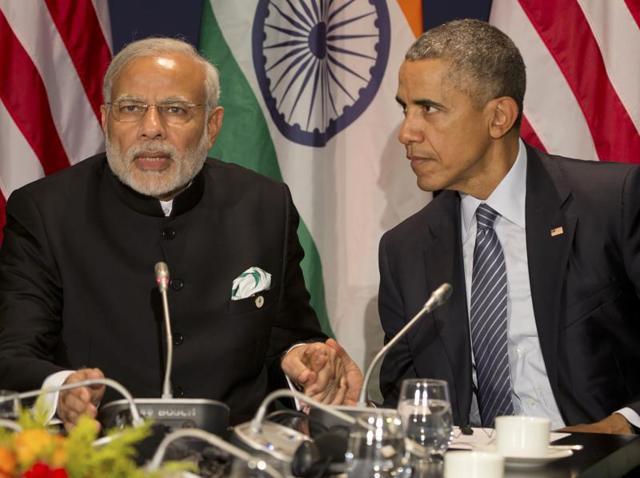
Obama reached out to Modi on Tuesday in an attempt to break the deadlock at the climate summit, where the responsibility of developing countries such as India in tackling rising global temperatures has been a sticking point.
He spoke to Modi hours before US Secretary for State John Kerry and environment minister Prakash Javadekar held a 45-minute meeting in Paris.
Sources said the meeting between Kerry and Javadekar failed to reach a compromise on a number of issues, including redefining the differentiation between the rich and the developing world in “changed circumstances” and a proposed review and verification of climate action plans.
Obama’s move was apparently aimed at breaking the ice and resolving contentious issues before the first draft of the ministerial consultations was released on Wednesday. Sources said an agreement in Paris will not be possible without India and the US converging on a range of issues.
A lot is at stake for both countries as the Paris climate agreement on limiting carbon emissions and financing cleaner energy will have a far reaching impact on their economies.
Obama, who faces opposition to his clean energy plan in the Republican-controlled US Congress – both chambers – and multiple states, wants to leave the White House next year with a “climate legacy” that protects American interests. This could mean India losing out on cheaper cleaner technologies, having to pay in future to the global climate fund and contending with an intrusive review mechanism for climate action plans.
“Both leaders underscored their strong commitment to address issues related to climate change being discussed in the Paris conference through constructive engagement, without impeding the progress of developing countries,” a statement from the Prime Minister’s Office said on the conversation between Modi and Obama.
The White House, in a statement, said both leaders emphasised their “personal commitment to secure a strong climate change agreement” and their interest in the two countries “working together to achieve a successful outcome”.
The conversations between India and the US are important for forging a deal in Paris that is acceptable to all while maintaining a balance between the interests of the two countries. India and the US have taken divergent stands on key issues.
“There was very little agreement on most issues,” a negotiator from a developing country said.
Among the sticky issues are embedding differentiation between the rich and developing countries in all elements of the Paris agreement, including mitigation, climate finance, review, adaptation and capacity building, the mechanism for reviewing and verifying each country’s climate action plans, the long-term temperature goal of 1.5 or 2 degrees by 2100 and compensation for damage because of disasters induced by climate change.
The fear is that the talks in Paris may be unable to deliver an ambitious agreement by Friday, the last day of the conference, and there could be a minimalistic agreement that may be described as a failure. The first draft released on Wednesday clearly showed the differences between the 196 nations participating in the conference were still huge.
The ministerial facilitators appointed by the conference president, French foreign minister Laurent Fabius, reported very little forward movement on climate finance, differentiation and the long-term goal of arresting temperature rise by the turn of the century.
Vivian Balakrishnan of Singapore told the conference on Tuesday that the countries are “yet to place their final positions” on differentiation, indicating the issue was the biggest sticking point of the talks.
India and its partners in BASIC (China, Brazil and South Africa) has clearly identified differentiation in all “elements to be the heart” of the Paris agreement.
“Bitter wind blowing and loss of trust between countries as ambition was missing from Paris agreement,” the WWF said in a statement.


