Engineers across half a dozen specialties are working overtime at Loughborough University in the UK on a prototype the size of a washing machine that "pressure-cooks" faecal sludge to turn it into green energy.
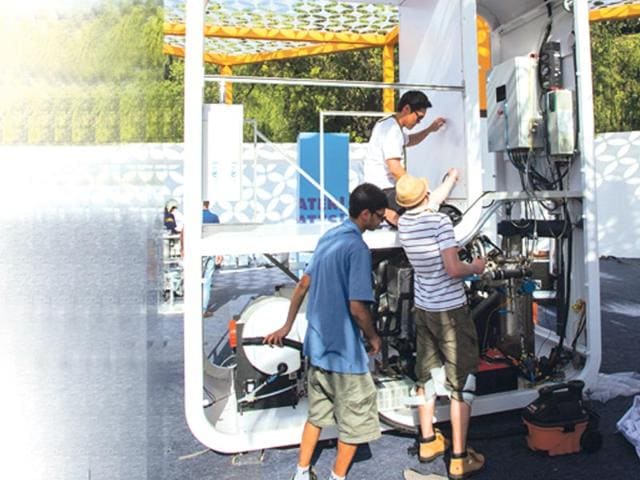
Their miracle machine converts human waste into carbonised material to provide heat, minerals for soil conditioning, and water for flushing and hand-washing.
"It's an off-grid solution that uses a process called continuous thermal hydrocarbonisation that kills all germs to create a safe material that looks like coffee without the smell," explains M Sohail (Khan), professor and head of sustainable infrastructure at the university. "The toilet is designed to work in both single-family and multi-user contexts, with daily running costs of just a few cents per person."Making a toilet that is clean, safe, durable and affordable without the need for connection to electricity or a sewerage system is not easy, but that's just what India needs to give momentum to its Swachh Bharat campaign.
Earlier this week, the urban development ministry signed MoUs with the Bill & Melinda Gates Foundation (BMGF) and USAID to strengthen sanitation in urban India. Apart from a financial commitment of $12 million over the next five years, the partnership will bring global best practices, innovation and technologies to India to help achieve national sanitation targets by October 2, 2019.
While BMGF has pledged $10 million over five years, USAID will contribute $2 million.
{{/usCountry}}While BMGF has pledged $10 million over five years, USAID will contribute $2 million.
{{/usCountry}}"India's Swachh Bharat campaign has become a jan andolan [people's movement] and we need smart waste management solutions to make it sustainable," says union urban development minister M Venkaiah Naidu.
Sanitation and solid waste-management are also critical to the success of the 100 smart cities initiative.
"It will take lakhs of crores of rupees to create smart cities and the government cannot make the investment alone. We need collaborations to build a clean and disease-free India," says Naidu.
"Toilets [catchment] is just the first step; we need to look at containment, treatment and disposal of waste. Since building a sewerage [system] is expensive and not always possible, the focus is on non-networked solutions and septic tanks," says Girindre Beehary, country director for BMGF.
Naidu's ministry is working on an action plan to release funds to states for sanitation and solid waste management, among others, which will be ready in two to three weeks.
Clean drinking water and improved sanitation prevent death and disease by lowering infection rates (see box) and malnutrition, which lowers immunity and causes physical and mental stunting. The partnership will boost program management, technical assistance and capacity building in five states - Uttar Pradesh, Bihar, West Bengal, Jharkhand and Uttarakhand. It will also focus on education campaigns.
"You can't solve the sanitation problem by just building toilets," says Beehary. "We need the mindset and behaviour change to create demand."
A biogas plant at Shirdi in Maharashtra (Above)