
 E-Paper



A thing of beauty: Rudraneil Sengupta on Shubman Gill at Edgbaston

 Prefer HTon Google


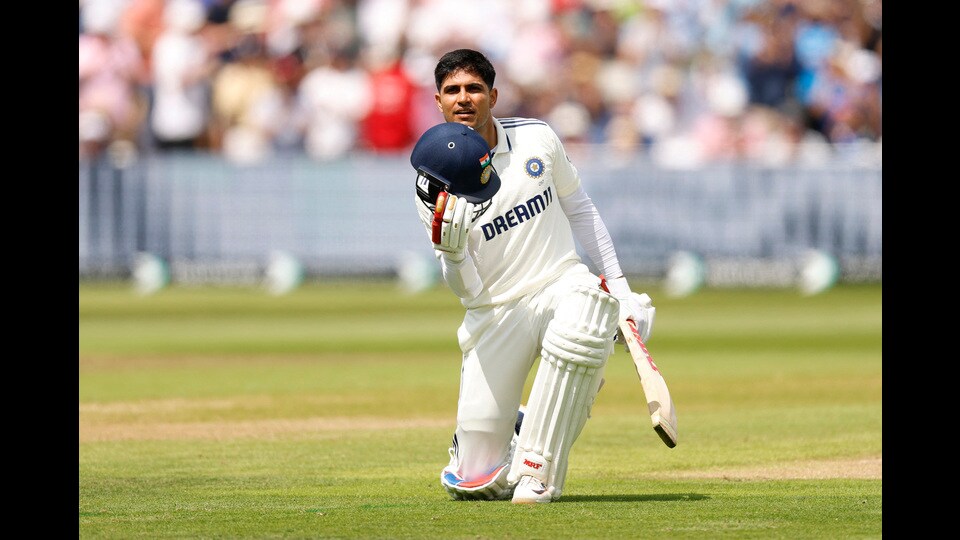
Watching Gill amass his mountain of runs in England, wearing whites, repeatedly scoring off that most sinuous of all shots, the cover drive... what a treat.
In his first few weeks as India’s Test captain, Shubman Gill has wrought wonders.
Leading India to a win at Edgbaston for the first time since 1967? Done.
Scoring a century on his debut as captain? Done.
Scoring a double century in one innings and a century in the next, in the same match? Done.
With 430 runs in a single match, Gill is now second only to England’s Graham Gooch (456) on the list of batters with most runs in a single match. He is also one of only five players to have scored 400 or more in a single match. (The others are Australia’s Mark Taylor, with 426; Sri Lanka’s Kumar Sangakkara with 424; and the West Indies’ Brian Lara with 400.)
Yet this column is not about the objective brilliance painted by the numbers. It is about something quite its opposite: a slippery, elusive, perilous, highly-subjective-but-often-universal concept — beauty.
Even the most statistical, analytical minded or result-oriented sports lover feels the effect of something “beautiful” when it unfolds on the field.
Think of Roger Federer’s one-handed backhand, Zinedine Zidane turning a full 360 degrees with the ball, Rebecca Andrade doing a tumbling pass across the gymnastics floor, or a reverse-swinging yorker uprooting the stumps. They’re all things to make the heart skip a beat.
Beauty has been a particular obsession in cricket, a game mythologised with tales of origins in the rolling green-and-gold fields of England, of “gentlemen” in whites under cotton-candy clouds, and pitches in the evening gloam, against groves of oak and elm.
Some of those ideas have faded, particularly amid the T20 format’s onslaught of helter-skelter hitting and garish, sponsorship-driven patchwork jerseys.
Which is why, watching Gill amass his mountain of runs in England, wearing whites, repeatedly scoring off that most sinuous of all shots, the cover drive, “beauty” comes to mind.
“The cover drive is not like other shots,” the English author Jon Hotten wrote recently, in an article in Wisden. “It is dangerous and beautiful. It is decadent and depraved. It is the purest expression of mastery in batsmanship and it is a destroyer of innings, of matches, of careers.”
In sport, beauty often lies in the difficulty of a skill, and the cover drive is certainly a skill reserved for the consummate. To be sure, almost anyone with some basic training can execute it, but to do it at the highest level, against great bowling, is what elevates it to “beauty”.
Because the cover drive is played against the ball that’s meant to lure the batter into giving away his wicket; the ball that’s placed in the “channel”, the area of the pitch where the batter is most likely to swing and miss, or swing and mistime to offer a catch.
To execute it safely calls for perfect placement of the head, arms, feet and bat; and it calls for perfect timing, so that the onrushing ball rockets off the bat with a sound like the crack of a whip.
In this frisson of risk and reward lies some of its beauty, and one of the great stories in cricket around the shot: Of Sachin Tendulkar denying himself the pleasure of the cover drive in a Test match in Sydney in order to preserve his wicket. He had gone through a string of low scores on India’s tour of Australia in 2004, often dismissed while trying to drive balls in the “channel”. In the Sydney Test, he made 241 not out, playing 436 balls, without once driving through the off.
“I decided not to play the cover drive,” he later said. “They were bowling consistently outside the off stump and I decided to leave all those balls. Then they had to bowl at me and I used the pace of the ball.”
Aesthetics drip from the very form of the cover drive, in that bent-knee symmetry, where so many right angles are made between the two legs and the torso resting straight from tailbone to head, in the eyes laser-focused on the direction of the ball, and in the bat tracing an artistic arc through the air…
There are two ways it can go after this. Some abruptly halt the bat’s follow-through, to yield a different kind of beauty: that of economy of movement. Some allow their bats to swing all the way through, in a feast of extravagance and supple wrists.
Every cricket-lover has their favourite cover drivers. There was geometric Rahul Dravid, muscular Tendulkar, slashing Virat Kohli, flamboyant Brian Lara, languid Aravinda de Silva, effortless Kumara Sangakkara.
There are fans who, inexplicably, insist no right-handed batter could play the cover drive as beautifully as a left-handed batter. England’s left-handed legend David Gower, whose cover drive remains a much-fetishised thing, dismissed this idea with a “pfft”.
“It’s just eyes playing tricks,” he told me in 2019, when I asked why left-handed drives are considered aesthetically superior. “If I play the shot in front of a mirror and you look at the mirror, you will see a right-handed cover drive no different from any other.”
In other words, you may see Shubman Gill.
(To reach Rudraneil Sengupta with feedback, email rudraneil@gmail.com)


