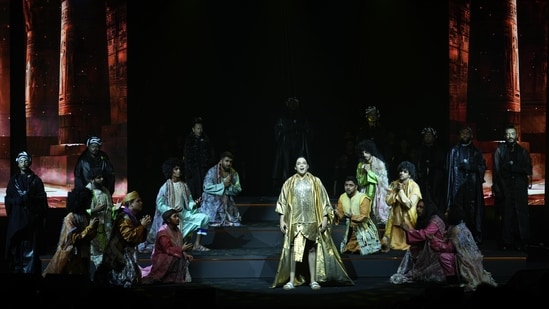
Joseph and the Amazing Technicolour Dreamcoat, 'India’s first all-male musical', has been making waves in Bengaluru's musical theatre scene with its recent production featuring over 100 boys and men from the city's schools, churches, and communities. It is directed and choreographed by Kevin Oliver and produced by Phase 1 World with music by Andrew Lloyd Webber and lyrics by Tim Rice. Also read | Lights, Camera, Broadway: Hollywood hits hit Broadway as musicals
The musical not only brings a fresh perspective to the classic story, but also puts Bengaluru in the spotlight, showcasing the city's thriving creative scene and talent pool. Highlights included a shimmering creation – a 21-kg technicolour coat crafted using over 30 fabrics – by Dubai-based fashion designer Michael Cinco, who has dressed several Indian celebrities in his exquisite designs, including Aishwarya Rai.
In an interview with HT Lifestyle, Kevin as well as Oum Pradutt, founder and managing director of Phase 1 World, spoke about how a live nine-part narrator format, and a choir-style score with fresh arrangements gave the production emotional depth and global flair.
Here are the excerpts.
What inspired you to stage this particular production, and how did you approach bringing the story to life?
Kevin Oliver: I had first directed Joseph in a school musical at Frank Anthony Public School early in my career. It has always been a show with a strong emotional pull, and the themes of family, resilience, and reconciliation still resonate. When Oum reached out about Phase 1 turning 30, it felt like the right time to return to this story, but with a professional lens. Our approach was to treat it as a full-fledged musical production while retaining the soul and heart of its message.
{{/usCountry}}Kevin Oliver: I had first directed Joseph in a school musical at Frank Anthony Public School early in my career. It has always been a show with a strong emotional pull, and the themes of family, resilience, and reconciliation still resonate. When Oum reached out about Phase 1 turning 30, it felt like the right time to return to this story, but with a professional lens. Our approach was to treat it as a full-fledged musical production while retaining the soul and heart of its message.
{{/usCountry}}Oum Pradutt: This was a very personal project for me. I grew up watching Kevin’s musicals, and some of my earliest experiences on stage were under his direction. For our 30-year milestone at Phase 1, we didn’t want a large-scale event just for the sake of scale. We wanted something meaningful. Joseph allowed us to bring together storytelling, music, community, and talent from across Bengaluru in a way that felt both celebratory and grounded.
Can you describe your creative process when working with actors, designers, and other crew members?
Kevin Oliver: We began by assembling the cast through a mix of school networks, church choirs, and community music circles. The casting was intentional — we wanted range in voice, age, and stage experience. Once the cast was locked in, we workshopped the material extensively. We built vocal harmony first, then layered movement and stagecraft. Design conversations were always integrated. I believe a show works best when the designers and the cast are growing the world together. Everyone on the floor was briefed on the emotional tone and musical rhythm of each scene before technical execution began.
Oum Pradutt: We ran this like a professional production while still building in flexibility for younger performers. On the production side, timelines were mapped across departments from the beginning. Whether it was fittings with the designers or stage layout conversations, we structured everything for collaboration. Kevin and I were in constant dialogue with the costume and lighting teams to ensure every element served the story.
How do you balance your vision for the show with the input and ideas of your collaborators? How do you work with actors to develop their characters and bring depth to their performances?
Kevin Oliver: My role is to give structure, not to impose. With young performers, especially, it’s important to create space where they can bring something of themselves to the role. I provide musical and emotional context, guide pacing, and anchor transitions. But I also ask them to think about the character’s motivations and relationships. Over time, you see them stop acting and start reacting. That’s when the performance starts to feel lived-in.
Oum Pradutt: It was important to trust the team. We had senior professionals designing costumes and lighting, alongside a young and enthusiastic cast. Kevin kept the emotional map of the show consistent while giving space for design inputs and character suggestions to come through organically.
What was your vision for the set and lighting design, and how did you work with your designers to achieve it?
Oum Pradutt: We wanted the stage to feel immersive without being overbuilt. The lighting had to serve the music and transitions without overwhelming them. The challenge was to balance scale with mobility, as we were working within the constraints of an existing auditorium.
Kevin Oliver: We worked with our lighting designer to use tone shifts to reflect Joseph’s journey, cool tones during moments of exile, warm builds for emotional resolution. The set was designed to be flexible, allowing fluid movement of the cast. It wasn’t elaborate by Broadway standards, but it worked in tandem with our choreography and vocals to tell the story.
How do you use blocking and movement to enhance the storytelling and emotional impact of the show?
Kevin Oliver: This musical is sung-through, so there’s a constant rhythm. Movement can’t be decorative — it has to serve the story. We mapped character relationships with their movement arcs. Joseph’s physical distance from his brothers early in the show narrows as the story progresses. In ensemble scenes, we created symmetry and imbalance deliberately. I worked closely with the narrators to ensure their movement mirrored the tonal shifts in each number.
Can you talk about any specific challenges you faced in staging certain scenes or sequences?
Kevin Oliver: Potiphar’s scene was tricky. It had to be menacing, theatrical, but still appropriate for a family audience. We used costume design, especially Potiphar’s wife’s gown, to bring in drama without being over the top. Another challenge was Pharaoh’s number — it’s a rock-and-roll sequence, but we didn’t want it to feel like a caricature. We sculpted his look to feel like pop royalty and kept the choreography tight and punchy.
What themes or messages do you hope audiences take away from the show, and how did you incorporate those into the production?
Oum Pradutt: The idea of redemption is at the core of Joseph. That someone who’s betrayed and left behind can still rise and forgive. It’s also a story about dreams and resilience. We made sure the emotional beats in the musical were clear and well-placed, so the audience could experience the arc of hope without needing to be told what to feel.
Kevin Oliver: We also wanted to showcase what young performers are capable of when given the right platform. Many in our cast had never performed at this level. Yet they owned that stage. The audience doesn’t just see a story—they witness growth.
How do you think the show's themes and messages resonate with contemporary audiences? What do you hope audiences will take away from the show emotionally or intellectually?
Kevin Oliver: The story may be old, but the themes are timeless. We live in a time where family structures, identity, and purpose are constantly evolving. Joseph’s journey speaks to anyone trying to find meaning through chaos. Musically, we stayed true to the original composition but let the local voices guide how it landed emotionally.
Oum Pradutt: People walked out of the show saying they saw themselves on stage. That was the goal. It wasn’t about spectacle. It was about finding emotional clarity in a story that has lasted for generations.
Are there any specific social or cultural issues that you aimed to address through the production?
Oum Pradutt: Not directly. But by design, this show became a platform for celebrating male vocalists and school-level performers in a city that rarely gives them centre stage in theatre. We had boys from six schools and the Bangalore Men’s Choir, all performing live. That sends a strong message — that musical theatre is for everyone and that local talent deserves national attention.
What was the most challenging aspect of bringing this production to life, and how did you overcome those challenges?
Oum Pradutt: Logistics were a challenge. Balancing rehearsals across school schedules, coordinating fittings with designers like Michael Cinco and Furne One Amato, managing stage tech—it needed tight planning. We treated it like any large-scale experiential event we’ve produced at Phase 1, with calendars, fixed milestones, and buffer windows built in.
Kevin Oliver: The emotional stamina needed from the boys was significant. We were asking 13 to 18-year-olds to perform live across 16 songs, hold character, and deliver in front of 700 people. It took a lot of encouragement and hands-on mentoring to build that consistency.
Can you describe a particularly memorable or pivotal moment during rehearsals or performances?
Kevin Oliver: One evening during tech rehearsals, the boys were exhausted. But when we ran Any Dream Will Do, something shifted. Their voices blended in a way that hadn’t happened before. No one spoke after the last note. That was the moment I knew the show had found its centre.
Oum Pradutt: There’s a point in the show where Joseph is reunited with his family. Watching the cast perform it, you could feel the room soften. Teachers and parents in the audience were moved to tears. That emotional connection—that’s what theatre is about.
How do you manage the logistics of a large-scale production, including scheduling, budgeting, and communication?
Oum Pradutt: We run this just like we would any high-stakes corporate campaign. There’s a master production calendar, weekly check-ins, and dedicated leads for every department. Budgeting included line items for costume production, venue rentals, technical setup, and hospitality. We also had an extended team handling content, PR, and audience experience. Everyone knew what they were responsible for, and we had a daily wrap to track progress in the final two weeks.