
 E-Paper



Errors in mapping: Deepanjana Pal writes on The Odyssey

 Prefer HTon Google


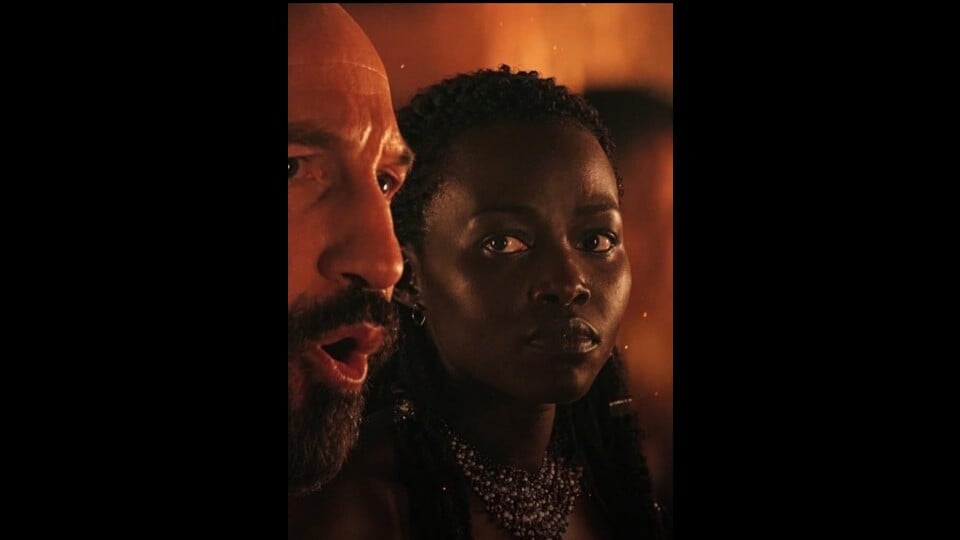
Isn’t it odd that the original epic, written about 3,000 years ago, should have stronger, more easily forgiven women than a modern retelling?
Christopher Nolan’s The Odyssey begins in a great hall, with a bard (Travis Scott).
Drawing an elegant line between ancient epic storytelling and modern-day rap, Scott begins the bard’s performance with a neat summary of the Iliad: “A face, a fleet, a war, a man, a thought, a trick.” Armed with that context, we enter its sequel, the Odyssey.
The face he’s referring to is that of Helen of Troy, played by Lupita Nyong’o. The decision to cast her led to outrage from conservative corners of the internet, populated by trolls whose tiny brains exploded at the idea of a Black woman playing the legendary beauty.
Nyong’o is an inspired choice and does justice to the roles Nolan wrote for her (she plays Helen and her sister Clytemnestra). However, as wonderful as Nyong’o is, she and her character are failed by Nolan.
In Homer’s 8th-century-BCE epic, Helen is a commanding presence as the queen of Sparta. She is powerful not only because her husband Menelaus is on the throne, but also by virtue of her “potion”, which comforts the drinker by taking away their pain and grief. Nolan strips her of her powers, in his retelling, turning her instead into a battered wife.
We meet Helen when Telemachus (Tom Holland), son of Odysseus, the absent king of Ithaca, travels to Sparta. Menelaus (Jon Bernthal) introduces the young man to Helen, taking vicious pleasure in turning his wife’s face so that he can see that the other side of her immaculate profile is disfigured by terrible scars.
Nolan’s Helen is a fear-struck woman who has been subdued into an apologetic alter-ego of the Homeric version. It’s ironic that one of the oldest surviving works of literature is able to imagine a woman commanding her husband’s respect and in a happy marriage even after having an affair, but the 21st-century retelling chooses to punishes her.
Another character reduced in the film to a fraction of her original stature is Athena, goddess of wisdom and protector of Odysseus. Towards the end, we are shown a flashback of the sacking of Troy. It includes a brief moment when Odysseus sees a priestess, weeping and begging for mercy, beheaded. The great reveal is that hers is the face that morphs into Athena’s and haunts him on his journey.
Homer’s Athena radiates power, and plays an enormous role in how the tale progresses. By contrast, the film version of the goddess, played by Zendaya, is a hallucination, entirely irrelevant to the action.
Nolan was arguably the perfect person to remake the Odyssey as a film. He has explored many of its themes with awe-inspiring elegance in the past (think of 2014’s Interstellar or even 2023’s Oppenheimer), and while The Odyssey is flawed, it is still a filmmaking feat. There are many flashes of brilliance from him as well as from collaborators such as cinematographer Hoyte van Hoytema and composer Ludwig Goransson.
The only aspect of Homer’s epic that sits uncomfortably with Nolan’s filmography is the ancient bard’s ability to make space for complex women within a rigidly patriarchal tradition. That says quite a lot about us in the present.
(Write to Deepanjana Pal @dpanjana on Instagram. The views expressed are personal)


