
 E-Paper



Eye for an I: Existential riddles with author Meghan O’Gieblyn

 Prefer HTon Google


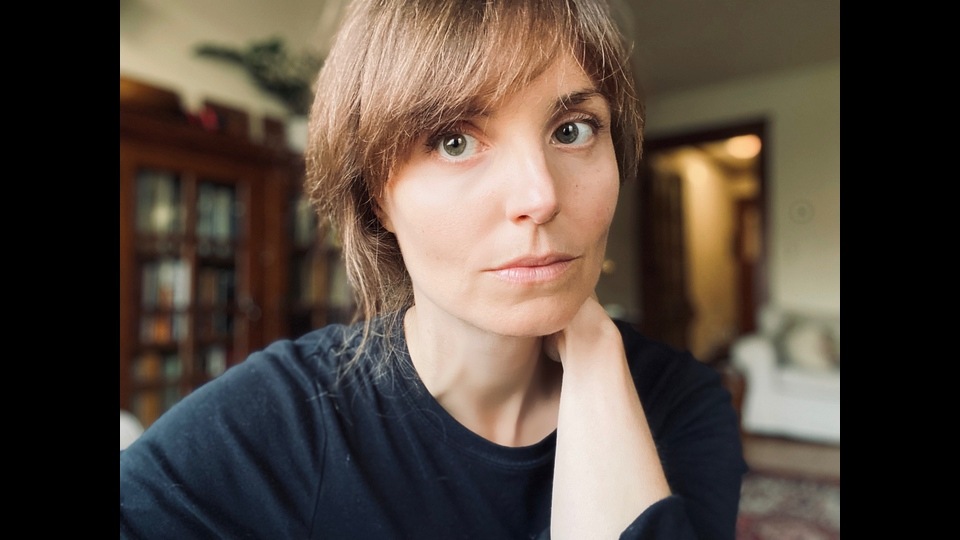
What does it mean to be an “I” in a time of intelligent traffic signals? To what extent are we being mirrored and altered by the newest machines of our making? Excerpts from an interview with Meghan O’Gieblyn, essayist and author of God, Human, Animal, Machine.
Meghan O’Gieblyn, 39, author of God, Human, Animal, Machine (Penguin Random House; 2021), tackles questions of the self in her writing. The essayist and author (her last book was Interior States [Penguin Random House; 2018]) draws on and contrasts points of view from her conservative Christian childhood, her search for answers in science, and her study of technology and its impact on individuals and societies.
What does free will mean, for instance, if superstore chains have made an exact science of predicting how much they will lose to theft and kidnapping? What does it say about the future of our race if chatbots can be programmed for friendship, and artificial intelligence programs are inheriting gender, race and other biases?
One thing her research has taught her, O’Gieblyn says, is the necessity of living with question marks. Finishing her second book amid a global pandemic and a climate crisis, she was confronted with new questions surrounding the idea of what it means to be an “I”. Where does the self begin? Is it possible to have a sense of self in isolation? Excerpts from an interview:
* Given that we’re having this conversation in a time quite unlike any other for our species ( the pandemic, climate change, political and economic upheaval): How do you think the sense of an I is altered in times of distress like the present?
In some ways, I think the central questions about subjectivity, or what it means to be an “I” become more acute during moments of social disruption, particularly when those disruptions are happening on a global scale. I was in the process of wrapping up this book at the very beginning of the pandemic, and many of the ideas I’d been writing about felt newly urgent: where does the self begin and end? Is it possible to have a sense of self in isolation?
* How has your research altered how you see yourself? How you see other people?
One thing it’s taught me is the necessity of living with doubt. This book was really the end point of a decade-long search, in the wake of my loss of faith, for some alternate source of certainty. I left my religious background in part because there were too many holes in the doctrine, too many unanswered questions, and I had this very naïve idea that science would fill in those holes and explain everything. But it turns out there are holes in the scientific worldview too—not just incidental ones, but big gaps: what is consciousness? What is matter? I’ve realised that the entire picture is never going to be complete.
* If there was one question you could retire from our reality entirely, what would it be (’Are we a simulation?’ ‘Are there parallel realities extending across a multiverse?’)?
When I set out to write the book, I was really tired of the question: Is the brain a computer? The computational metaphor has become so integral to cognitive science and artificial intelligence. And as many people have pointed out in recent years, it’s a limited and imperfect analogy. But I don’t know that we should retire it from reality entirely. One thing I realized while writing the book is that the computer analogy is just one of many metaphors we’ve used over the centuries to try to describe how the mind works (previous thinkers argued that the brain was a telephone exchange, or a chariot, or a loom), and metaphors are crucial to thought and discourse, even when they are imperfect. The harm comes when we forget that the metaphor is a figure of speech and take it to be a literal description of reality.
* What is the one idea you set out with at the start of this journey, that has changed the most dramatically for you?
I became more of a humanist over the course of writing the book. I think there’s a tendency these days, at least in academic circles, to see humans as the scourge of the earth, given that we’re responsible for vast environmental destruction and climate change. And this sentiment has coincided with a lot of research about how the qualities we once believed were uniquely ours—like intelligence, awareness, planning—are present not only in animals but in plants, and in ecological systems, like forests, at least if you define those qualities broadly. The delineations between humans and other organisms are breaking down. When I first started writing the book, I thought this was mostly a good thing—getting knocked off our pedestal—though it gradually became clear that machines are developing a lot of those capacities as well, and these broader definitions of intelligence are often used to justify granting personhood to AI, or integrating these systems into public institutions. So that question about whether humans are unique, or special, becomes more thorny. I don’t know if my opinion on this question changed, per se, but it has definitely became more complicated.
* What in your opinion does differentiate us from the most advanced humanoids we can currently imagine?
I suppose the simplest way to explain the difference between us and some future, superintelligent humanoids—the kind the transhumanists imagine, for example—is that we’re limited by our biology. Our brains can only hold so much information, our bodies can only last so long before starting to decay. If we someday figure out how to merge our bodies with technology and evolve to a higher form of intelligence, I imagine these future humans, our descendants, will look back and see our lives as somewhat tragic, full of ignorance and suffering. The interesting question is: what other essentially human qualities are bound up with those limitations? Is compassion or empathy possible without suffering? Is meaning dependent on us having a limited lifespan? These are questions that are currently difficult to answer, but I imagine they will become more important questions as technology advances.


