What if the Soviet Union had won the space race in 1969? This is the premise of the streaming series For All Mankind (2019-), in which creators Ronald D Moore, Matt Wolpert and Ben Nedivi imagine an alternate history in which America is forced to play catch-up after Soviet Russia becomes the first country to send a man to the moon.
Over five seasons, the series has established itself as one of the best science-fiction shows on streaming. So it’s
What if the Soviet Union had won the space race in 1969? This is the premise of the streaming series For All Mankind (2019-), in which creators Ronald D Moore, Matt Wolpert and Ben Nedivi imagine an alternate history in which America is forced to play catch-up after Soviet Russia becomes the first country to send a man to the moon.
Over five seasons, the series has established itself as one of the best science-fiction shows on streaming. So it’s surprising that the spin-off, Star City, belongs to an entirely different genre. It is also a hidden gem, though: a story of heroes who don’t get the spotlight.
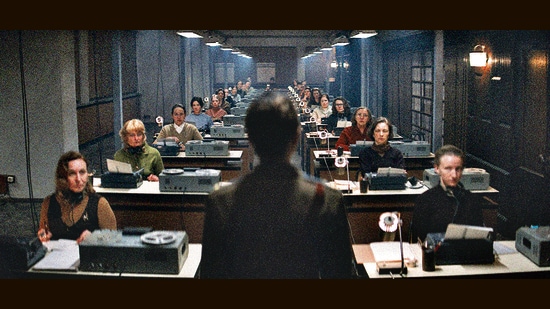
Created by the same team of Nedivi, Wolpert and Moore, Star City is the Soviet side of the story, but with more espionage and less stargazing. While space plays a critical role, most of the drama is earthbound.
In its excellent first season, the two poles of the plot are chief designer Sergei Korolev (Rhys Ifans) and Colonel Lyudmilla Raskova (Anna Maxwell Martin). He heads the Soviet space programme. She works with the KGB and is in charge of surveillance at Star City. The two butt heads when Raskova learns there is an American mole on Korolev’s team.
Everyone has secrets here, and the state exerts its autocratic power ruthlessly. Yet resistance bubbles up in unexpected places.
When the docile Anastasia Belikova (Alice Englert) becomes the first woman to land on the moon, for instance, she goes off-script. “Standing here, looking at this beautiful new world,” she says, “I’m aware that I am here because of those who have come before me. Filosofova, Tereshkova, Yana Akhmatova.”
The sound from her video is cut off immediately because Akhmatova (Niamh Algar) has been branded an American spy. (There’s probably a little ode here to 20th-century Russian poet Anna Akhmatova.)
Belikova knows what she has done. After all, she replaced Akhmatova at the last minute and is wearing a space suit that still has the other woman’s named stitched on it.
Star City is a taut spy thriller that often feels reminiscent of Chernobyl (2019) and The Lives of Others (2006; set in East Berlin). Although it isn’t as brilliant as those shows, the performances are uniformly excellent, and world of the show is realised beautifully by production designer Paul Spriggs. Brendan Uegama’s cinematography is breathtaking and the show benefits from some brilliant editing.
The script frequently tips its hat to historical figures and events, blurring the lines between fact and fiction. Two of the names in Anastasia’s speech, for instance, are nods to the 19th-century feminist Anna Filosofova and cosmonaut Valentina Tereshkova, the first woman in space. The sculpture that stands at the centre of the fictional facility, meanwhile, resembles the motif on the flag of the real Star City cosmonaut training centre in Russia.
An engineer named Sergei Korolev really did lead the Soviet space programme, though he died in 1966 (having spent years in a gulag during the Stalin years). At one point in the series, Korolev tells Belikova she reminds him of Yuri Gagarin, the first man in space, foreshadowing her descent into alcoholism.
Star City also includes a nod to the historical camaraderie with India, through the character of Lakshmi Chadha (Priya Kansara), who joins Korolev’s team on a secret mission. In a rare accomplishment for Hollywood, and a welcome change, the Hindi dialogue doesn’t sound like it was written by a bot.
While it does occasionally lose its way in the last two episodes, I found Star City to be one of the most bingeworthy shows of the year so far. Through the lives of its cosmonauts, engineers and office workers, it examines ideas of heroism, patriotism, dissent and loyalty. Like all the best speculative fiction, it is a flight of fantasy rooted in frustrations and anxieties that are only too real.
(Write to Deepanjana Pal @dpanjana on Instagram. The views expressed are personal)
One Subscription.
Get 360° coverage—from daily headlines
to 100 year archives.
Archives
HT App & Website