
 E-Paper



The eras tour: A Wknd chat with Vajra Chandrasekera, author of the award-winning Rakesfall

 Prefer HTon Google


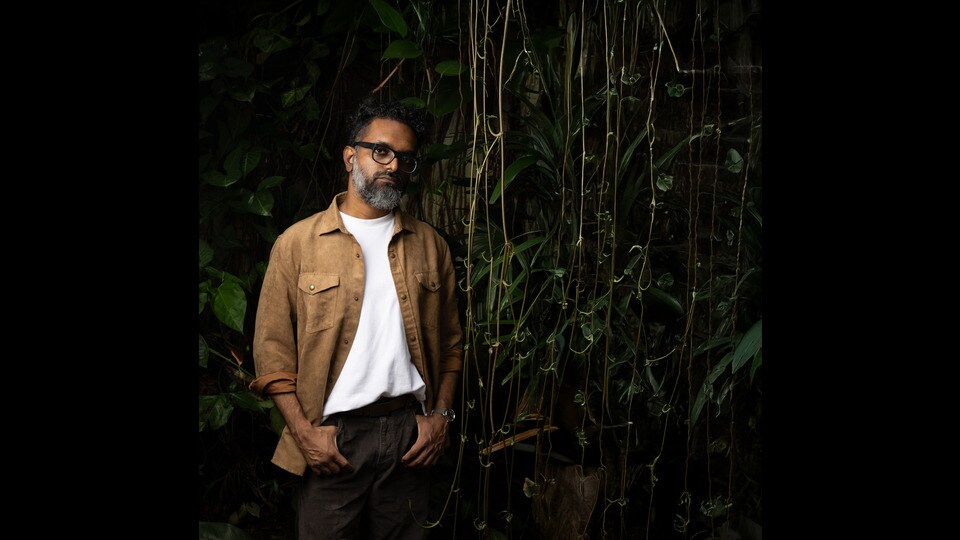
The winner of the Ursula K Le Guin prize is a wild ride of time travel, world-rebuilding, rage, hope. ‘It is never too late to embody hope,’ Chandrasekera says.
Time twists, bends and folds back on itself, in Rakesfall. The protagonist, who goes by different names in different epochs, steps through her various lives at will; travels through worlds of the living and the dead, and through domains in which the two overlap so densely that courts must rule, in surreal judgements, on how they may best coexist.
It is a wild ride, in other words; one that sweeps through dystopias to end with some pale hope. All of which is why the Sri Lankan writer Vajra Chandrasekera has just won the Ursula K Le Guin Prize.
Rakesfall was also nominated for a Nebula, a prize that Chandrasekera’s debut novel, The Saint of Bright Doors (about an assassination plot in a city tinged with the supernatural) won in 2023.
This time, I really let loose, he says. His slipstream sci-fi work dives underground, shoots forward across aeons, sees the world literally rebuilt. The book’s haunting echoes — of hubris, hyper-capitalism, and the sins of history repeating themselves — linger long after the story ends. “I think it’s important to recognise that the past has always been a deeply changeable thing,” says Chandrasekera, 46.
Excerpts from an interview.
* When and how did you come up with a book this bendy?
Rakesfall was written very soon after I finished my first novel, so its structural exuberance reflects some of my frustrations with trying to write that first one, where I felt obliged to be more constrained and relatively conventional.
This one was a lot of fun to write. The person who writes the book is also the first person who reads it, so I think it’s quite important to keep your audience entertained.
* At the same time, it reflects a deep scepticism… of hyper-capitalism, of our veneration of technology and of the men who infuse our world with it.
Yes, Rakesfall is very sceptical about a lot of things, but perhaps most of all about techno-optimism as a solution to climate change. The idea that grand engineering projects or hypothetical new technologies can save us from having to reduce consumption or suffer through any significant change in our political or economic systems is absurd.
A better world is absolutely possible, but not certain or guaranteed, and it is deeply improbable without massive social and political changes.
I don’t think of hope as something that exists outside of people. I think for most ordinary people, by which I mean people who have not already chosen to embody fascism, it is never too late to embody hope.
* Your father was a writer too. Growing up, you’ve said the entire family helped with each of his books. What were those years like?
They were a thorough introduction to the world of writing and publishing.
My father’s work is very different from mine: auto-fictional, minimalist, realist. But I saw the care with which he set to work on the page; how he would get up at 3 am every day to painstakingly edit his books — which were handwritten manuscripts; he had no access to word processors — before going to work as a civil servant.
I also learned that being a writer is precarious even by the standards of modern precarity.
Your fortunes can swing wildly between the good years and the bad ones. My father’s advice was always to make sure you have some other kind of paying work to lean on. That was good and, unfortunately for me since I didn’t take it, timeless advice.
* And yet this is vital work. How do you see your role, and the role of stories in general?
I am a writer, an artist working in a tradition, and a cultural worker in a vast, thinly globalised, unevenly distributed industry. Stories and language are what I work with, so naturally I think stories and language are important and essential to anything we might call culture.
I do believe that language and narrative are our primary technologies for thinking and articulating complex thoughts. But stories are also an industry with billions of dollars at stake, vast amounts of which go toward propaganda — look at how Marvel superhero movies are supported by the US military, for instance.
We live immersed in narrative: fiction, news, analysis, propaganda, counterpropaganda, ideology, worldviews, deep-seated assumptions. It’s quite overwhelming to even try and become conscious of just how many stories we are being told, or how many we are telling ourselves.
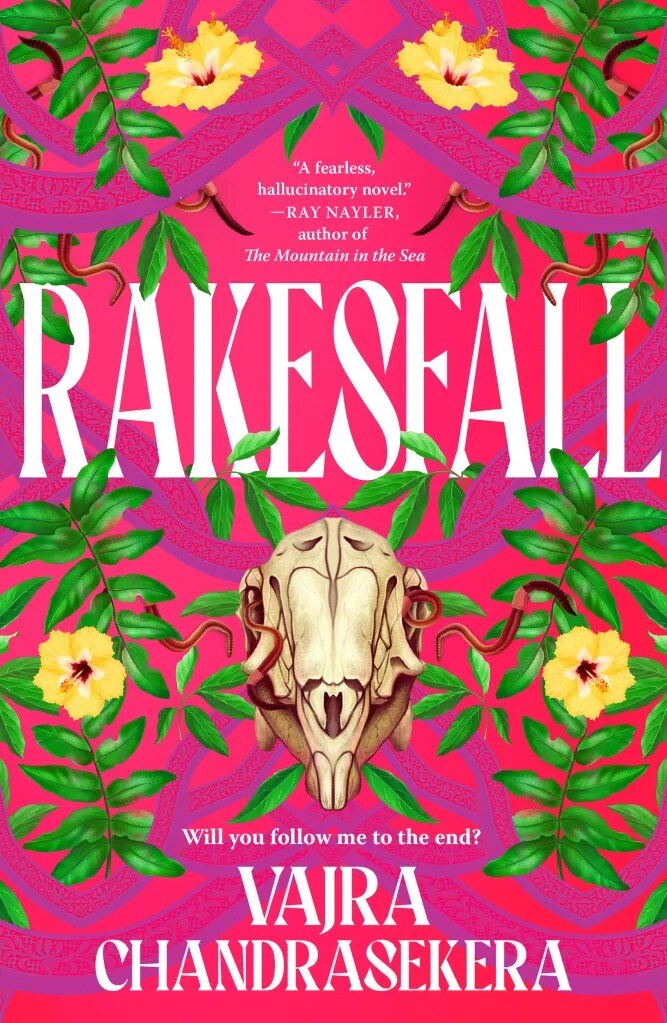
* Echoes of imperialism, colonialism and class war ricochet through Rakesfall. Given the changes colonialism and capitalism have wrought — in many ways, forming a sort of Original Sin — are we doomed to fight the tangles they caused, indefinitely?
Especially in South Asia, we tend to think of the “modern era” as being “after colonisation”, and so distinct from the colonial era. But the colonial era is modernity: that’s where all of it comes from, the modern sense of personhood, of science and rationality, of capitalism and development, of liberalism and democracy…
The underlying relationship of violence, debt and extraction between the First and Third Worlds remains in place, even though its forms have been altered.
Of course, as you say, anti-colonialism can also very easily become a cover for nationalist and fascist rhetoric, especially when it becomes a violent nostalgia harking back to an imaginary golden age, which did not exist either. I think one way to avoid making history into a scapegoat while at the same time retaining the capability to understand ourselves is to recognise that the past has always been a deeply changeable thing.
It’s important to study those pasts critically and ask why and how each one has been given this or that shape. In fact, given current still-growing emissions rates and the smug determination of our present generation of oligarchs to drive us directly into crisis, I think you could say that we live in a moment where the future is fixed and the past is in flux.
* Yet the novel does end in hope, of a kind. Is it a hope for some kind of new beginning?
Well, Rakesfall argues, if anything, that nothing ever ends, so there are never any new beginnings. Only history, which goes on.
I’ve always liked this quote from the late writer-activist Mike Davis: “I don’t think that people fight or stay the course because of hope, I think people do it out of love and anger.”
Loving-anger leads to empathy and solidarity, which is the bedrock of all positive social change. You need some anger to care, when one of the biggest fantasies that keeps getting sold to us in this age is that “pragmatism” is all that matters.
* What do you love? What would you fight for?
Rakesfall is about learning to love the conflicted parts of yourself. I think a big part of getting older is when we draw lines, consciously or not, around the parts of ourselves that we choose to fight for, and for too many of us, the fire and idealism of youth is one of the things we let go of too easily.
As the world gets darker, I think we could all stand to love our own love of justice more.
* Who is Vajra Chandrasekera beyond the glimpses we get in these wild, ecstatic rides? What do you do when you’re not writing?
Disappointingly, I am an extremely normal person. I spend much of my time reading. Writers are quite boring. There’s a great deal of sitting around with a book, either your own or somebody else’s. I have always meant to take up some exotic hobbies so I can answer questions like this one. I’m about to experience my very first winter in New York, which I am visiting for a fellowship, and I intend to try ice-skating. I am determined to enjoy this, and I hope someone somewhere finds that surprising, or at least incongruous with my whole tropical gothic vibe.


