E-Paper



Windshields, holograms: What does the future hold for the TV set?

 Prefer HTon Google


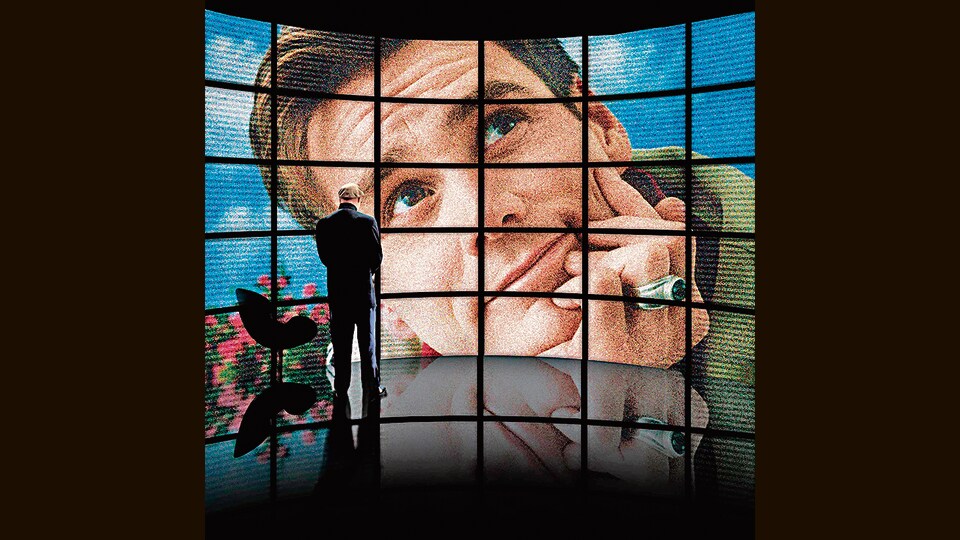
The next avatar of the idiot box could involve smartglasses, screenless laptops, tiny projectors, or even holographic displays, says Vishal Mathur.
They once feared it would take over the world. Access to a small, personal screen would draw us in, serve as the eyes and ears of the establishment, isolate us from each other.
It turned out, of course, that the fears weren’t entirely unfounded.
Once we had shrunk the magic of the moving picture down to the size of a box, there would be no going back. It has only shrunk further from there. Much of our extended screentime is now spent in front of our phones, whose flickering personalised algorithms keep us riveted as they peddle and pitch and endlessly scrape up the minutes and data… even as night turns to morning and we lie side by side, late into the night.
Soon, this may feel out-of-date.
The future could be a world of screenless laptops, smartglasses, pinch gestures, and a screen only the wearer can see, overlaid on top of their real world.
It’s been quite a journey from the bulky cathode-ray tubes and bulbous fluorescent screens of the 1930s.
By the late 1990s, that screen was being flattened. Liquid crystal display (LCD) electrically manipulated crystals packed within a thin screen, for far sharper picture quality. Next came plasma screens, in which tiny cells filled with gases emitted light when electrically charged. Both these were expensive, and easily damaged. So the world moved on.
Today, most of our screens, whether TV, laptop, fridge or phone, use LED or OLED (Light-Emitting Diode or Organic Light-Emitting Diode) technology. These are essentially carbon-based compounds that react to electrical impulses by generating crystal-clear light. The OLED is so self-illuminating, it requires no backlight. This allows for hyper-realistic resolution and contrast, deeper blacks and more vivid colours.
Even this can now feel out-of-date, given that one can instead pull a projector out of one’s backpack, set it a few inches from the nearest vertical surface, and have it create its own screening platform, 100-inches wide. This is a big screen that can travel with you: on the road, when camping, or from room to room.
The Bengaluru-based Lumio, set up by former executives from Xiaomi and Flipkart, for instance, offers an Arc series of projectors with in-built access to streaming apps and features such as automatic picture alignment and focus settings, for prices that start at ₹17,999.
This could soon feel outdated too.
The future of personal entertainment may very well be the holographic projector.
True holographic displays would eliminate the need for headsets, projectors, screens and smart glasses, and instead use a small hub to create three-dimensional images that could be viewed from any angle.
This is an idea still in its infancy, but researchers have demonstrated small-scale holographic displays that hint at a future in which floating images of this kind could become commonplace.
Currently, the technology faces significant challenges, including enormous computational requirements and the need for extremely precise light control. But I’d be willing to bet that the display technology of tomorrow won’t be about better pixels or brighter colours. It will involve fundamentally reimagining how we interact with visual content.
We could soon have display elements embedded in car windshields, walking ahead of us as holographic advertisements, or floating about in our living rooms. The eventual goal will be visual experiences that are more immersive, more personal, and more integrated into our daily lives — as with the TV, whether we like it or not.