I went to London for three packed days to attend a meeting. But no matter what I did, I was never too far from India.
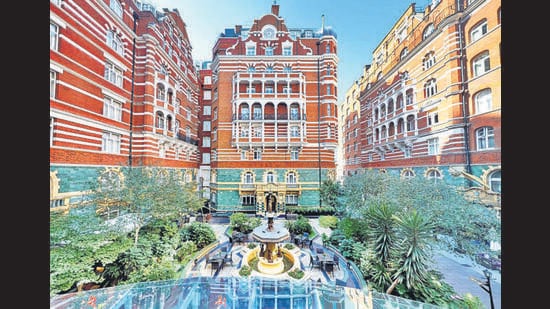
I stayed at 51 Buckingham Gate, the apartments-only hotel run by the Taj, next to the group’s St. James Court Hotel. I first stayed there in 1987, when it had just opened, which, I guess, makes me one of their oldest regulars. The complex has seen its ups and downs, but a string of very good general managers (Prabhat Verma, Digvijay Singh and now Mehrnavaz Avari) have turned it into my favourite place in London.
I have done most of the city’s better-known hotels, from the trendy places, to the Grand Dames to the Park Lane institutions. But rarely am I as comfortable and happy as I am at 51.
On my first night in London, I went to the recently opened Socca. This is a Southern French restaurant where the chef is Claude Bosi, a culinary heavyweight who has two Michelin stars at Bibendum, his other restaurant. Socca is a sort of La Petite Maison for grown-ups who want good food, not just a Riviera vibe. And of course, Claude’s food (which I first tried many years ago at Hibiscus) is terrific. We had perfectly fried courgette flowers, the eponymous socca (a sort of besan chilla made by French people) the last of the season’s English asparagus, a tart lentil salad, oysters, carpaccio, snails and an intense beef cheek with golden shoe-string fries.
Here too, I found an Indian connection. Claude’s old Hibiscus is now Bombay Bustle, a fun restaurant owned by Samyukta Nair, granddaughter of the legendary Captain Nair, who founded the Leela hotel chain. The Nairs have sold the Leela chain, but Samyukta has her grandfather’s flair for high-quality luxury and is fast emerging as a star on the London scene. She also owns Socca along with Claude, and runs at least three other top London restaurants.
{{/usCountry}}Here too, I found an Indian connection. Claude’s old Hibiscus is now Bombay Bustle, a fun restaurant owned by Samyukta Nair, granddaughter of the legendary Captain Nair, who founded the Leela hotel chain. The Nairs have sold the Leela chain, but Samyukta has her grandfather’s flair for high-quality luxury and is fast emerging as a star on the London scene. She also owns Socca along with Claude, and runs at least three other top London restaurants.
{{/usCountry}}Socca has taken over the old Richoux tea room space on South Audley Street (always a favourite with wealthy Indians who lived in the Park Lane hotels) and transformed it into a little corner of the Mediterranean. Indians will be delighted to know that there are many vegetarian options and not an anchovy in sight.
My London meeting coincided with my birthday, and because there was also an official reception that evening, my wife decided to take me out for dinner on my birthday eve rather than the birthday itself. She left it to me to choose the restaurant. I picked the Soho outpost of the Noble Rot mini chain, all of whose restaurants I love, partly for the food, which is always good, but mostly for the wine which is out of this world (the Noble Rot book is actually called Wines From Another Galaxy) and is reasonably priced.
I ordered food that went with the wine, Cos d’Estournel, 1975, and while it took an hour for the wine to open up, we drank a Greek red (surprisingly good) and snacked on fresh salami. The sommeliers (at all the Noble Rots, all the servers are very knowledgeable sommeliers) warned me that in 1975, they had not heard of Robert Parker so the chateaus of Bordeaux made elegant, classy wines, not the powerful fruit bombs that Parker likes. (Apparently they have to explain this to guests because too many people expect big wines.) She was right: It was a terrific wine.
I didn’t find an Indian connection at Noble Rot, but I did find one at House of Ming, the Taj’s latest venture.
We have been here before. In the 1990s, the Taj transported Frankie Lok, who then ran the Delhi House of Ming, and two expat Chinese chefs from Delhi to London, to open the Inn of Happiness. At that stage, nobody in London knew very much about Sichuan food, so the restaurant found the going tough. It eventually shut down.
This time around, the Taj is being cleverer. Though they have kept the House of Ming name, the idea is not to faithfully reproduce the Delhi restaurant. The menu has some House of Ming favourites, but it also has new dishes that should appeal to contemporary diners in London. It is a difficult balance to pull off. I had thought that they would just divide the menu into two sections: House of Ming classics (the Delhi favourites) and a section of newer dishes, more attuned to the London market. That way, the restaurant was guaranteed a base clientele of Indian fans without seeming out of place in London.
They have opted for the riskier strategy of mixing Delhi dishes with new ones, and to the credit of executive chef Sujoy Gupta, it mostly works. The dim sum were excellent, the quality of the stir-frying was good and the chef had been adventurous, picking dishes from Xinjiang and Sichuan. I reckon he should be even more adventurous while keeping the House of Ming legacy intact. The restaurant has what it needs to be a success (not just with Indians). All it needs is a little fine tuning.
Sticking with the Indian connection, I went back after many years to Quilon. The restaurant has been helmed by chef Sriram Aylur from the time when the Taj was keen on Malayalis and Malayali food. The menu was inspired by Karavali, where Sriram had been the chef. It took a year to convince Londoners to eat dishes that were hits in Bangalore (In those days, Karavali was one of India’s best restaurants). Sriram pulled it off. Ironically, while the original Karavali has ceased to be of much interest now, Quilon is still one of London’s best Indian restaurants. It has been 24 years now and for at least 14 of them, Quilon has kept its Michelin star.
Quilon has many fancy dishes, but I ate the simple stuff: Urlai roast, channa, prawn masala, anda paratta, crisp bhindi, mini masala dosas. All of it was good.
Tomos Parry is the leading light of a new generation of British chefs, alongside people like Isaac McHale (the Clove Club) and James Lowe (Lyle’s). Many of those chefs have now come to global attention. (They have Michelin stars and sometimes turn up on the 50 Best Restaurant list, etc.) But they are mostly an essentially British phenomenon, running innovative restaurants that are always packed with locals (few tourists; no oligarchs) because of their excellent food and prices that are far from Mayfair levels.
I first ate Tomos’s food at Kitty Fisher’s in Shepherd’s Market and was blown away. Then, he opened Brat in Shoreditch, which became a favourite for people in the know. Nigella Lawson took Phil Rosenthal there for the London episode of Somebody Feed Phil. Rosenthal, who had never heard of it, was astonished by how good the food was.
When I ate at Brat, I knew that Tomos had the ability to cook meat over a fire in a way that only the Spanish (Extebarri of course, but many others ) and those who have followed their lead understand: Lennox Hastie in Australia, Dave Pynt in Singapore, etc. But it was clear that Tomos had less interest in simply reproducing Spanish dishes and more in mastering the complexities of cooking with fire.
Mountain is his newest restaurant, and I reckon it will be the Next Big Thing in London, at least partly because it is located more centrally in Soho. I went before it had formally opened for a friends-and-family night (their first night of full service) and the room was full of restaurant royalty. Fay Maschler took me, and Karam Sethi, whose JKS group are the kings of the London scene, was at the next table.
The kitchen and service were both under pressure, but what struck me was that Tomos was applying his Spanish techniques to British produce. The sobrasada sausage was made in Britain and tasted better than anything I had eaten in Majorca. His signature steak, originally made with meat from Galician dairy cows, is now fully British and is even better.
At some stage, Tomos will cease to be a UK-only phenomenon and become world famous. (Should he want it; he is remarkably low-key and modest.) So, you will probably be hearing a lot more about him.