
 E-Paper



You play what? These musicians have invented instruments with unique sounds

 Prefer HTon Google


What happens a flute and guitar have a baby? Or when a violin gets an extra string? Hear from four musicians whose inventions can’t be beat
When Rishab Rikhiram Sharma released the music video for Bijli, a track from his album Navaras, last year, he knew the song would go viral. It’s based on Raga Kirwani, and is as thunderous as the name suggests. What the 26-year-old musician didn’t expect is to be almost upstaged by his own instrument. It sounded like the sitar, but where the traditional instrument has a heavy, bulbous base, Sharma’s contraption was flat and light, almost like a guitar. He was strumming it like a guitar too, standing up. The world was curious.
Sharma is the son of national-award-winning instrument maker Sanjay Rikhiram. The family runs music stores in Delhi and the US. They know that sitars are frightfully expensive – even a zitar, an electric version invented by Rikhiram, costs close to ₹1 lakh. So Sharma developed a lighter, cheaper version, ideal for someone starting out, and asked his father to handcraft it.
His Rik-E-Sitar isn’t on sale yet, but across India, musicians are tinkering with popular instruments to create new sounds, new experiments. See how tech, tradition and a literal fine tuning are making this possible.
Nine strings to rule them all
Vishnu Ramprasad, 29
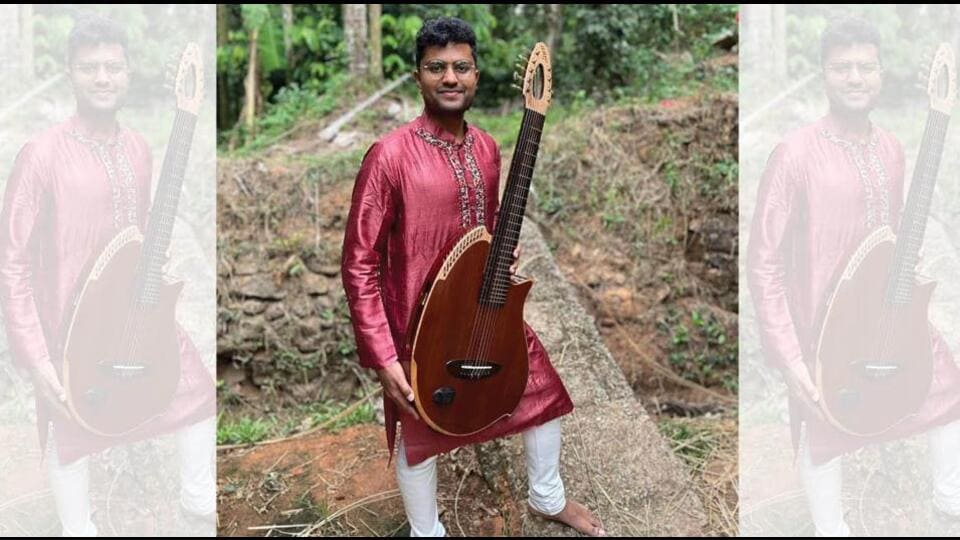
Ramprasad, comes from a family of musicians and grew up in Bengaluru, studying Carnatic music, but also rock, and Western classical jazz. He knew they all sounded unique. He’d watched East-West collabs. “I realised that the guitar has limitations in bringing out ghamaks, the microtones and oscillations of Indian music,” he says.
He wondered if there was a way to work them all into a single instrument. It had to be a stringed one, which could be played like a guitar or lute, and allow for separate fretted and fretless play. So, in 2018, he worked out a prototype with six fretted strings, like a regular guitar, and three more on a fretless board that could be tuned for Indian classical music. “I wanted to keep it simple, direct, with its own identity,” he says, and asked instrument-maker Alexandra Letellier in Puducherry to build it.
What emerged was a veena-sarod-sitar-guitar hybrid that allows a musician to seamlessly switch between Carnatic, jazz and world music. Ramprasad named it navtar and patented it in 2022. “It’s a new, global sound,” he says. “Even Carnatic traditionalists have found the sound authentic. Wherever I have performed, be it South Africa or Hong Kong, people are excited to witness the blend of traditional and contemporary music.”
Ramprasad hopes to set up a manufacturing unit to create more navtars and train students how to use it. Already an unexpected challenge has popped up. “Because I compose especially for the navtar, it makes collaborations difficult,” he admits. “It’s like having many musicians in one.”
Carnatic on the iPad
Mahesh Raghvan, 34
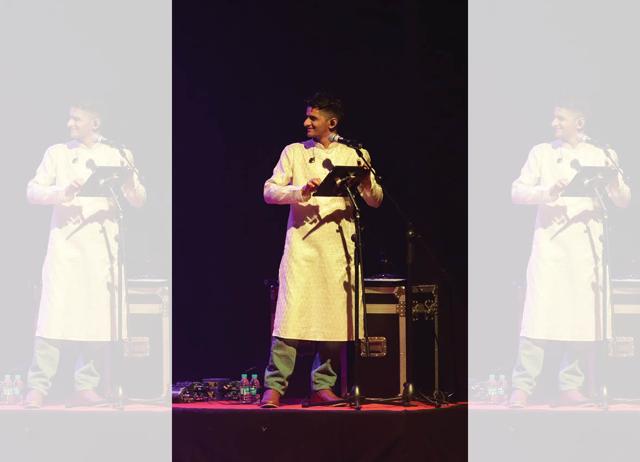
When Raghvan is on stage, it almost seems like he should have been at the back of the hall, with the tech crew. For the most part, he just works intently on his iPad, his fingers flying across the screen. He’ll look up and smile occasionally. Is he a DJ? Not quite. He’s using GeoShred, an app that allows users to play musical instruments on touchscreens. So, how come it’s playing the gamaks and meends of Carnatic music? The answer, the Mumbai musician says, was four years in the making.
“I got to know about GeoShred in 2013,” Raghvan says. Back then, the software would play pop, even jazz. But it couldn’t handle anything as complex as the note-bending quality that Indian instruments were designed for. Raghvan, the son of a chartered accountant and a teacher, had been learning Carnatic music since he was three. He’d had lessons in keyboard and music theory. He knew he could get the app to do more. “I started developing a technique to play Indian classical music on the iPad,” he says. It was innovative enough that Jordan Rudess (Yes, that Jordan Rudess, from Dream Theater, who also developed GeoShred) took notice. His team worked with Raghvan to reproduce expressions and inflections on the app for Indian music.
“Whenever I needed a feature modified, the developers made it happen,” Raghvan says. He did his own homework as well, adding techniques used in sitar, veena, harmonium, and guitar to the app. There was no instruction manual – all of this was new. “It required a lot of trial and error until it felt right,” Raghvan says. “I would sometimes practise tiny phrases for hours to figure out which fingers work best with which note.”
A lot of Raghvan’s videos look like he’s playing a video game. So, audiences are surprised by videos titled Harry Potter – The Ultimate Indian Theme on his socials. In a way, it is a kind of magic.
Charging up the flute
Pravin Godkhindi, 51
Dharwad-based flautist Pravin Godkhindi grew up with music. His father was the veteran flautist and vocalist Venkatesh Godkhindi, who gave him lessons early on. So, wherever travels abroad, he visits music stores to check out regional instruments, and looks for ideas on how to tweak his own flutes to produce different sounds.
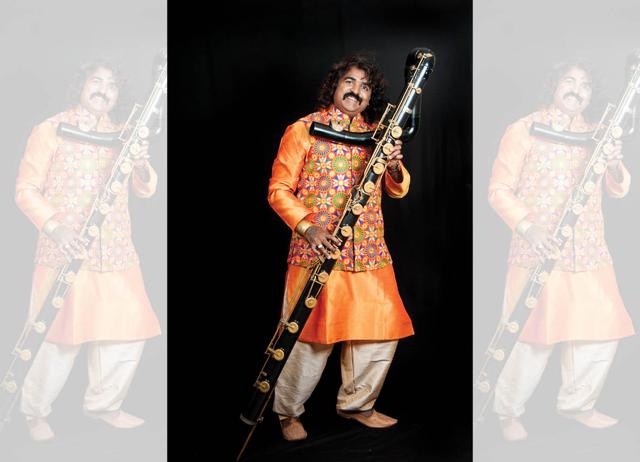
It’s yielded three inventions so far: A flutar (a flute-electric guitar combination); a mandra bansuri that plays the lower-than-usual mandra octave; and an illuminated flute fashioned from a glass pipe. Each, unsurprisingly, has a story.
For the flutar, Godkhindi drew on his engineering skills to adapt an audio-to-MIDI convertor to convert the notes played on a bamboo flute into the sound of an electric guitar. It has no strings, so audiences are surprised to hear strumming sounds when a flute being played. For the mandra bansuri, producing the alto range was a question of physics. “For regular flutes to reach the lower octave, the instrument needs to be longer, but then the hand can’t reach the end,” he says. So, he created a flute with a U-shaped neck to let the musician access the lower-range flute-holes too. As for that illuminated flute, its magic lies in cleverly placed LEDs and a little mic. “I make the stage go completely dark and then play,” he says. “People love the experience.”
The new instruments call for new breathing techniques. And Godkhindi has picked up circular-breathing hacks from conch-blowers and shehnai players. Each of his inventions feels special, he says. But Godkhindi does not intend to patent them. He hopes flautists everywhere use them.
He woke up and chose violins
Ambi Subramaniam, 33
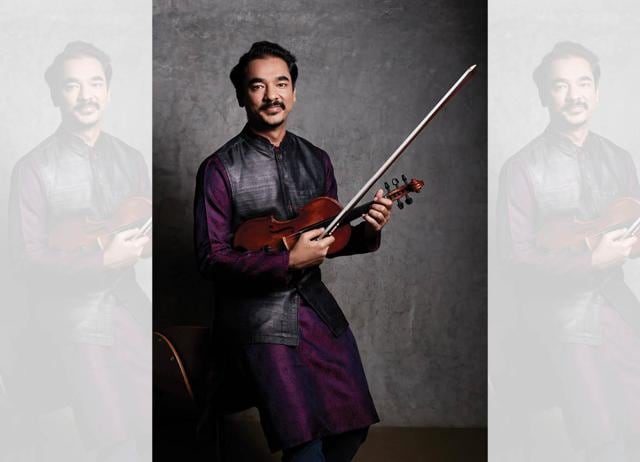
Subramaniam feels right at home with musical inspiration and experimentation. His father is the legendary violinist and Padma Vibhushan L Subramaniam, who was making little tweaks to his own instruments even in the 1970s. “He developed a portable tanpura so it was easy to travel with,” he recalls. “On some violins, he has added sympathetic strings such as the veena or the sitar, which gives it a little more resonance. He also experimented with electric violins,” Subramaniam says.
And while most violins have four strings, Subramaniam plays one with five, a genius addition developed by his father that gets the violin to produce viola sounds too. It’s allowed him to collaborate with artists across musical genres. “I am also able to play a lower register, which is more suited to Indian music.” The five strings have made for a tighter-sounding violin – the notes emerge a little thicker, deliver more power. So when the sound fills concert halls, it captivates listeners in ways that didn’t happen before.


