
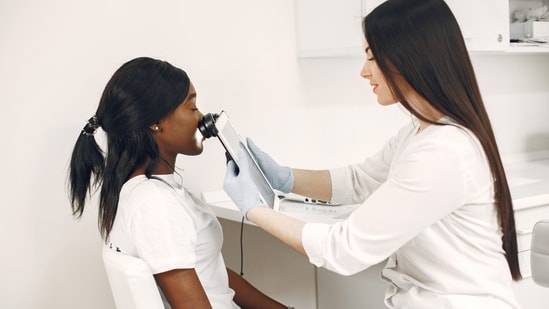
People are increasingly using smartphone photographs to identify skin conditions and, through AI, prescribe themselves a skincare routine or skin treatment based on this. The technology itself is promising, but there are certain pitfalls to it.
Dr Manisha Mareddy, MBBS, MD, dermatologist, founder of Shlok Dermatology and Wellness Clinic, Kokapet, Hyderabad, Dr Dhanraj Chavan, MBBS, MD (dermatology), consultant dermatologist, Clear Skin Clinics, Pune, and Dr Sadhana Deshmukh, MBBS, DNB, dermatology, venereology, aesthetic and trichologist, Forever Young Clinic, Bandra West, Mumbai, explained the risks and limitations of AI-powered skin analysis.
Is your AI skincare app reading your skin correctly?
According to Mareddy, the main question lies in its accuracy, especially when it comes to Indian skin tones. It is commonplace nowadays to have patients come in with “ChatGPT prescriptions" and scrutinise our treatment using AI input.
One of the most fundamental challenges is skin tone diversity because Indian skin cannot be classified as a single category. There are so many variants in Indian skin types. There are differences in genetics, ethnicity, geographical backgrounds, and sun exposure, all of which factor into skin type. The skin type used widely in dermatology is not the only parameter to assess skin.
{{/usCountry}}One of the most fundamental challenges is skin tone diversity because Indian skin cannot be classified as a single category. There are so many variants in Indian skin types. There are differences in genetics, ethnicity, geographical backgrounds, and sun exposure, all of which factor into skin type. The skin type used widely in dermatology is not the only parameter to assess skin.
{{/usCountry}}“The limitations of this skin type grading, which is the Fitzpatrick skin type, are particularly obvious when we are treating a diverse range of Indian skin tones,” highlighted Dr Mareddy.
AI-based skin analysis platforms rely on images captured using smartphone cameras. However, these are not standardised pictures. Camera sensors, exposure, white balance, lighting, image compression, and all these technical parameters can significantly alter the appearance of the skin. Even minor artefacts and subtle variations can influence how an algorithm interprets pigmentation. What might seem like one condition in a picture could be a totally different one on examination.
“You need to understand that the very first problem is the photograph. A selfie is not an ideal way to detect skin issues. A tube light can make your skin look darker or yellowish. And a window behind can put dark spots on your face,” explained Dr Chavan. Also, a number of holes automatically smoothen and make the skin bright. And the app they are using is not able to detect what's really there on the face. Different locations of the photograph with different lighting conditions can give you different results.
Why is personal consultation important?
Dr Mareddy highlighted that even in the clinic, we recommend that patients come in for in-person consultations for this reason. Treatments are totally dependent on the diagnosis, and one mistake in the user input from pictures, history or the description of the condition itself can completely misplace the diagnosis and the following treatment.
According to Dr Mareddy, most AI models are trained on Caucasian skin types. There is a lot of variation in the presentation of skin diseases in Caucasian and Indian skin types. So, the datasets lack representation of Indian skin types.
AI may be useful in tracking certain skin changes and giving preliminary recommendations, but it is not reliable at the moment. There are many skin conditions that need clinical correlation. A picture is not often enough to assess and diagnose them.
“I also see a lot of confusion with pigmentation. Conditions like melasma, tanning, and dark spots left by pimples may look the same in the photo, but they are completely different and need different treatments,” said Dr Chavan.
A photo also does not tell the details about the person's life. There are factors like PCOS or thyroid problems, and which medicine they take, or if there is a new face wash that they have started using. A person might be in the sun every day, going to work. All these things need to be known before we make any decision about the treatment. But an app does not necessarily ask all of this.
“This becomes even more important in aesthetic dermatology. When someone comes to me for Botox, fillers or skin-tightening treatments, I don’t simply look at their photograph and decide what they need. I assess their facial proportions, muscle movements, volume loss, skin laxity and symmetry. I also observe how their face changes when they smile, frown, or make different expressions. A photograph cannot show all of this,” said Dr Deshmukh.
Risks of using an AI for skin
According to Dr Chavan, the real risk happens after the scan. People read the product list and start using strong acids or retinol right away. Indian skin can react to these things by making more pigments. A skin routine made to help with dark spots might cause new dark spots instead.
Note to readers: This article is for informational purposes only and not a substitute for professional medical advice. Always seek the advice of your doctor with any questions about a medical condition.
ABOUT THE AUTHOR
Anukriti Srivastava thrives at the intersection of words and voice, where journalism meets storytelling. A digital editor and journalist with over 5 years of experience, she has written across lifestyle, women issues, relationships, entertainment, fashion, and travel. She did her Masters in Broadcast Journalism and has published more than 500+ lifestyle content pieces across platforms. As a former Sub-Editor at HerZindagi, she produced engaging digital content, interviews, and event coverage for a wide audience. She has also contributed as a Webstory Producer with Travel + Leisure, transforming travel experiences into immersive stories for readers who love exploring the world. Beyond writing, Anukriti’s storytelling extends to the microphone. As a voice-over artist, her warm and expressive voice has brought scripts to life across audio platforms, turning simple words into immersive experiences. Her work reflects a deep interest in people, culture, and everyday stories that resonate with readers and listeners alike. She enjoys crafting content that informs, inspires, and sparks curiosity. Away from screens and studios, you’ll find her reading self-help books, listening to music, getting lost in romantic novels, and playing the guitar for a creative reset. For Anukriti, storytelling isn’t just a profession—it’s a way of seeing and sharing the world.
Catch your daily dose of Fashion, Taylor Swift, Health, Festivals, Travel, Relationship, Recipe and all the other Latest Lifestyle News on Hindustan Times Website and APPs.
Catch your daily dose of Fashion, Taylor Swift, Health, Festivals, Travel, Relationship, Recipe and all the other Latest Lifestyle News on Hindustan Times Website and APPs.