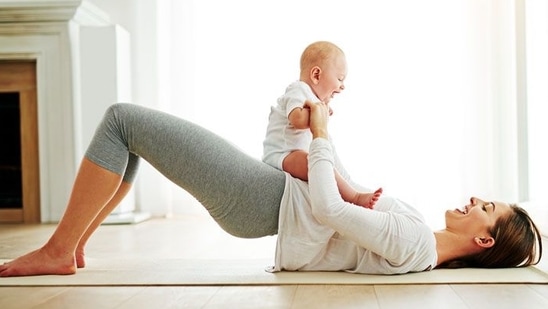
Giving birth to a new life is considered to be one of the most cherished event for a woman but how can we forget that pregnancy and childbirth brings so many changes in a woman’s body from these three aspects - anatomical, physiological and emotional. These three parameters are the pillars for every individual’s wellbeing.
In an interview with HT Lifestyle, Priya Singh, Women’s Health Physiotherapist and Lactation Consultant at Cloudnine Group of Hospitals in Vashi and Navi Mumbai, highlighted that the documented changes that occur during the course of pregnancy are:
- Changes in the hormonal secretions
- Overall increase in body fluid
- Laxity of joints and ligaments due to relaxin hormone
- Changes in the curvature of the lumbar spine
- Stretching of the abdominal muscles to accommodate the growing fetus.
- Changes in the skin
- The most important: weight gain
According to Priya Singh, there are many other changes that a woman’s body may go through but the above changes mentioned are the most common ones and visible ones.
Why are we discussing changes during pregnancy while we discuss ‘return to exercise after childbirth’?
Priya Singh explained, “That is for you to understand that the changes that have occurred during child birth would certainly require some time to return back to normal, as how it was! You can make your bounce back process a little easier by staying active during pregnancy as exercising would help you maintain your fitness level, the muscle strength, stamina and flexibility which in return helps you to combat the expected pregnancy discomforts and that allows you to start your post-partum fitness journey soon after you give birth.”
{{/usCountry}}Priya Singh explained, “That is for you to understand that the changes that have occurred during child birth would certainly require some time to return back to normal, as how it was! You can make your bounce back process a little easier by staying active during pregnancy as exercising would help you maintain your fitness level, the muscle strength, stamina and flexibility which in return helps you to combat the expected pregnancy discomforts and that allows you to start your post-partum fitness journey soon after you give birth.”
{{/usCountry}}She elaborated, “The most common concerns that every women has after child birth are “why this belly still looks bigger after the baby is born, what can be done to have this belly go in, how much time will it take, what all activities can I do”, will wearing a belt help?. The uterus is made up of smooth muscles and it grows in size with progressing weeks of pregnancy and so the abdominal muscles also stretch to accommodate the growing fetus. After childbirth the uterus is still big in size. Which shrinks and reduces naturally on its own with time. This process is referred as Involution.”
Now let us discuss something that also causes the abdominal muscles to bulge is Diastasis recti; the separation of the rectus abdominal muscle that is more than more than 2 cm would require your attention. There are 4 types of Diastasis recti and that are:
- Open Diastasis
- Open below Naval
- Open Above Naval
- Completely Open
As per Priya Singh, 2-3 weeks after childbirth it is recommended to get checked from a physiotherapist so that they can prescribe exercises as per the assessment and type of Diastasis recti present.
What the role of abdominal belt to play here? Let’s discuss.
The criteria for wearing a belt are–
- Always consult your healthcare provider before using one for yourself.
- If you have a loose, saggy abdominal muscle and basic daily activities are affected without support.
- Less strength in core muscles
- Twin pregnancy
- If you are a Multiparous women.
Priya Singh suggested, “One may require to use a belt initially for about 6-12 weeks which is enough. An abdominal belt offers you a good posture and support but avoid prolonged usage as it will lead to muscle wasting, work on the muscle consistently with core exercises as per one’s existing muscle strength. A physiotherapist can help you with wearing the belt correctly and guide you with the right core exercises to begin with.”
The fitness expert advised, “The exercises that can be started soon after giving birth are abdominal muscles contraction or activation, Deep breathing exercises along with the core activation & other muscle activation exercises can be considered.”
She added a few suggestions that mothers may follow to avoid any injury, discomfort while they are returning to exercise after giving birth -
- Take it slow, allow your body to heal for about 4-6 weeks.
- One can start basic mobility and muscle activation exercises soon after childbirth as it allows the joints and muscles to retain its basic function.
- Intensity of the exercises can be increased and mild to moderate intensity exercises for upper body, back and abdomen can be started after 6 weeks.
- Moderate strength training can be started to strengthen upper and lower body with weights of up to 3-3.5 kg for beginners along with core activation exercises. Avoid lifting heavy weights during daily chores or as a part of exercise, weight training is an important part of the exercise routine but the weights must be increased in gradual manner to avoid any injury.
- Mild to moderate Cardio exercises like walking and brisk walking can be started after 6 weeks. Avoid HITT (high intensity interval training).
Priya Singh concluded, “I would recommend mothers to take professional advice on which exercise to begin with. Evaluation of muscles strength plays a vital role in forming an exercise program of an individual. The result of not having a good core strength is having multiple discomforts out of which the most common is backache. A Physiotherapist can help you with having a safe exercise routine post childbirth by keeping all the exercise guidelines in mind. The aim of your exercise program shall focus on building a strong system instead of weight loss. Weight loss is the byproduct of life style that we have, eating habits, consistency and patience.”
Catch your daily dose of Fashion, Taylor Swift, Health, Festivals, Travel, Relationship, Recipe and all the other Latest Lifestyle News on Hindustan Times Website and APPs.
Catch your daily dose of Fashion, Taylor Swift, Health, Festivals, Travel, Relationship, Recipe and all the other Latest Lifestyle News on Hindustan Times Website and APPs.