The Bharatiya Janata Party (BJP) is expecting major gains from West Bengal in 2019. That the BJP has emerged the main opposition party against the ruling All India Trimanool Congress (AITC) is not in doubt. The BJP finished a clear, albeit distant, second in the 2018 panchayat elections n the state. Until 2016, it was the Communist Party of India (Marxist)-led Left Front that was second in the state in terms of vote share.
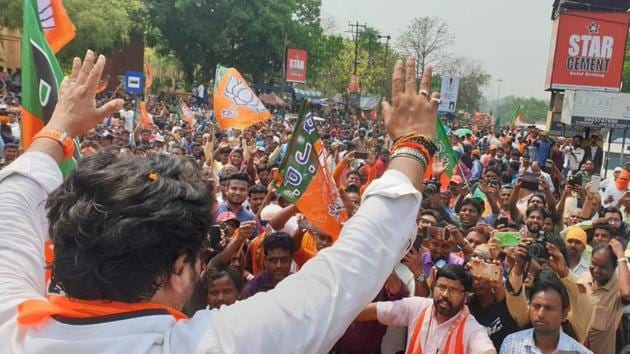

Because the panchayat elections witnessed allegations of large-scale intimidation and rigging by the AITC, there was an impression that the opposition’s tally could have been better had the polls been fair. Will 2019 spring a surprise performance by the BJP in West Bengal?
Two factors are worth underlining. One, in order to get a large number of seats in the state, the BJP would have to significantly increase its vote share from 2014 levels. And two, the BJP’s growth in West Bengal until now has been at the cost of the opposition, namely the Communist Party of India (Marxist)-led Left Front and the Congress. The AITC, in fact, has increased its vote share during this period. Unless a section of the AITC voters jump ship to the BJP, the latter will find it difficult to make significant gains in the state.
The example of the AITC is useful to explain the critical minimum vote share point. After Mamata Banerjee walked out of the Congress to form the AITC (then West Bengal Trinamool Congress) in 1998, it won seven seats in the 1998 Lok Sabha election. However, these seats came with a 24.4% total vote share. To be sure, the AITC did not contest all seats in the state, and its contested vote share was much higher at 35.5%. The BJP does not have an ally in West Bengal, and its footprint is not particularly concentrated in a region of the state. This means that unless the BJP increases its 2014 vote share by at least 10 percentage points, getting a significant number of Lok Sabha seats will be extremely difficult.
{{/usCountry}}The example of the AITC is useful to explain the critical minimum vote share point. After Mamata Banerjee walked out of the Congress to form the AITC (then West Bengal Trinamool Congress) in 1998, it won seven seats in the 1998 Lok Sabha election. However, these seats came with a 24.4% total vote share. To be sure, the AITC did not contest all seats in the state, and its contested vote share was much higher at 35.5%. The BJP does not have an ally in West Bengal, and its footprint is not particularly concentrated in a region of the state. This means that unless the BJP increases its 2014 vote share by at least 10 percentage points, getting a significant number of Lok Sabha seats will be extremely difficult.
{{/usCountry}}This raises the question of what has contributed to the BJP’s growth in West Bengal since 2014. It is primarily the collapse of the CPI(M)-led Left Front. The median vote share of the Left and the BJP put together in all 42 parliamentary constituencies in the state was almost the same in 2009 (47%) and 2014 (47.8%). However, the distribution shifted discernibly in favour of the BJP in the 2014 elections.

To be sure, the BJP is not the only party which has gained from the Left’s decline in West Bengal. It is the AITC which has been the biggest beneficiary of the decline of the Left. The vote share of the AITC increased from 21% in 2004, when it won just one Lok Sabha seat to 39% in 2014. This increased to 45% in the 2016 elections. If the AITC is able to retain this kind of a vote share, it might be difficult for the BJP to increase its seat tally.
The other interesting question in West Bengal is the multi-polar contest in 2019. With alliance talks between the Congress and the CPI(M) not materialising, there will be three competitors for anti-AITC votes in West Bengal: BJP, Left Front and Congress. This increases the possibility of fragmentation in the opposition vote. But the absence of an alliance may have prevented some potential attrition from the Congress and the Left to the ranks of the BJP, as disagreement over seat sharing between the Congress and the Left could have pushed disgruntled local leadership of these parties towards the BJP. For example, there were reports of Deepa Das Munshi of the Congress, who lost the Raijganj seat to Md Salim of the CPI (M) by a couple of thousand votes in 2014, being in touch with the BJP when the Congress and the CPI (M) were both staking claims over Raiganj. For a party like the BJP, which is still in an organisation building exercise in West Bengal, fielding popular and known candidates is half the battle won.
With both the Congress and the left competing for anti-AITC votes, the BJP has the unenviable task of attacking not just Mamata Banerjee but also the Congress and the Left to ensure that they do not divide opposition votes.