A dual policy of reaching out to residents and going tough on lockdown violators is beginning to yield results in Sadar’s Kasaibada locality, the first to be declared a coronavirus hotspot in Lucknow.
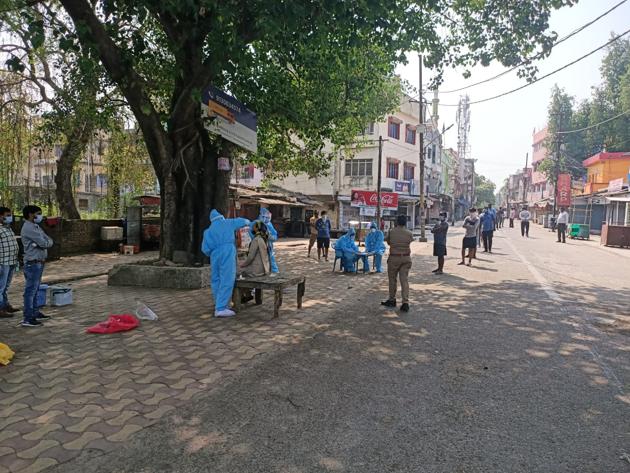
“As a result of the carrot and stick policy, more than 300 people from the area of Kasaibada have been tested and now there is no resistance to testing,” says Amit Mishra, chief executive officer of the Cantonment Board.
“Initially we thought that police and administration would be able to handle the situation. But when we saw the inhabitants were not under control, we decided to be very strict with people who were creating problems for the authorities. We decided to go for aggressive testing in every house and anyone stopping that would be dealt with according to the law,” Mishra adds.
Kasaibada area of Lucknow’s Sadar area was declared a hotspot when 12 jamaatis were found infected with the coronavirus on April 3. Later, 74 more people tested positive. About 3,000-4,000 residents of Kasaibada live in ghettos.
“At the same time, we had to create awareness among the people and meet their daily needs like milk, bread and other food items. We arranged a community kitchen to ensure proper food distribution in every house in the presence of the local corporator and other influential people. We also motivated the residents to volunteer for testing as it was in their interest to do so. The corporator and influential people played their part perfectly,” Mishra says.
{{/usCountry}}“At the same time, we had to create awareness among the people and meet their daily needs like milk, bread and other food items. We arranged a community kitchen to ensure proper food distribution in every house in the presence of the local corporator and other influential people. We also motivated the residents to volunteer for testing as it was in their interest to do so. The corporator and influential people played their part perfectly,” Mishra says.
{{/usCountry}}At present, the authorities are distributing food to rozedars in the evening and encouraging them to get medically examined, says Mishra.
However, some people still ventured outdoors, defying the lockdown and spat ‘deliberately’ on the road and then ran away.
“We decided to go tough against these misguided people, who are trying to test the patience of the police. We used informants to record their acts on mobile phone cameras. We also used our CCTV network and drones to control such activities. Around 30 FIRs were lodged against troublemakers and 15 of them were arrested on the basis of evidence,” the CEO said.
Local corporator Anjum Ara says, “Person-to-person contact while distributing food brought things in our favour. We not only supplied food but also medicines, fruits, and other household items. A WhatsApp group was also created and officials of the Cantonment Board, the district administration and police were included. People’s queries were answered. This swung the game in our favour and now residents are coming for tests on their own accord and have started maintaining social distancing.”
The corporator also says, “After jamaatis were taken away, the lack of trust was visible as people were not happy with the police. But now they have befriended them as police are supplying food and medicine daily.”
Taking the help of public representative worked, says district magistrate Abhishek Prakash.
“Such interventions are required where people are less aware, less educated. We are confident we will control the coronavirus in the area soon,” he says.
“For decades, the authorities shut their eyes to problems of the area, where certain pockets lack toilets and ventilation. Now it’s the time to address real issues like proper toilets and running water supply,” says Pramod Sharma, former vice-president, Cantonment Board.