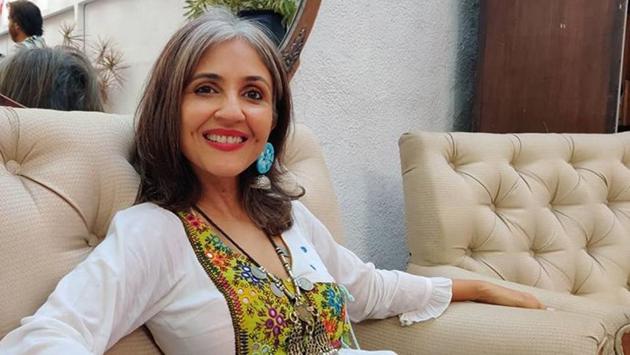
Anyone who has read her, or seen her work in advertising, would know of the spunk about her spirit. Anuja Chauhan is as animated talking about drafts as she is about creating things from ground zero. In the same spirit, she talks about making her own Ravanas on Dussehra. Tracing it back to her childhood spent between Meerut and Delhi, she shares: “It started in Meerut. I am the youngest of many cousins and one Dussehra when went to my Nani’s house for holidays, my older cousin decided to make a Ravana for the first time in our garden. It made a deep impression on me.” The fascination with this festival grew over the years. “At my dad’s house on New Rohtak Road in Delhi, we used to climb on the chhat of that house and at the back, we could see the Ajmal Khan Park and we could see three Ravanas burning from there. And up the road till Jhandewalan, so for free, you could see all this,” adds Chauhan who currently resides in Bengaluru and is continuing the legacy there.
Ravana-making has become a collaborative effort with neighbours pitching in various roles. “We have recycled everything possible and used old newspapers and cardboards. Somebody was chopping down their bamboo so we took the stalks from them. The challenge was to do it in an eco-friendly, inexpensive way. We used old saris, and got hay from an empty plot. We had two Bengali and Nepalese men who are used to making Durga Puja pandals ; they got really excited and made frames out of bamboo. Another boy, Vivek, who used to make ravanas in Jabalpur in his childhood, helped make the main head. The other nine heads were made by the ladies in the township,” she reveals excitedly.
Read: Dussehra’s eco-friendly avatar: Delhi-NCR residents say won’t burn effigies but will cut cake
She is aware that due to the pandemic, they cannot be lax in following safety protocol. “People are maintaining social distancing and bringing their own food and drinks,” she says.
{{/usCountry}}She is aware that due to the pandemic, they cannot be lax in following safety protocol. “People are maintaining social distancing and bringing their own food and drinks,” she says.
{{/usCountry}}The bestselling author of books such as The Zoya Factor and Those Pricey Thakur Girls, Chauhan feels that Dussehra is a great equaliser. “It is a symbolic destruction of evil, so I feel it is very uniting for all religions. Who doesn’t want evil to be destroyed and goodness to prevail,” she concludes.
Interact with Etti Bali @TheBalinian
Follow @htlifeandstyle for more