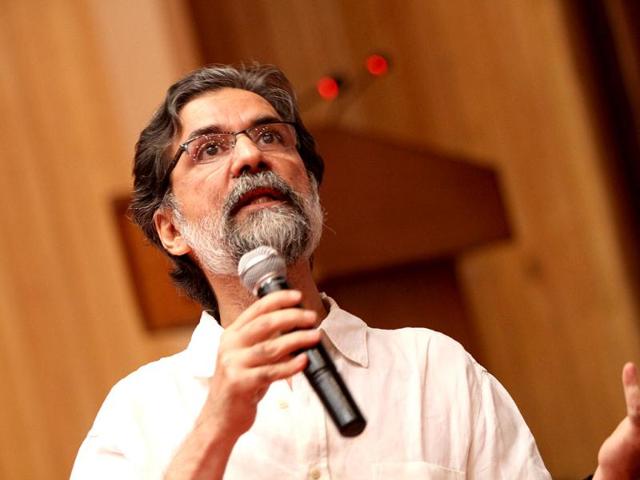
Well-known documentary film-maker Sanjay Kak has always explored subjects that have tried to pose an alternative to the national discourse. His critically acclaimed documentaries are ‘Words on Water’ on the anti-dam Narmada movement ‘Jashn-e-Azadi’ on the suffering and grit of the people of the Kashmir valley. ‘Red Ant Dream’ on the revolutionary linkages between different people’s movements in India is his latest film.
Q: Please explain the title of your film Red Ant Dream. How long did it take to make?
A: Titles can't always be explained, they are like names. What is the relationship between ourselves and our names? The film’s title is for the audience to figure out. The title of this film comes with some whimsy, and hopefully some ambiguity: and after people have seen the film we imagine it will make more sense.
We've been working on this for a little over 3 years. There was not a lot of shooting, perhaps a total of 8 weeks. But the editing process was long, and hard, and went on for what must easily add up to 8 months!
Q: 'Red Ant' has diverse narratives. The Maoists in Chhattisgarh, Jharkhand. You also film Punjab and bring in references to Pash the revolutionary poet and Bhagat Singh. How did you link them?
A: The film was always a film about the persistence of the revolutionary ideal in India: the Maoists are only one strand within that, just as the Samjwadi socialists in Odisha is another. Inquilab Zindabad - the persistence of that idea of revolution, not as a slogan to be mouthed at Jantar Mantar but as a real objective. That is one reason we move to Punjab. We also go there because of Pash, who exemplifies some of that spirit of the turbulent 1970s. We go there because of Bhagat Singh and what he meant to people once, and what he continues to mean to them. We go there because it disturbs our viewers’ tidy conception of where revolutionary sentiments reside...
Q: At one point in your film there was a reference to what constitutes ‘internal threat and internal security’ by Satnam, the well-known Punjabi writer of ‘Jungle Nama’.
A: Satnam reads from the poem, ‘Asurakhya,’ by Avtar Singh Pash: If the security of the land calls for a life without conscience/ To imagine a word other than 'yes' is an obscenity /And the mind prostrates before the lecherous times/ then the security of the land is a threat to us.
Q: For the film, you met Azad and perhaps other top Maoist leaders. Did they mention expanding the terrain of their struggle?
A: I did not meet Azad: the audio interview used in the film is a widely circulated interview that the Maoists made available to journalists a few years ago as part of their propaganda effort. I didn’t meet any top level leadership.
Q: In the film, there was an SP who had ordered journalists killed if they came in the way. In your experience for filming in Kashmir and in Chhattisgarh for the latest film, would you say now there is a real threat to life to members of the press who even try to bring a balanced point of view?
A: An SP was recorded in that wireless interception: again this was also widely circulated by the Maoists and made available to journalists a few years ago. There are only a handful of journalists who try and press into the darkness and shine some light into the pit. Of course there is a real threat to their lives, which is why I suppose most of them cannot really keep the pressure going.
Q: What do ordinary soldiers on counter-insurgency operations feel about their job? You filmed some of them in Red Ant Dream.
A: In ‘Red Ant Dream’ that was not my area of focus. What can they say? You and I can guess: they feel overworked, underpaid, exhausted from the constant threat to their lives, and the hostility of the civil population - in Kashmir, Bastar, Jharkhand, Manipur. They are themselves as brutalised as the populations they brutalise. But they do it because they need jobs, they need to support their families. They're not there to defend the nation necessarily or protect capitalism. That's for sure!
Q: Would you say ‘Red Ant Dream’ is a neutral film?
A: What can I say? Why would I want it to be? Remember the words of the radical American historian Howard Zinn: You can't stay neutral on a moving train.
Q: In the film, there was an SP who had ordered journalists killed if they came in the way. In your experience for filming in Kashmir and in Chhattisgarh for the latest film, would you say now there is a real threat to life to members of the press who even try to bring a balanced point of view?
A: An SP was recorded in that wireless interception: again this was also widely circulated by the Maoists and made available to journalists a few years ago. There are only a handful of journalists who try and press into the darkness and shine some light into the pit. Of course there is a real threat to their lives, which is why I suppose most of them cannot really keep the pressure going.
Q: What do ordinary soldiers on counter-insurgency operations feel about their job? You filmed some of them in Red Ant Dream.
A: In ‘Red Ant Dream’ that was not my area of focus. What can they say? You and I can guess: they feel overworked, underpaid, exhausted from the constant threat to their lives, and the hostility of the civil population - in Kashmir, Bastar, Jharkhand, Manipur. They are themselves as brutalised as the populations they brutalise. But they do it because they need jobs, they need to support their families. They're not there to defend the nation necessarily or protect capitalism. That's for sure!
Q: Would you say ‘Red Ant Dream’ is a neutral film?
A: What can I say? Why would I want it to be? Remember the words of the radical American historian Howard Zinn: You can't stay neutral on a moving train.