When the education department released the first merit list for seats in junior colleges in the Mumbai Metropolitan Region (MMR), the college rankings astounded experts. As this newspaper reported, the top institute on the list was a college in Mulund run jointly by the municipal corporation and a private coaching class that prepares students for entrance exams to courses like engineering. This college does not even offer a graduate course in science; its academic facilities are limited to Classes 11 and 12 (higher secondary certificate). Yet, students wanting admissions to this college needed at least 95% marks in the Class 10 examinations to get a seat here.
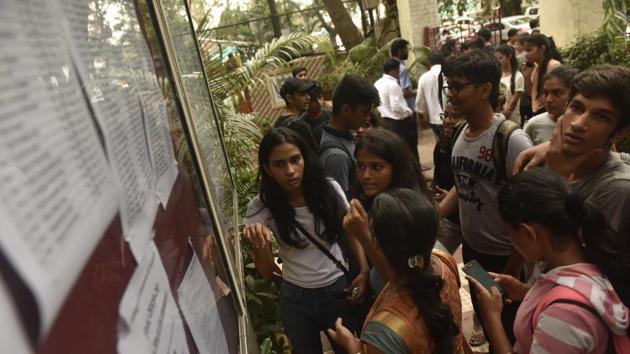
For a seat in the next ranked college, also limited to Classes 11 and 12, students needed 94.8% aggregate. The top five colleges were all relatively obscure junior colleges. The first prominent college in the list, VG Vaze College, ranked 15, with a requirement of 91.2% for a seat. The only other well-known college in the top 20 was Ramnivas Ruia College, where student required 91% to get a seat. This is two per cent down from 2018.
These junior colleges, which have a tie-up with coaching institutes, also prepare students for Joint Entrance Examination (JEE) or National Eligibility Entrance Test (NEET), along with HSC. These “integrated courses” are popular among students as it helps them prepare for entrance examinations and saves time spent in commuting from college to coaching classes. The trend started in 2010 when the first such institutes were featured in the centralised admission process for seats in junior colleges. The number of such institutes is now estimated to be in hundreds. Education activists call it a “money making racket”. Fees at these institutes are substantially higher than regular colleges.
After a backlash from colleges and a ban in 2017, the institutes no longer call themselves “integrated classes”. This year, the admission brochure for the top-ranked college said that it offers “synchronised learning” in which students are trained for the “boards as well as engineering entrance exams”. The owner of a chain of junior colleges, that train students for engineering entrance tests, including that for the Indian Institutes of Technology (IIT), apart from preparing them for the HSC, or Class 12 examination, explained their success to providing what students and their parents want – results. One of the junior colleges operated by the chain closed its merit list at 93.2%. These institutes are not constrained by rules on recruitment; they can hire and fire instructors at will. Also, competitive tests follow multiple-choice questions (MCQ) format, rather than theory, and conventional college teaching does not make allowance for this.
{{/usCountry}}After a backlash from colleges and a ban in 2017, the institutes no longer call themselves “integrated classes”. This year, the admission brochure for the top-ranked college said that it offers “synchronised learning” in which students are trained for the “boards as well as engineering entrance exams”. The owner of a chain of junior colleges, that train students for engineering entrance tests, including that for the Indian Institutes of Technology (IIT), apart from preparing them for the HSC, or Class 12 examination, explained their success to providing what students and their parents want – results. One of the junior colleges operated by the chain closed its merit list at 93.2%. These institutes are not constrained by rules on recruitment; they can hire and fire instructors at will. Also, competitive tests follow multiple-choice questions (MCQ) format, rather than theory, and conventional college teaching does not make allowance for this.
{{/usCountry}}The trend, which has been growing for the last few years, has intensified now. In 2018, of the three students from MMR who got a 100% score in their SSC exams, two have picked smaller junior colleges near home. One student secured a seat at Ramnivas Ruia College, not in its science section — which is considered to be one of the best in the city — but in the arts stream as she wanted to pursue advanced studies in humanities.
Where does this trend leave the established science colleges that are now struggling to get the top rankers into their rolls? Many academicians are of the opinion that these institutes, regardless of whether they call themselves “integrated” or “synchronised” teaching centres, are promoting an unhealthy education culture. A college principal who spoke to this newspaper said that these courses are not helping students, but are creating candidates equipped to answer MCQs for competitive examinations. The new institutes that are little more than teaching shops cannot provide the holistic education that the traditional colleges provide.
Stay updated with all the Breaking News and Latest News from Mumbai. Click here for comprehensive coverage of top Cities including Bengaluru, Delhi, Hyderabad, and more across India along with Stay informed on the latest happenings in World News.
Stay updated with all the Breaking News and Latest News from Mumbai. Click here for comprehensive coverage of top Cities including Bengaluru, Delhi, Hyderabad, and more across India along with Stay informed on the latest happenings in World News.