Why is there always a crowd at Jai Jalaram Bhelwala’s stall in Mulund west? Because his bhel stands a few degrees apart from the rest.
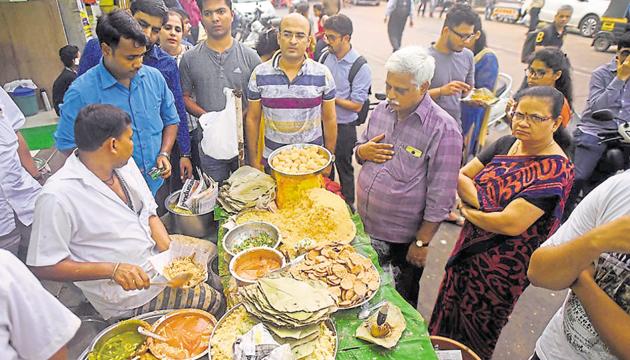
A few degrees below, actually. Jalaram’s bhel variations – you can order dahi, sev puri and the usual chaat options – are made with three chutneys that each contain one unusual ingredient: ice. Blocks of it sit in his chutney bowls, chilling them so they taste fiery and cooling at the same time. Chips of ice also make their way into the mix, making every morsel moist yet crispy.
With Jalaram’s snacks, you can tell the difference even before the first bite. The paper packet chills your hands, and those ice chops sometimes catch the light, making the bhel glitter. Vishal Dubey, who usually assembles the bhel, says they’ve been adding ice to their mix since the summer of the mid-2000s. They also offer pineapple and pomegranate as optional ingredients. “Once we started, many other stalls followed,” he says.
Ice bhel is going places. In malls in Borivali and Thane, kiosks have the spicy, tongue-numbing snack as one of their menu items. A few competitors up the street from Jalaram have been serving it too. Few places, however, are as busy.
WHO’S DRILLED BLACK RINGS ON THE SIDES OF FORT’S BUILDINGS?
To be fair, there’s enough to see on DN Road – beautiful buildings; arcaded shops; and hawkers selling shirts and ‘Rolox’ wristwatches. But if you’ve been jostling down the road recently, you may have also noticed black plastic discs affixed to the walls of some buildings. Each features four protrusions, and someone seems to have numbered them and marked a code on the wall.
{{/usCountry}}To be fair, there’s enough to see on DN Road – beautiful buildings; arcaded shops; and hawkers selling shirts and ‘Rolox’ wristwatches. But if you’ve been jostling down the road recently, you may have also noticed black plastic discs affixed to the walls of some buildings. Each features four protrusions, and someone seems to have numbered them and marked a code on the wall.
{{/usCountry}}They’re not surplus props from Star Wars. But they have much to do with the tunnelling happening along the street, to construct the Colaba- Bandra-Seepz Metro line.
“When we work close to a building, it’s important to ensure it is not at risk from our construction work,” says SK Gupta, director (Projects) at the Mumbai Metro Rail Corporation. “We have to monitor the structures for any possibility of movement or tilting.”
That’s where the discs come in. Engineers call them tilt plates and fix them on to the walls of buildings to be able to measure even the smallest changes in vertical-level inclination “even a hundredth of a millimetre,” says Gupta. The protrusions are designed to snap into the grooves of a tilt meter, which does the measuring and which will be used at a later date in the Metro’s construction process.
Around the world, tilt meters and plates have been used to monitor volcanoes, dam pressure, landslide-prone zones and (as with the Metro) when underground foundations are laid. Gupta’s team has other safety tech too – devices to measure the effects of wind, and fluctuations in water levels that might threaten the integrity of the buildings.
The black tilt plates are merely the visible tip of the iceberg.
Rachel.Lopez@htlive.com
Stay updated with all the Breaking News and Latest News from Mumbai. Click here for comprehensive coverage of top Cities including Bengaluru, Delhi, Hyderabad, and more across India along with Stay informed on the latest happenings in World News.
Stay updated with all the Breaking News and Latest News from Mumbai. Click here for comprehensive coverage of top Cities including Bengaluru, Delhi, Hyderabad, and more across India along with Stay informed on the latest happenings in World News.