The viral video of artist and activist Durga Gawde being assaulted on a street in Goa is deeply unsettling, but there is a brief moment when it offers some dark amusement. At one point, after Gawde has given it right back to her assaulter, the man is heard repeatedly saying, “She hit me!” (He might be saying “She hate me”. Either way, the sentiment is the same.) You can hear the shock in his voice. Clearly, he didn’t expect the slight figure, with a shaved head and wearing a dress, to retaliate. Not just that, the person in the dress took him down, tore his shirt and showered him with verbal abuse while reminding Franco how he had groped and assaulted her. That is clearly not the sort of behaviour Franco associates with femininity; just his luck to come up against a gender fluid person who is in no mood to be either victim or survivor. “I’m just a person who stood up for myself,” Gawde said in a video uploaded on social media.
As troubling as it is to know that someone like Franco was confident he was entitled to harass Gawde, the fact that Gawde is furious in the video offers us a narrative we don’t usually see. This is not a sad story, but an angry one – and that’s important because anger is an emotion women aren’t supposed to feel (never mind the minor detail that practically every mythology is filled with stories of furious goddesses wreaking havoc). Rage is a masculine affair in the present-day real world while fear is feminine.
In societies that have forgotten that there is more to the world than binaries, we need artists to remind us that these gendered stereotypes need breaking. On June 4, The Metropolitan Museum of Art in New York City opened a retrospective titled Phenomenal Nature, of sculptor Mrinalini Mukherjee’s works. Curated by Shanay Jhaveri, the show has 57 of Mukherjee’s sculptures. Aside from covering her 40-year career, the show is also a reminder of how art can push boundaries and change narratives.
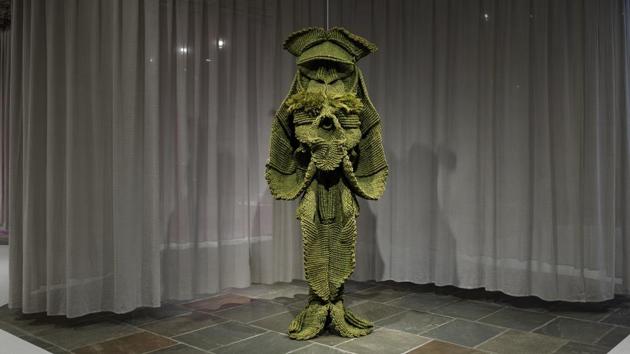
Take, for example, Mukherjee’s decision to use natural rope and fibres as the material for sculptures at the start of her career. Between the 1970s and 1990s, Mukherjee would make magnificent, towering sculptures by knotting natural rope, hemp and other fibres. Not for her the granite or metal that male-dominated Indian sculpture used, but natural fibres that are tough, resilient and flexible. Her sculptures did not stand on floors or lean against walls; they were suspended from ceilings. Drawing inspiration from classical forms of ancient art and architecture, Mukherjee sculpted figures that were simultaneously strong and sensual. See Black Devi – her spine is straight, the pleats are in place, a dark crown is on her head. Viewed from the corner of your eye, Black Devi is reminiscent of a granite idol in a traditional temple. Come closer, and the body is revealed to be an incredible network of knotted fibre. Look up to gaze upon her face, and all you can see is an eerie combination of knots, emptiness and negative space.
{{/usCountry}}Take, for example, Mukherjee’s decision to use natural rope and fibres as the material for sculptures at the start of her career. Between the 1970s and 1990s, Mukherjee would make magnificent, towering sculptures by knotting natural rope, hemp and other fibres. Not for her the granite or metal that male-dominated Indian sculpture used, but natural fibres that are tough, resilient and flexible. Her sculptures did not stand on floors or lean against walls; they were suspended from ceilings. Drawing inspiration from classical forms of ancient art and architecture, Mukherjee sculpted figures that were simultaneously strong and sensual. See Black Devi – her spine is straight, the pleats are in place, a dark crown is on her head. Viewed from the corner of your eye, Black Devi is reminiscent of a granite idol in a traditional temple. Come closer, and the body is revealed to be an incredible network of knotted fibre. Look up to gaze upon her face, and all you can see is an eerie combination of knots, emptiness and negative space.
{{/usCountry}}In her last years – Mukherjee passed away in 2015, weeks after making Palm Scapes IX, which is part of Phenomenal Nature – bronze was her chosen material. The metal known for its solidity and immutability becomes almost fluid and takes the form of mutant flora and fauna. It’s tempting to interpret this as Mukherjee taking the masculinity associated with bronze sculpture, and giving it a feminine (and feminist) twist.
Mukherjee’s works feel distinctive and modern, even today. In part, this has to do with the way her art continues to challenge conventional ideas of what is pretty, feminine, artistic, masculine; what comes within the scope of ‘natural’. Her works weren’t crafted out of anger, but in the fantasies they offer the viewer are reminders that there’s a lot in our world that needs to change.
Stay updated with all the Breaking News and Latest News from Mumbai. Click here for comprehensive coverage of top Cities including Bengaluru, Delhi, Hyderabad, and more across India along with Stay informed on the latest happenings in World News.
Stay updated with all the Breaking News and Latest News from Mumbai. Click here for comprehensive coverage of top Cities including Bengaluru, Delhi, Hyderabad, and more across India along with Stay informed on the latest happenings in World News.