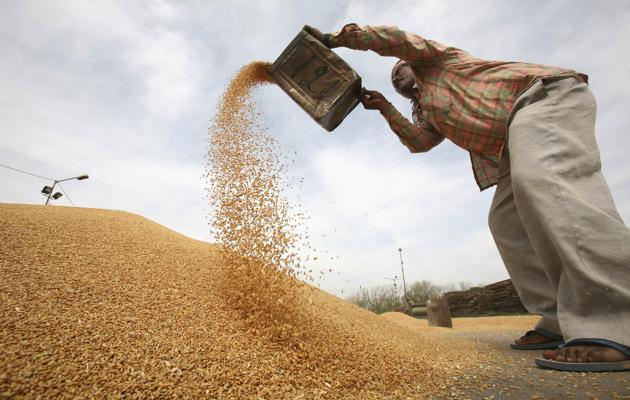
Surface ozone is destroying around 22 million tonnes (21%) of India’s wheat yield and 6.5 million tonnes (6%) rice crop every year, a multi-institute study led by the Indian Institute of Technology-Madras (IIT-M) has revealed, with Punjab and Haryana alone accounting for losses of 16% and 11% for wheat and rice respectively.
The economic loss caused by the plant-damaging pollutant to the country is estimated to be about USD 5 billion for wheat and USD 1.5 billion for rice.
Surface ozone is generated by chemical reactions between primary pollutants such as oxides of nitrogen and volatile organic compounds in the presence of sunlight.
The sources of these primary pollutants are power plants, vehicles, industries, and biomass burning.
“Like any other gas, surface ozone enters the plant leaves through its stomata as part of normal atmospheric gas exchange. Upon uptake it dissolves in the water present in the plant and further reacts with other chemicals affecting photosynthesis and thereby crop yields,” said Sachin Gunthe, principal investigator and associate professor, environmental and water resources engineering division, department of civil engineering at IIT-M.
Researchers said the findings of the study are important in view of the projected rise in manmade pollution, including surface ozone, with significant impact on the Indo-Gangetic Plain (IGP) which is an important agricultural region. A decrease in crop yield in India – also the second-most populous country – therefore will have a serious impact on its food security and economic growth.
{{/usCountry}}Researchers said the findings of the study are important in view of the projected rise in manmade pollution, including surface ozone, with significant impact on the Indo-Gangetic Plain (IGP) which is an important agricultural region. A decrease in crop yield in India – also the second-most populous country – therefore will have a serious impact on its food security and economic growth.
{{/usCountry}}A previous study estimated losses of 15% and 6% for wheat and rice yield, respectively based on measurements of surface ozone levels recorded mostly in urban, suburban and high altitude areas, thus not adequately accounting for ozone over rural agricultural areas which can be compensated by using chemistry transport meteorological models.
The new study attributed the increase in both crop yield and economic losses in the new study to the regional chemistry transport model WRF-Chem simulations, which factored in differing ozone chemistry in rural agricultural fields away from urban and semi-urban monitoring stations.
The study provides spatial distribution of yield losses, which could be of interest to scientific communities not limited to environmentalists, botanists and plant physiologists.
Wheat is a Rabi crop cultivated between November and April, while rice is grown during the Kharif season from June to October as well as Rabi season. Compared to wheat, crop loss for rice is less because surface ozone levels are lower as the main harvesting period is soon after the monsoon and also because rice is relatively less sensitive to ozone compared to wheat.
Although there is a permissible human exposure level for surface ozone set by the Central Pollution Control Board, there are no safe levels prescribed for plants.
For the study, the five-member team used WRF-Chem model to simulate mixing ratios for surface ozone every hour to derive accumulated ozone levels that exceed 40 parts per billion by volume (ppbv) – also referred to AOT40 – during the Kharif and Rabi seasons across various states.
Findings showed that a combination of higher crop production and coincident exposure to elevated surface ozone levels resulted in IGP region, comprising of states of Punjab, Haryana, Uttar Pradesh (UP), Bihar and West Bengal, to bear the maximum brunt of losses in wheat and rice yields. Among the leading wheat producing states, the highest crop loss of estimated 5.5 million tonnes (23%) is recorded in MP, followed by 5 million tonnes (21%) in UP every year. Both these states incur an economic loss of more than USD 1 billion each every year.
Of the major states – Punjab, UP, Bihar and West Bengal in the IGP region, and Orissa and Andhra Pradesh (AP) – that cultivate rice, Punjab incurs a maximum loss of around 1.5 million tonnes (11.5%) followed by 1 million tonnes (9%) in UP annually. These two states suffer an annual economic loss of around USD 0.3 billion each.
“There is an urgent need to conduct strategic ozone observations, especially over agricultural fields, and the development of annual regional-emission database to support policy making in India,” said Gufran Beig, co-author, Indian Institute of Tropical Meteorology, Pune. “There is also a need for aggressive cooperation between agricultural scientists and scientists involved in studies on air pollution to carry out research to develop ozone-resistant cultivars.”
Stay updated with all the Breaking News and Latest News from Mumbai. Click here for comprehensive coverage of top Cities including Bengaluru, Delhi, Hyderabad, and more across India along with Stay informed on the latest happenings in World News.
Stay updated with all the Breaking News and Latest News from Mumbai. Click here for comprehensive coverage of top Cities including Bengaluru, Delhi, Hyderabad, and more across India along with Stay informed on the latest happenings in World News.