Solar energy has helped a Ghatkopar-based housing society save ₹1.9 lakh annually on electricity expenses by covering 80% of the society’s electrical requirements.
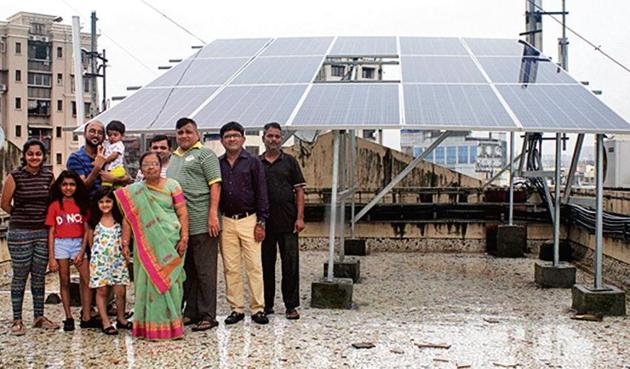
Arihant Darshan CHS in Ghatkopar (East), an eight-floor building, installed an 11.05 kilowatt peak (kWp) rooftop solar system to light up its common areas, staircases and an elevator.
After installing the solar system in the first week of May, the society’s monthly electricity bill fell from ₹17,917 prior to setting up, to ₹2,083 post the installation.
“Adopting rooftop solar technology is more than just about savings. The fact that it helps in reducing the carbon footprint is something that is truly motivating as a cause,” said Nemish Shah, chairman of the society.
The solar plant is spread across 1,500 sqft of the rooftop, uses 34 panels and generates 15,000 units (kilowatt hour kWh) annually. The society was consuming 18,000 units from the grid before the plant’s installation.
A net metering system installed by the society allows surplus power to be exported back to the grid while any deficiency is imported from the grid. At the end of the financial year, the society will be charged only for the ‘net usage’ by the power supplier. The entire system has a lifespan of 25 years.
According to the Ministry of New and Renewable Energy, an 11.05 kWp system can mitigate 338 tons of carbon dioxide emissions and is equivalent to planting 541 teak trees over its lifetime.
“It is not easy to convince people to adopt rooftop solar technology as the initial cost is high. It is generally misunderstood is that the solar system will be battery operated,” said Animesh Manek, founder and director, Avishakti Rooftop Solar Pvt Ltd, the company that installed the project.
Ramesh Patel, secretary of the society, said, “Avishakti explained how rooftop solar with net metering policy results in savings. As it is not a battery-based, it is not prone to the maintenance or replacement problems.”
{{/usCountry}}Ramesh Patel, secretary of the society, said, “Avishakti explained how rooftop solar with net metering policy results in savings. As it is not a battery-based, it is not prone to the maintenance or replacement problems.”
{{/usCountry}}Manek added that the entire cost of installation will be recovered over the next three to four years and thereafter the society will save on power consumption.
“Overall, solar power is free and a clean form of energy, resulting in zero environmental impact,” said Shah.
Stay updated with all the Breaking News and Latest News from Mumbai. Click here for comprehensive coverage of top Cities including Bengaluru, Delhi, Hyderabad, and more across India along with Stay informed on the latest happenings in World News.
Stay updated with all the Breaking News and Latest News from Mumbai. Click here for comprehensive coverage of top Cities including Bengaluru, Delhi, Hyderabad, and more across India along with Stay informed on the latest happenings in World News.