At a time when the state is dealing with severe water crisis, a professor from the Indian Institute of Technology Bombay (IIT-B) and his team of students have created a wetland at the institute’s Powai campus that processes approximately 30,000 litres of sewage per day and converts it in to re-usable water.
According to Mumbai’s municipal corporation, an average resident of Mumbai uses 135 litres of water every day. The research plant currently treats, without chemicals and electricity, wastewater generated by nearly 300 students living on the campus.
The project, called the Constructed Wetland (CW) plan, started functioning in November 2013 and is an idea from professor Shyam Asolekar from the Centre for Environmental Science & Engineering and his research team comprising of PhD and MTech students and research engineers, Dinesh Kumar, Rahul Sutar, Dheeraj Kumar, Ketan Kamble and Anurag Singh and advised by Yogen Parikh.
“A constructed wetland bed is a natural treatment system that does not need energy or chemicals to clean wastewater. It traps the foul odour below the wetland bed and treats sewage through a continuous biotechnological process once the wastewater is released into the wetland bed,” said Asolekar.
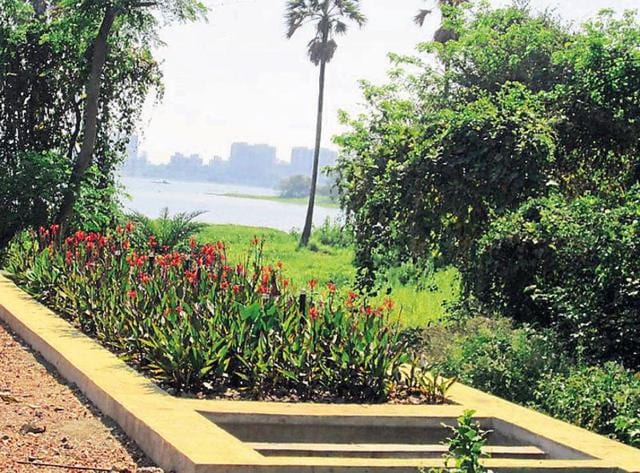
The artificial wetland bed, having dimensions of 13 m length, 3 m width and 0.6 m depth, approximately equal to an area of 450 square feet - about the size of a a one-bedroom-hall-kitchen flat - is covered by almost 1000 plants of one wetland species, Canna indica, Sewage water is released into the beds through a pipeline, diverted from the main sewer lines to the pilot plant for research purposes.
{{/usCountry}}The artificial wetland bed, having dimensions of 13 m length, 3 m width and 0.6 m depth, approximately equal to an area of 450 square feet - about the size of a a one-bedroom-hall-kitchen flat - is covered by almost 1000 plants of one wetland species, Canna indica, Sewage water is released into the beds through a pipeline, diverted from the main sewer lines to the pilot plant for research purposes.
{{/usCountry}}“The roots of the living plants in the wetland provides a peculiar habitat for beneficial microorganisms in the root-zone (which also pump oxygen from the atmosphere into the bed) and jointly purify the sewage while the plants are automatically nurtured by utilising carbon, nitrogen and phosphorous from sewage,” said Asolekar.
The treated water can be used for a variety of reusable purposes including drinking water for animals, irrigation in farms and gardens, and water for flushing and washing.
Co-funded by the European Commission and IIT-B, the project cost for developing this technology as well as building this pilot plant was close to Rs 4 crore. After the successful demonstration of the CW technology on IIT-B campus, three similar CWs have already been commissioned at three separate locations across Maharashtra (see box).
BOX
EXPERTS SPEAK
“A project like this goes to show that indigenous research and development is happening in India for water conservation and it is a timely discovery considering the acute water shortage in the state. However, constraints such as land acquisition for urban cities like Mumbai and a financial problem for rural cities need to be worked out. But if we consider the larger benefits, these problems can be resolved easily,” said Dhaval Desai, senior research fellow, Observer Research Foundation (ORF).
Stay updated with all the Breaking News and Latest News from Mumbai. Click here for comprehensive coverage of top Cities including Bengaluru, Delhi, Hyderabad, and more across India along with Stay informed on the latest happenings in World News.
Stay updated with all the Breaking News and Latest News from Mumbai. Click here for comprehensive coverage of top Cities including Bengaluru, Delhi, Hyderabad, and more across India along with Stay informed on the latest happenings in World News.