This August, the first children of free India turn 79; lakhs more are older than India’s independence itself. Lakshmi, born in the monsoon of 1947, has lived the entire arc of independent India, from ration cards to UPI. She now inhabits a country transformed in every respect but one: Its laws still assume that a joint family will catch her when she falls. That household, in much of India, no longer exists in the form the law imagines.
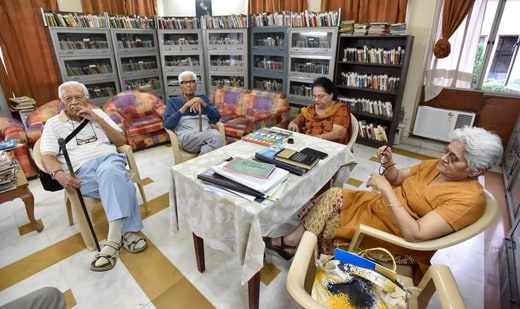
The Sample Registration System’s latest report puts India’s total fertility rate at 1.9, i.e., below replacement levels. India has roughly 150 million people over 60 years of age; by 2050, that number will touch 347 million. And the transition is geographically uneven. The states that led India’s fertility decline are ageing first: in Kerala and Tamil Nadu, the 18–29 cohort is barely 17% of the population; in Karnataka, just over 19%. The question is who now stands in the middle.
As economist Amarendu Nandy recently wrote, India’s welfare State has long been hidden inside the household — the joint family, co-resident children, and unpaid female care quietly caring for the elderly. That arrangement is dissolving under urbanisation, migration, and women’s rightful entry into paid work. Its costs have not disappeared; they are just being borne by the next generation. Lakshmi’s daughter, at 48, manages a career, a teenager’s board examinations, and her mother’s medication chart. The “sandwich generation” is trying to balance it all — and within it, long-term care falls disproportionately on “her”. Every gap in the eldercare ecosystem that the State fails to close, is plugged — mostly unacknowledged — by the time and earnings of India’s working-age women.
ALSO READ | HT Insight: India's ageing population needs a new health care blueprint
{{/usCountry}}ALSO READ | HT Insight: India's ageing population needs a new health care blueprint
{{/usCountry}}What does the State provide? More than we realise, and much less than what is needed. There is now health insurance for every citizen over 70, a national helpline, tax concessions, and an old-age pension whose central contribution — ₹200 a month, for the poorest elderly between 60 and 79 — has not been revised since 2007. States top it up, unevenly, which means an elderly widow’s monthly income depends on her PIN code.
The problem is not that schemes do not exist. It is that they are schemes: fixed at discretion, revised at will, fragmented across ministries, received as benevolence, and enforceable by no one.
And money is the narrowest of the gaps. There is no regulated caregiving profession: Anyone may call themselves a caregiver, with no qualification, standard, or register to answer to, and no binding quality framework governs the care homes or agencies to which more families must now turn. India has fewer than 500 practising geriatricians for its 150 million elders. The Indian Academy of Geriatrics’ own benchmark of one specialist per 6,000 older adults implies a need of over 27,000. Our public spaces are built for the young. And the newest predator is digital, with the elderly being the primary targets for fraudsters. Each of these gaps is absorbed, privately and invisibly, by families.
ALSO READ | How does modern health insurance support holistic wellness for senior citizens in India?
The courts have begun to say what the legislature has not. In July, the High Court of Karnataka, hearing the case of a 74-year-old woman suffering from gangrene and abandoned by her family, observed that the State should examine a comprehensive legislative framework for “senior citizens in need of care and protection”, modelled on the Juvenile Justice Act, 2015. The court is saying the elderly need an Act that addresses the need for rescue, shelter, health care and protection — and that the only existing law for the elderly does not provide it. The Maintenance and Welfare of Parents and Senior Citizens Act, 2007, is a maintenance-enforcement statute: It treats old age as a family dispute to be adjudicated, not as a stage of life to be lived with dignity. The Madhya Pradesh High Court recently took suo motu notice of a video showing elderly women assaulted at an unregistered Indore shelter home. No central law mandates the registration of such homes, and none recognises institutional elder abuse as a distinct offence.
ALSO READ | HT Opinion: Why India needs to integrate palliative care into its ageing future
The Supreme Court has read dignity into the heart of Article 21 — and dignity does not expire at 60. Article 41 of the Constitution directs the State to make effective provision for public assistance in old age. Parliament knows how to honour such a directive: it made a child’s education an enforceable right in 2009, and food a legal entitlement in 2013. Ageing with dignity is the promise that is still waiting its turn. The scaffolding exists. What is missing is the political and legislative will to say that dignity in old age cannot be a favour the State extends, or a scheme it announces, but a right that the citizen holds.
What would such a right contain? The Karnataka court’s order outlines the floor: rescue, protection, shelter, health care and community-based care — owed as entitlements, not extended as schemes — and a forum where an older citizen can claim it. A right for the mother is time returned to the daughter.
The generation that built the institutions the rest of us inherited is ageing differently from every generation before it — living longer, more urban, more alone. It has asked for little, and its silence has been mistaken for an absence of need. What it needs now is a framework that secures agency and independence, not one that adjudicates dependence. A scheme can be withdrawn; a right must be enforced.
It is often said that India will grow old before it grows rich. The real question is whether it can afford to grow old before it builds the guardrails for dignified ageing.
Barkha Deva works on policy on ageing and social legislation. The views expressed are personal.