India’s Independence Day is, unquestionably, the Prime Minister (PM)’s day. From the very first time — in 1947, when India’s first PM Jawaharlal Nehru unfurled the country’s new national flag from the ramparts of Delhi’s Red Fort — the date has been the PM’s day.
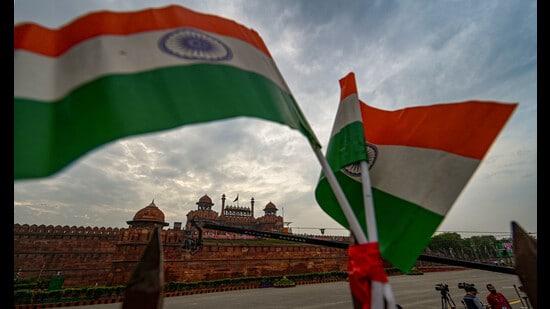
And so it should be. August 15 has also become, by the sheer association of time with space, Red Fort’s day, with the PM, the flag and the fort fluxing into one moment of glory.
And just as Bastille Day, commemorating the Fête de la Fédération right from July 14, 1790, brings the Bastille to France’s life, on India’s Independence Day, Red Fort speaks to us about our past, present, and future.
Inaugurated by the Mughal emperor Shah Jahan (1592-1666) in 1639, it carries on the walls of its Diwan-i-Khas (Hall of Special Audience) a Persian phrase: “Gar firdaus bar rû-e-zamīn ast, hamin asto, hamin asto, hamin ast” (If there be a paradise on Earth, it is here, it is here, it is here). I take the phrase to be about India itself. It is said to have been first used by the Mughal Emperor Jahangir (1569-1627) when he beheld the valley of Kashmir.
The Fort’s full story is not heavenly. Things have happened in Red Fort that could very well turn the phrase on its head: “If there be hell on Earth, it is here, It is here, it is here.”
{{/usCountry}}The Fort’s full story is not heavenly. Things have happened in Red Fort that could very well turn the phrase on its head: “If there be hell on Earth, it is here, It is here, it is here.”
{{/usCountry}}It was from the Red Fort that Mughal emperor Aurangzeb (1618-1701) had his elder brother- the startlingly eclectic and, in today’s idiom, secular, Prince Dara Shukoh (1615-1659) — chained, placed on a deliberately dirtied elephant’s back and paraded through Chandni Chowk before being beheaded. And again, it was from the Red Fort that, under orders of Aurangzeb, the free-thinking saint Sarmad (c.1590-1661) and the Sikh guru, Tegh Bahadur (1621-1675), were ordered to be beheaded — the first at the Jama Masjid opposite the Fort and the second in Chandni Chowk right ahead of it. Red Fort has witnessed the fabric of India’s social cohesion being torn, shredded. Like India itself has, repeatedly, only to see it becoming whole again.
About one-and-a-half centuries after Aurangzeb, in 1857, when Bahadur Shah Zafar (1775-1862), the last Mughal ruler to live in Red Fort, became the fulcrum in the war being waged against the East India Company by revolting sepoys, Hindu and Muslim, the Fort became a magnetic field (albeit briefly) of Indian resistance to British rule. Another revolt within the ranks of the British Indian army was to reverberate within Red Fort’s walls almost 90 years later. Over 1945 and 1946, three sons of Sikh, Hindu and Muslim India, colonel Gurbaksh Singh Dhillon, colonel Prem Kumar Sehgal, and major general Shah Nawaz Khan — were tried in Red Fort for what the British Raj described as “waging war against the King Emperor”. They were of the Indian National Army led by Netaji Subhas Chandra Bose and bravehearts. A slogan wafted from Red Fort at that time, “Lal Qila se aayi awaaz /Dhillon, Sehgal, Shah Nawaz” (Comes the the call from the Red Fort — Dhillon, Sehgal, Shah Nawaz). The men were defended by a galaxy of formidable lawyers put together by the Indian National Congress, comprising Bhulabhai Desai, Jawaharlal Nehru, Tej Bahadur Sapru, Kailasnath Katju and Asaf Ali. Sentenced to deportation, all three were released shortly thereafter, in free India.
The bitter and bloodied sectarian strife that engulfed North India in the months before and during Partition found an echo in Red Fort when, in 1948, a set of men committed to the cause of a Hindu rashtra and accused in the assassination of Mahatma Gandhi were tried in a special court that assembled in the Fort. That cause has an opposite number, and on December 22, 2000, divisive poison, this time from the opposite end, coursed into Red Fort. Two Lashkar-i-Taiba militants gained access to the Fort that day and killed two soldiers and one civilian in indiscriminate firing. The terrorists were intent on keeping India divided and India’s two principal communities torn asunder. And so Red Fort is now more than a monument with historical charge. It is a vehicle of moral force, telling India that it must choose, unfailingly and unflinchingly, between social collapse and social cohesion, between the poison of hate and the nutriment of harmony.
As our PM tells India today, as only he can, that disruptors of India’s unity and enemies of India’s peace and progress will be taught a lesson, we will all hail that resolve of his. But will we see the folly of letting hate rule the minds of the many and fear pervade the hearts of the economically weak, the ethnically vulnerable, and the socially unsheltered? Will, on August 15, 2047, the PM of the day, unfurling the tiranga for the 100th time over Red Fort, be able to say “Heaven, my fellow Indians, is here, it is here, it is here, for we do not hate, we do not fear, and we are at peace with each other”?
It is political pietism to think the PM in 2047 will be able to say that. But it is a civilisational imperative to hope that in India@100, the Red Fort will still beam the aawaaz: “Dhillon, Sehgal, Shah Nawaz”, and not just in Hindi but in all the languages of India — North, South, East and West — in an equal freedom.
Gopalkrishna Gandhi is a student of modern Indian history and the author of The Undying Light: A Personal History of Independent India. The views expressed are personal.