In the third high-level Indian visit to China in recent weeks, external affairs minister S Jaishankar called for the “continued normalisation of ties” between the two countries. Jaishankar once again reiterated that the bilateral approach should be based on “mutual respect, mutual sensitivity, and mutual interests.” A strategic vision between India and China that takes into consideration these mutuals is the need of the hour on energy and climate issues.
Today, China has emerged as the dominant supplier of green technologies and critical minerals while also vying for leadership in global climate governance. China’s role in the global green economy, combined with the backsliding of Western economies towards their climate commitments, has geopolitical implications for India’s green energy ambitions. At the Leaders’ Summit on Climate and Just Transitions held by the United Nations and the Brazil COP Presidency in April 2025, President Xi Jinping made a strong pitch for China to remain committed to global climate goals. First, Xi criticised some “major countries” for their unilateralism and protectionism, iterating China’s support for international climate cooperation through multilateral governance platforms like the United Nations Framework for Climate Change. Second, in what was essentially a reference to the trade and tariff restrictions on Chinese-manufactured EVs and solar modules, Xi called for free circulation of high-quality green products and promotion of technological innovation and industrial transformation through cooperation. Third, Xi has labelled China as a “doer”, taking strong action for tangible results.
However, China’s narrative doesn’t wholly reflect today’s reality, climate action for the country is not only about protecting the global commons but also impacts economic growth, trade, investments, and national security. In fact, UN Secretary-General António Guterres also calls the transition to renewable energy the “economic opportunity of the century.” China presently dominates key green technologies: Over 75% of global lithium-ion battery manufacturing, almost 80% of solar module production, and a majority share of the world’s electric vehicle output. Further, China’s rising global leadership in providing climate adaptation and mitigation strategies in the Global South is aimed at expanding its influence.
{{/usCountry}}However, China’s narrative doesn’t wholly reflect today’s reality, climate action for the country is not only about protecting the global commons but also impacts economic growth, trade, investments, and national security. In fact, UN Secretary-General António Guterres also calls the transition to renewable energy the “economic opportunity of the century.” China presently dominates key green technologies: Over 75% of global lithium-ion battery manufacturing, almost 80% of solar module production, and a majority share of the world’s electric vehicle output. Further, China’s rising global leadership in providing climate adaptation and mitigation strategies in the Global South is aimed at expanding its influence.
{{/usCountry}}If China truly seeks to become a climate leader, championing energy transitions in the Global South, it will need to constructively engage with India. India is the world’s most populous country, with a strong economic growth and ambitious renewable energy policies. India aims to double its renewable energy capacity and quadruple electric vehicle penetration by 2030. Even as India attempts to become more self-sufficient in manufacturing green technologies and building resilient supply chains for raw materials, in the short-term, the country will still be reliant on China.
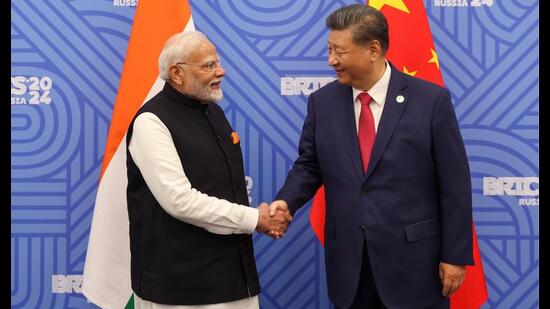
As Prime Minister Narendra Modi said at the BRICS summit earlier this month, it is beneficial for countries to jointly work together on minerals supply chains, rather than weaponising them. The restriction of rare earth minerals has caused the Indian government and auto manufacturers to rethink the country’s EV strategy, potentially impacting the phase-out of conventional fossil fuel cars. If China’s policies are resulting in the deceleration of energy transition in India, this punctures China’s narratives of promoting the “free flow of green technologies” and “industrial transformation through cooperation”. Rather, it encourages countries to accelerate their protectionist policies, diversify supply chains, and look towards alternative cooperative partners.
In fact, a decade ago, our mapping of India-China bilateral climate engagement shows that between 2005 and 2015, there was a flurry of plans, agreements, and joint statements. These plans were diverse, covering a broad range of climate mitigation and adaptation issues. Environmental conservation, sustainable urbanisation, and water governance were the most discussed topics. Traditional energy issues, such as coal and energy security, and newer issues, such as energy efficiency and renewable energy, were also key points of discussion. The interactions involved active participation from government officials, the scientific community, as well as the private sector. Site visits, trainings, capacity building, standards, and regulation setting complemented knowledge exchanges on governance and data sharing. Yet, despite such a wide agenda and density of engagements, there was limited project implementation.
Today, engagement between the two countries may benefit from pragmatism, strategically identifying key areas of engagement such as technology and knowledge exchange, and climate resilience of shared resources. Initially, low-risk, small-scale engagements that encourage trust-building and understanding of modalities of operation can then lead to larger-scale engagement. If direct bilateral engagement proves difficult, the two countries can explore coordination through multilateral development organisations, smaller groupings, or in triangular agreements with a third country.
At the same time, India needs to carve out its own credibility as an economic and developmental partner. This doesn’t mean merely playing ‘catch-up’ with China or positioning itself as an alternative, but relying on its own strengths. For instance, in the critical minerals sector, India can build partnerships at the processing stage of the supply chain. On technology and knowledge exchange in the Global South, India must continue to focus on developing low-cost, effective solutions for climate adaptation and mitigation, such as climate resilient agriculture, artificial intelligence for disaster risk management, and renewable energy applications for health, education, and rural livelihoods.
It is important for both countries to have clear strategies on the role that they can play, cooperatively and competitively, in the global green economy.
Pooja Ramamurthi is an expert on climate change and energy transitions. Shruti Jargad works on Chinese domestic governance and China-South Asia relations. The views expressed are personal.