
 E-Paper



Elections with Dalits as the rallying point
The prominence that reservation and Constitution have acquired in elections due to the years of Ambedkarite assertions will, hopefully, augur well for Dalits

 Prefer HTon Google


The 2024 polls have centred on reservations and the rhetorical replacement of the Constitution. The Bharatiya Janata Party (BJP) and the Congress have clashed over the issues of constitutionality and representation in rallies, press conferences and meetings. The INDIA bloc is on a warpath with the BJP on the question of a constitutional safety net for the historically marginalised.
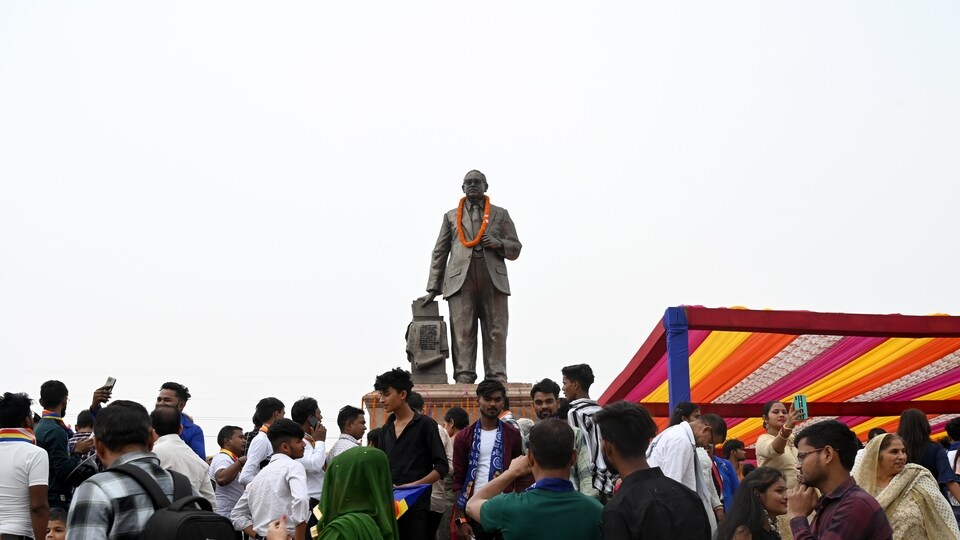
This is unique. Dalits have rarely been a rallying point of mainstream electoral discussion through the anti-caste lens and constitutional framework of representation as is happening now. They are often taken for granted as a community under either the broader Hindu religious category or within the Bahujan identity. Dalits are a strong aspirational community that holds constitutional promises very dearly for two reasons. First, the Constitution was drafted by BR Ambedkar as an egalitarian social document. Second, the Constitution protects and safeguards the interests of Dalits. So, they are deploying constitutional provisions to interrogate the unfinished tasks of political parties of the Left, Right and centrist streams.
The consternation on the issue of guaranteeing reservations has some serious connotations. For Dalits, it’s very important to note the identity of the person assuring them of constitutional promises. Invariably, most political parties have no strong assertive Dalit face to assure them, and therefore, political slugfests transform into mere rhetoric.
One of the important Dalit faces in independent India was Babu Jagjivan Ram for the Congress from 1937 to 1977. It took another 40 years for Mallikarjun Kharge to lead the party. The BJP credits itself with nominating Ram Nath Kovind as President. But it currently has no pan-Indian Dalit face.
The Telugu Desam Party has not nurtured anyone after GMC Balayogi, who was elevated as speaker of the Lok Sabha. Communist parties and prominent regional parties such as the Trinamool Congress (TMC), YSR Congress Party, Aam Aadmi Party, Dravida Munnetra Kazhagam, All India Anna Dravida Munnetra Kazhagam, Biju Janata Dal or the Janata Dal factions, also don’t have prominent Dalit figures leading them. Parties of the backward classes such as the Samajwadi Party and Rashtriya Janata Dal have never nurtured Dalits in leadership. As a result, when these parties talk about issues such as reservations, they lack credibility. The most glaring example of this is in West Bengal, dominated first by the Congress and Communists and now, by the TMC and BJP.
The politics of the state is overtly casteless but is organised around the socially dominant upper castes. The Communists, in their three decades of rule, never nurtured a major Dalit face. This is despite the presence of numerically large Dalit communities such as Rajbanshis, Namashudras, Poundras, Bagdi and Bauris. The TMC, too, merely fields Dalits from reserved constituencies as symbolic tokenism but doesn’t have a prominent pan-state leader from the community. The BJP’s rise in the political landscape of Bengal is also marked by Brahmin and upper caste faces while addressing Dalits only as a broader Hindu vote bank.
On the other hand, independent Dalit political parties such as BR Ambedkar’s Republican Party of India, Kanshi Ram’s Bahujan Samaj Party, Ram Vilas Paswan’s Lok Janshakti Party and Viduthalai Chiruthaigal Katchi (VCK) exist in some tension with the mainstream. With the exception of the BSP, and to an extent the LJP, their foray into the political mainstream has been halting. But their political assertion has constantly been in support of constitutional remedies such as reservation, strengthening protection from caste-based atrocities and opposing tampering of the Constitution.
The lack of prominent Dalit leadership in mainstream political parties shows that Ambedkar’s warnings about the dangers of democracy remaining a top dressing are relevant. The spaces of national and state politics remain hostile and indifferent toward creating a Dalit leadership. Powerful party organisational ranks and cabinet portfolios in governments have historically been assigned to upper-caste political leaders, and Dalit representation has remained tokenism. This is not only true of the central cabinet formations — where the social justice ministry is typically the home of the Dalit minister — but also of many state governments, irrespective of the party in power.
In 2024, the prominence that reservation and Constitution have acquired in the elections due to the years of Ambedkarite assertions will, hopefully, augur well not only for Dalits and organic Dalit leadership in mainstream political parties but also for the completion of the egalitarian project the country began when it adopted the Constitution.
Subhajit Naskar is assistant professor at the department of international relations, Jadavpur University. The views expressed are personal


