The right to vote is one of the fundamental pillars of an electoral democracy such as India’s. However, to truly represents popular will, the right to vote cannot simply be understood as being about the physical act of casting a vote.
The right to vote requires the creation and nurturing of an infrastructure designed to guarantee that citizens can freely vote for the candidates or parties that they feel will best represent their interests in the legislatures: That is the pre-requisite of a ”free and fair” election.
The “freedom” to vote extends to all stages of the election process. To begin with, it means that all citizens who so choose should be on the electoral rolls, and entitled to cast their vote. While this seemed long assured, the recent special intensive revision (SIR) process, with regards to the electoral rolls across the country, and the widespread disenfranchisement that it has caused, has given cause to question this basic assumption.
Then there is the familiar requirement that the election itself be conducted in an atmosphere free of intimidation, coercion — and, some might argue, free of all forms of bribery and blandishment of voters as well. Here again, India’s past and present have been chequered, to say the least.
Also Read | The machine that hides how your booth voted: Why India’s EVM ‘totaliser’ has been stuck for 18 years
{{/usCountry}}Also Read | The machine that hides how your booth voted: Why India’s EVM ‘totaliser’ has been stuck for 18 years
{{/usCountry}}However, although less discussed than the other two, an equally important freedom is the freedom from the consequences of having cast one’s vote in a particular way. Put simply, if I vote for a losing candidate in an election, the victor should not be able to use their newly-won — or retained — political power to make me suffer for my choice. This principle assumes specific relevance in India, where the line between executive, administrative, and legislative functions has grown increasingly blurred.
Indeed, the Indian legislator — or representative — is far closer to an administrator than they are to a lawmaker. Through mechanisms such as the PMLADS fund and other equivalents, MPs or MLAs assume responsibility for developmental works, and other such administrative functions. All this ensures that the relationship between legislators and their constituents is closer, in substance, to a patron-client equation rather than a representative-constituent one.
What this means, in turn, is that legislators do have the power to visit consequences upon constituents — or groups of constituents — whom they do not like or have a vendetta against. A road might not get built. A neighbourhood might not get electrified. And so on. The slow-moving pace of our courts and the general immunity granted to legislators also means that there is very little remedy that a citizen has against such reprisals.
Furthermore, this is not just an academic concern. On more than one occasion, political candidates have publicly threatened voters that once they win, they will see to it that those who did not vote for them suffer material consequences; there is even some evidence of uneven development in certain constituencies with known voting patterns.
Also Read | SC rejects pleas for 100% EVM-VVPAT cross-verification, ballot paper voting
The democratic problem with this is obvious: If a voter fears reprisals after elections, then, instead of voting for the candidate whom they think will best represent their interests, they will begin to calculate which candidate is more likely to win, and throw in their lot with that candidate.
It is folk wisdom that in many Indian elections, voters perceive which way the wind is blowing (hawa ka rukh), and cast their vote accordingly. While this may simply be singular voter behaviour at one level, fear of reprisals as a motivating factor cannot be ruled out.
It is for this reason that one critical part of “free and fair elections” has been the secret ballot. How, one may ask, can a political candidate or party find out who voted for them given that the ballot is secret? It isn’t quite so hard: Since votes are polled and counted by booths, techniques of modern data analysis can quickly reveal voting patterns, at least at an aggregate level.
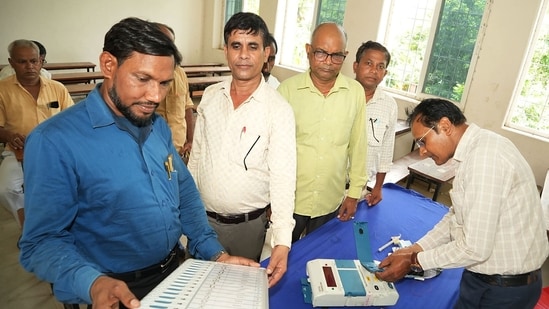
It is here that the use of the totaliser machine becomes extremely crucial for democracy: A totaliser machine will cumulatively count the results from multiple booths, rather than individual booths. It is akin to scrambling physical votes before counting them — which actually used to happen before the EVM era, precisely to avoid identification of voting patterns.
For the last 12 years, public interest litigation asking for mandatory use of totaliser machines has been pending before the Supreme Court.
The arguments above should make it clear that if the secret ballot in the age of EVMs is to mean anything — and thus, if free and fair elections are to mean anything — this is a necessary step. It is also clear that political parties lack the will to bring it about, and so the remedy must be judicial. The sooner the better.
Gautam Bhatia, a Delhi-based advocate, is the author of Offend, Shock or Disturb: Free Speech Under the Indian Constitution. The views expressed are personal