Smarter attire, youngish lingo and contemporary music—from rap to rock—is unlikely to impress Gen Z, which is gearing up to play a significant role in the upcoming 2027 Uttar Pradesh assembly polls and the 2029 Lok Sabha elections, dubbed decisive in turning the political landscape of the state and the country.
Can the youth, many of whom would be first-time voters, actually become agents of social and political change?
Until the 2014 Lok Sabha elections, youth (18-25) participation in electoral
Smarter attire, youngish lingo and contemporary music—from rap to rock—is unlikely to impress Gen Z, which is gearing up to play a significant role in the upcoming 2027 Uttar Pradesh assembly polls and the 2029 Lok Sabha elections, dubbed decisive in turning the political landscape of the state and the country.
Can the youth, many of whom would be first-time voters, actually become agents of social and political change?
Until the 2014 Lok Sabha elections, youth (18-25) participation in electoral politics was low. To enrol and activate first-time voters, the Election Commission of India (ECI) launched a countrywide campaign in 2012 to boost their turnout till 2024. Along with that, the BJP also launched a positive and progressive campaign under Narendra Modi's leadership that raised the aspirations of the youth and drove them to the polling booths.
Their participation increased in the 2014 Lok Sabha elections and further jumped by 41% in 2019 but declined by 2% in 2024. Similarly, their participation in UP elections also showed a decline. After maiden victories in West Bengal and Bihar, the BJP faced youth anger at Jantar Mantar as well as in several states. Obviously, it's worrisome for the ruling BJP as India is a young country with two-thirds of its population below 35 years. This raises the Opposition's hopes.
The leadership of major political parties, however, appears confused. In the past, they made promises aligned with the aspirations of the young -- jobs, education, laptops, skills and scooters. The same manifestos won't work, nor will gimmicks like bringing young leaders to the forefront while seniors retain control. They need to find concrete time-bound solutions to plug the loopholes in the education system and check unemployment.
The driving factor in the 2014 and 2019 elections was Modi’s leadership coupled with a weak Opposition.
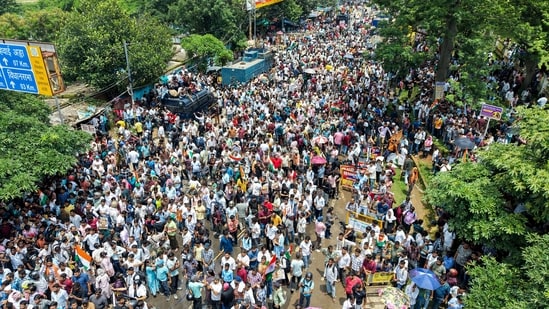
Now, the young are restless. Rattled by their show of strength at Jantar Mantar followed by protests in several states, almost all political parties are trying to appease them. BJP-RSS leaders, including Prime Minister Narendra Modi and Sangh chief Mohan Bhagwat, have intensified their dialogue with the youth.
The Congress has launched ‘Chhatron ki Goonj’ in a rock show style while the third largest party in the Lok Sabha, the Samajwadi Party, has issued QR codes to invite suggestions from the youth.
Obviously, this time, their manifestos will not merely be a piece of paper. Instead, it will speak louder than their public speeches as every promise will be assessed and the ruling parties' performance judged. It's not going to be an easy task. Women were convinced by handouts. Here, the young would demand more than an unemployment allowance.
Their demands will vary between rural and urban areas, and between the south and north as the youth are not a cohesive unit under any single leader.
The Modi-Yogi combine may yet retain a section of youth, influenced by their Hindutva politics, despite anti-incumbency against the 10-year-old regime. But the constant blame game may not appeal to them as many Gen Z members were born during the BJP rule. They have witnessed the BJP's rule, not that of the Gandhis, either at the Centre or in some states like UP, Bihar, Tamil Nadu, West Bengal.
Former Prime Minister Rajiv Gandhi was the last from the family to rule the country from 1984 to 1989, much before 1997, when Gen Z members were born. They were witness to the Congress rule at the Centre from 2004 to 2014 but they hold little against Manmohan Singh. History has been kind to him. In Uttar Pradesh, the last Congress government was also in the late 1980s.
Gen Z is interested in the present and the future. The past is best buried for them as frequent changes in history have compounded their confusion. This is also a generation that wants to be heard, not preached at. They like their independence and don’t want to be controlled in what they eat or wear.
Furthermore, they are not vulnerable because they have access to data and information. And they are quick in debunking propaganda and sharing facts on social media.
While all political parties are realising the significant role the Gen Z will play in both the elections, the stakes are highest for the BJP, as Chief Minister Yogi Adityanath will be seeking a third consecutive term in in UP in 2027 and Narendra Modi a fourth in 2029.
Gen Z right now are rudderless unlike the JP movement of 1974 and Mandal Commission protests of 1990 when the youth movement had driven a huge political shift. The Congress lost power and the socialists gained ground. The Mandal Commission report delayed the arrival of the BJP on the scene as it initially pictured the temple movement.
A survey by ADR found better employment opportunities and healthcare the two top priorities for voters before the 2019 polls. In 2018, 47% of voters across all genders, social statuses, age and rural-urban areas described better employment opportunities as their top priority, compared to 30% in 2017.
In 2026, 53% of voters of all age groups categorise employment, education and healthcare as their topmost priority. It’s clear the unemployment rate is increasing. Distributing appointment letters on the eve of elections, even for jobs candidates secured by clearing exams, is insignificant compared to the huge population of educated job-seekers.
I asked a young student, who is finishing school and preparing for medical examinations, to summarise his aspirations. He listed five demands which many of his peers supported: education reforms with stricter laws pertaining to paper leaks, reducing rote learning in competitive exams, reducing the immense pressure on students because of NEET and JEE, participation of youth in policy making and establishing a structured process, transparency in governance and accountability, creation of jobs for post graduate students and mental health support, including easier and affordable access to counselling services.
The set of demands from the young in rural areas will be different: skill training for blue-collared jobs, easy loans for tiny shops and affordable education.
Majority of the areas demand better and affordable education in schools and a degree college for girls as distance discourages their higher education. This time, the students want a detailed plan along with accountability for promises in the manifestos. Mere announcements on the eve of polls may not help. Also, their issues will drive their decisions more than the political personalities.
One Subscription.
Get 360° coverage—from daily headlines
to 100 year archives.
Archives
HT App & Website