Lord Palmerston, the British foreign secretary, told the House of Commons in 1848 that Britain had no eternal allies and no perpetual enemies, and that only its interests were eternal and perpetual. The line has survived because it is as close to realpolitik as anything can be. But the interests argument is easier made than related policy framed – what makes for national “interest” is not easy to answer, more so when it keeps changing. As a result, States and strategic thinkers are poor at identifying national interests, especially during times of geopolitical shifts. So, they go by past experiences, received wisdom and past friendships, enmity and neutrality. Our reflexive scepticism towards the shifting dynamics in West Asia — from the so-called Mecca Pact to Ankara’s regional manoeuvring — indicates that certain entrenched habits are still overriding fresh strategic assessments of the region.
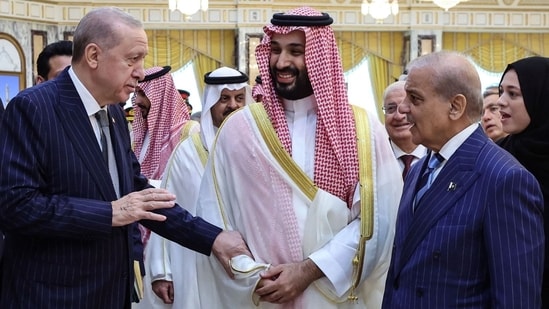
Consider how we view two of the three parties to the pact. Turkey has been designated as an adversary. After all, Ankara backed Pakistan throughout Operation Sindoor, and it has been vocally uncharitable about India in the past – and that is Turkey’s fault, not ours. So while our reasons to view Turkey in the “adversary’s camp” are genuine, doing so may not be in our interest.
Also Read | Mecca pact: Regional fix to hedge against a fickle US
We may have also put the other signatory to the pact, Saudi Arabia, in the enemy camp due to two reasons. Reason one is Pakistan: Riyadh’s relationship with Islamabad is old, solid and predates India’s partnerships in the region. The other reason is the UAE, around whom we have built our Gulf policy in recent years. With Abu Dhabi, Delhi has a trade agreement, growing investments, I2U2, and so on. Today, our friendship with Abu Dhabi and enmity with Islamabad have started colouring our relationship with Riyadh.
In ordinary times, New Delhi could afford an imperfect relationship with Riyadh; today, the Mecca Pact makes any diplomatic distance far too costly.
{{/usCountry}}In ordinary times, New Delhi could afford an imperfect relationship with Riyadh; today, the Mecca Pact makes any diplomatic distance far too costly.
{{/usCountry}}For sure, the pact among Saudi Arabia, Turkey and Pakistan places them in a military camp opposed to India more as a function of the pact than as a function of the intentions in Riyadh or Ankara. One can interpret that their declaration that an armed attack on one will be treated as an attack on all three is directly aimed at India, thanks to our intensely adversarial situation with Islamabad. But let’s look at the record of such recent pacts, which is less dramatic.
Also Read | Challenges India faces from the Mecca pact
Recall that Pakistan and Saudi Arabia had signed a bilateral version of the same agreement in September 2025. Iran struck Saudi territory repeatedly thereafter: Neither Riyadh sought Pakistani military intervention, nor Pakistan considered itself under attack. Now, after the signing of the Mecca agreement, Houthi forces struck Saudis again, and neither Ankara nor Islamabad did anything. So, I have little reason to believe that if Pakistan is under Indian attack tomorrow, Saudi Arabia and Turkey will come attacking India.
There is another reason why I think so. Riyadh has clearly sought to minimise the impact of the agreement itself. On the very day of signing, deputy minister for public diplomacy Rayed Krimly said the agreement was not a military axis, not a sectarian bloc, not linked to nuclear ambitions or an arms race, no threat to any country in the region, and no replacement for existing agreements with other States. That is way too explicit on what it is not.
Ankara has sought to institutionalise the pact even as Krimly played it down. Turkish foreign minister Hakan Fidan has compared the collective defence provision to NATO’s Article 5, discussed a ministerial mechanism and a permanent secretariat in Saudi Arabia, and said the arrangement should not remain limited to three countries, with Egypt among potential candidates. Notably, he has also said it targets no State.
The one capital that has sought to play it up is Pakistan and its analysts. Pakistan’s defence minister Khawaja Asif called for Muslim nations to unite against Israel, explicitly characterising such an alliance as a NATO of the Islamic world. Deputy PM Ishaq Dar later stated that the agreement was purely defensive and directed at no country. Some Pakistani analysts have gone further even speculating about coordinated command and control.
Also Read | The utility test of the Mecca pact
When it comes to a military pact, the deterrence value is set by its most careful member, which in this case is Saudi Arabia. Riyadh has the money but has the least appetite for anyone else’s war. So the capital doing the loudest talking, Islamabad, is not the capital that will eventually make the decision. That is the reassuring half of my argument.
The not-so-reassuring half has got to do with the changing nature of regional geopolitics and military dynamics. At the most basic level, the pact is evidence that West Asia is reorganising itself around the failure of American security guarantees, and that middle powers in the region are now keen on creating their own arrangements. So, we in India should be reading this as a description of the broader strategic environment we operate in rather than as a move directed against us.
This takes me back to Palmerston. If interests are the only permanent thing, then we must identify them, and revise our interests when circumstances change, as they have now in West Asia. Our interests in restive West Asia are energy, millions of our citizens there, sea lanes, and the potential corridors to Europe. And those interests of ours are hardly served by permanently dividing the region into camps – friendly and unfriendly.
The case I am making is for setting aside old grudges, for reasons arising out of pragmatism and not out of charity. Holding grudges is the opposite of geopolitical agility, and they limit our options in a multi-aligned world where options are more important than ever.
India has spent a decade arguing for a multipolar order, the importance of multialignment, and for the right of States to hedge against and refuse binary choices. Saudi Arabia has now exercised that right, as has Turkey. This is what our own argument looks like when other countries practise it. The world is multi-aligned today; why shouldn’t we be too?
Happymon Jacob is founder and director, Council for Strategic and Defense Research, and editor, INDIA’S WORLD magazine. The views expressed are personal