
 E-Paper



Same-same? Not quite: Nationalism brings out complexity of Nepal-India ties
Kathmandu mayor's now-upturned ban on Hindi film, Adipurush for depicting Janaki as ‘Bharatputri’ is a sign of the intimacy and the complicatedness of our ties

 Prefer HTon Google


Even at the best of times, a visit to the Indian capital is never easy for Nepal’s Prime Minister. If the national mood was on an upswing after a breakthrough on power trade, there has been a series of controversies since his return home.
On June 1, at a joint conference with his Indian counterpart, PM Narendra Modi, Nepal’s PM Pushpa Kamal Dahal ‘Prachanda’ read out a 30-point statement, in a bid to highlight the achievements of his visit, many of them at best works in progress. The most widely reported – and anticipated – was an agreement on the long-term power trade in which India will import 10,000 MW of power from Nepal in the next 10 years.
The excitement over the development in power trade agreement – a longstanding demand – however, was short-lived.
Only a few days before Prachanda’s arrival in Delhi, PM Modi had inaugurated the new Parliament building, which has a mural showing parts of the current-day Nepal (and Bangladesh and Pakistan) within ‘Akhanda Bharat,’ a depiction that has riled populations and political parties in all these countries. India maintains that the wall painting of ‘undivided India’ represents the reign of Ashoka, the third Mauryan Emperor whose empire covered a large part of the subcontinent.
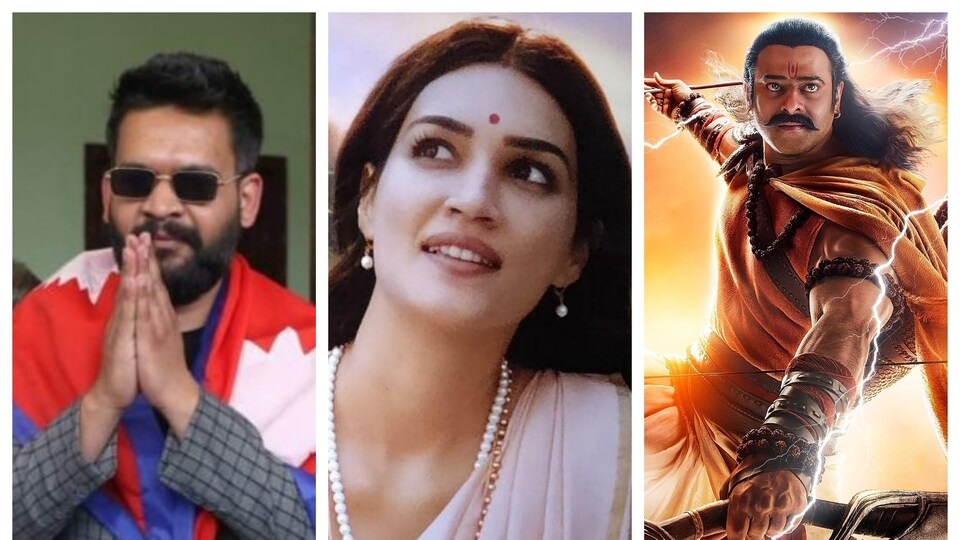
Almost all of Nepal’s prominent leaders, including some former prime ministers, have asked Prachanda’s government to take a stronger position against BJP’s active endorsement of the ‘cultural’ map. But it’s Kathmandu’s young mayor Balen Shah, who has aced the nationalist game.
Shah has grandly splashed the map of Greater Nepal in his office, which shows parts of the current-day India to the east, southeast, and west of Nepal within Greater Nepal, a depiction of Gorkha empire at its height. Unsurprisingly, Shah, 32, has been lauded by many.
The Nepal government has asked (twice already since PM Prachanda’s visit) its embassy in Delhi to seek an explanation on what has become a political hot potato in the Himalayan nation.
Shah took things up a notch. He stopped the screening of the newly-released Hindi movie Adipurush in all theatres in Kathmandu, objecting to a line in the film which is an adaptation of Ramayana. In one scene, Rama says, "Janaki is a Bharatputri [the daughter of India]." A few other cities in Nepal have followed the Balen Shah playbook and banned the movie too.
No one, either in India or Nepal, is contesting the Hindu mythology that depicts Janaki (popularly known as Sita in Nepal) as the daughter of Raja Janak from Janakpur, a town in Nepal’s Terai. This is where the shared history and cultures comes into play.
Janakpur is part of Mithila, a geographical and cultural region comprising parts of present-day Bihar and Jharkhand, stretching to Nepal’s eastern and central Terai. Janakpur is also the capital of Madhesh province where Maithali is the mother tongue of close to 60 percent of the population; Maithali is also the second most widely spoken language in Bihar after Hindi.
But these nuances are lost in the nationalist narrative that undergirds Adipurush. A similar backlash from viewers in India, upset over the depiction of the characters based on mythological figures of Ram and Hanuman, has also resulted in the makers of the film to re-release it with changed sentences.
Some of Nepal’s leaders (most notably Shah) have decided they would not be left behind with their own nationalist reading of history.
Though ‘Bharatputri’ was beeped out by Nepal’s censor board before Adipurush was allowed to screen in Nepal, Shah is still not happy. He wants it removed from the movie altogether, wherever it is screened. He also banned the screening of all Hindi movies in Kathmandu.
Aggrieved theatre owners, the Nepal Motion Picture Association, decided to challenge the move in the court, arguing that the objectionable word had already been blipped out by the censor board and due clearance was given for screening. However, on June 22, Shah went on an all-out war, declaring that he would defy a high court order, which temporarily stayed the implementation of the city's decision to ban Adipurush.
“The court and the government,” he wrote on his Facebook, “are understood to be the slaves of India. I am ready to suffer any punishment for this, but the film will not run and will not be allowed to run.” This followed a Patan High Court interlocutory order asking the city not to ban any movie passed by the censor board.
Nepal’s media has broadly portrayed Shah’s move as ultra-nationalistic, irrational, and even illegal. But let’s also not forget Balen Shah has a legion of followers, who see the media as status quoist.
Here’s the bigger picture. Interestingly, the backlash against Adipurush and the Ashoka empire mural comes from the country India’s current government and moviemakers perhaps least expected. While both these controversies may die down for now, they have delivered two clear messages: one, the nationalist card can be a tricky tool and, two, the age-old shared history and cultures makes Nepal-India relationship intimate and complex at the same time. That should make us all humble in approaching our deeply multifaceted relationship.
Akhilesh Upadhyay is a Senior Fellow at IIDS, a Kathmandu-based think tank. Views expressed are personal.


