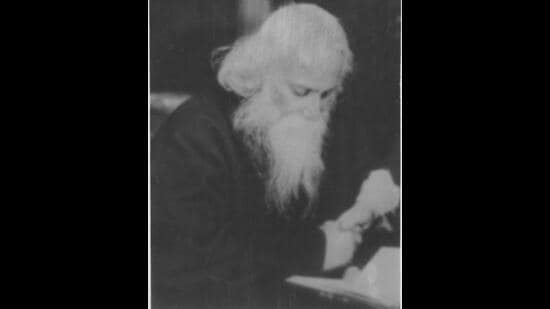
On a tiny island in the Baltic Sea, with the cool winds of the peaceful sea brushing against my face, I found myself thinking of home. Of Bengal. Of India. Of history. And of the irony of time itself. This tumultuous month — marked simultaneously by political upheaval and the birth anniversary of Rabindranath Tagore — compels reflection far deeper than electoral arithmetic. That the swearing-in ceremony of a new political order should coincide with the remembrance of the poet who warned India against the dangers of narrow nationalism is one of those ironies thathistory occasionally stages with unsettling precision. For Bengal stands at a threshold once again.
The winds of change sweeping through the state carry with them both hope and apprehension. Hope for institutional renewal, economic revival, restoration of governance, and an end to political exhaustion. Yet, also apprehension — that in the pursuit of political correction, Bengal may lose something civilisationally precious about itself. In moments of fundamental transition, societies reveal not merely what they oppose, but what they truly are.
Tagore’s writings remain profoundly relevant precisely because he distinguished between love for one’s civilisation and the temptation of exclusionary nationalism. He deeply respected Hindu philosophy, India’s spiritual traditions, and the cultural inheritance of this ancient civilisation. But he rejected the idea that India could ever be defined through the prism of a single religious identity.
To Tagore, India was never a monolith; it was a civilisational confluence shaped by centuries of synthesis, absorption and coexistence. A land shaped by Hindu thought, Buddhist compassion, Islamic aesthetics, Sikh courage, Persian refinement, and even certain western liberal traditions. India’s greatness, in his eyes, lay not in uniformity but in absorption — the extraordinary ability to synthesise contradictions into a shared inheritance.
{{/usCountry}}To Tagore, India was never a monolith; it was a civilisational confluence shaped by centuries of synthesis, absorption and coexistence. A land shaped by Hindu thought, Buddhist compassion, Islamic aesthetics, Sikh courage, Persian refinement, and even certain western liberal traditions. India’s greatness, in his eyes, lay not in uniformity but in absorption — the extraordinary ability to synthesise contradictions into a shared inheritance.
{{/usCountry}}His warning was timeless: When nationalism becomes aggressive, intolerant, or majoritarian, it ceases to elevate a civilisation and instead, weakens the very civilisation it claims to defend. “Patriotism cannot be our final spiritual shelter; my refuge is humanity,” he wrote.
This was not rootless cosmopolitanism. Tagore viewed it as civilisational confidence. Only a civilisation secure in itself can afford generosity for such perspectives. Bengal historically understood this instinctively. Its greatest cultural figures drew deeply from Hindu spirituality while simultaneously embracing universalism. Swami Vivekananda embodied precisely this synthesis. Fiercely proud of Vedantic philosophy and India’s civilisational depth, he nevertheless rejected fanaticism, caste arrogance, and sectarian hatred. At the Parliament of Religions in Chicago, he did not proclaim supremacy; he proclaimed acceptance.
Vivekananda spoke not merely of worship, but of service. Not merely of identity, but of upliftment. His concept of nationalism was moral and spiritual — rooted in India’s regeneration through education, dignity, social reform, and empowerment of the poor. Influenced profoundly by Ramakrishna Paramahamsa, he believed truth could manifest through multiple faiths and traditions. He admired in Islam the principles of equality and brotherhood, envisioning an India where Vedantic spirituality and social egalitarianism could coexist harmoniously.
This composite ethos became Bengal’s civilisational signature.
That is why the present political moment demands wisdom and statesmanship rather than retribution; reconstruction rather than triumphalism. After decades of ideological stagnation, administrative decay, political violence, corruption, capital flight, and institutional erosion, Bengal undeniably seeks renewal. An aspirational younger generation seeks jobs rather than slogans, investment rather than patronage, infrastructure rather than rhetoric. The demand for governance, accountability, and economic dynamism is legitimate and overdue. But political renewal cannot come at the cost of Bengal’s deeper identity.
The state must resist two equal and opposite temptations: The hollow appeasement politics that weakened institutions and deepened cynicism, and the seductive pull of majoritarian polarisation masquerading as civilisational resurgence. Both ultimately fragment society.
The Bengal Renaissance was never built upon exclusion. From Tagore to Vivekananda, from Kazi Nazrul Islam to Netaji Subhas Chandra Bose, Bengal’s intellectual tradition rested on confidence without hatred, pride without insecurity, and spirituality without intolerance. That inheritance now stands tested.
The true challenge before Bengal’s emerging political order is, therefore, not merely electoral consolidation. It is whether it can build a model of governance that combines economic revival with civilisational maturity; cultural rootedness with pluralism; administrative firmness with democratic restraint.
History offers many examples of societies replacing one form of decay with another form of excess. Bengal must avoid that fate. Or of being described in past conditional — the way a beloved friend is described who has been unwell for long. Calm reflection reminds us that civilisations endure not through triumphalism or noise, but because they retain moral balance during moments of immense political change. The verdict of an election can alter governments. But only wisdom can shape the future of a civilisation.
And Bengal now faces a historic test: Whether it can remain proudly rooted in its civilisational identity without surrendering the pluralism that has long defined its soul. For in an age increasingly shaped by polarisation and certitude, the highest form of civilisational confidence may well be the ability to remain plural, humane, and secure in itself.
Prabal Basu Roy is a Sloan Fellow of the London Business School and a board member. The views expressed are personal