The monsoon session of Parliament was expected to be a stormy one. The Opposition had signalled that it wanted to corner the government on the NEET paper-leak issue and misappropriation of donations in Ram Mandir. The country hoped that our parliamentarians would constructively debate pressing national issues and find solutions. However, the session came to a disappointing end on August 13, with Parliament failing in its constitutional responsibility of discussing critical national issues.
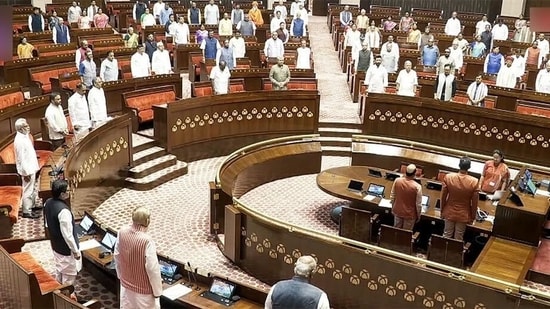
The Opposition parties and the government could not agree upon the mechanics of discussing the contentious issues of paper leakage and the handling of the student protest in Jantar Mantar. As a result, the entire monsoon session was washed out. The two Houses barely functioned, and this session was reminiscent of the winter session of 2010, which was also completely lost to disruptions. Over the last 15 years, there have been three other instances when a parliamentary session has been completely washed out.
During the 19-day monsoon session this year, Lok Sabha and Rajya Sabha functioned for 15% and 33% of their scheduled time. Except for two days, Lok Sabha did not function for more than one hour. Rajya Sabha’s functioning was lowest since the Budget session of 2023. The chair adjourned Lok Sabha 35 times and Rajya Sabha 37 times during the session.
Also Read | 9 bills go through without discussion, one cleared in 2 minutes: Monsoon Session of Parliament, in numbers
{{/usCountry}}Also Read | 9 bills go through without discussion, one cleared in 2 minutes: Monsoon Session of Parliament, in numbers
{{/usCountry}}Let’s start at the beginning. The President issued the proclamation for convening the monsoon session on July 4, with the session scheduled to begin on July 20 and work for 19 days. The session date is decided in advance so that MPs, political parties, and the government can prepare and maximise the time of the monsoon session for the benefit of the nation. As soon as the session date is announced, the parliamentary accountability of government is set in motion.
Parliamentarians ask detailed questions to Union ministers about the performance of government programmes, utilisation of allocated funds, and governance challenges. But the Question Hour barely functioned this monsoon session -- for nine minutes in Lok Sabha and a little more than two hours in Rajya Sabha. Ministers responded to only two questions in Lok Sabha and 16 questions in Rajya Sabha.
Question Hour, which is the most visible aspect of parliamentary functioning, is also the only part that, when disrupted, cannot be made up for by sitting longer. A non-functioning Question Hour is a lost opportunity for the country. Had it functioned properly this session, it would have led to the government being held accountable for the effectiveness of its functioning. It would also have led to the government getting valuable feedback from across the country about how its schemes were doing on the ground. Had the Question Hour functioned, the country would have heard the government explain their policy stance on issues like education, nuclear power, petrol blending, essential medicine, floods, etc.
Also Read | Din, disruptions and a dozen bills: Monsoon Session comes to a close
Even though the proceedings of both Houses remained disrupted throughout the session, the government was able to get 11 bills passed through Parliament. It took Lok Sabha roughly five minutes to pass seven of these bills. The only bill that was debated extensively was the government amendment to strengthen the existing law on preventing cheating in examinations.
The Public Examinations (Prevention of Unfair Means) Amendment Bill, 2026, increases the fines and punishments for such cheating. Parliament had passed the original law just before the 2024 general elections, and its purpose was to prevent unfair means in public examinations conducted by the related examination authorities. Both Houses together discussed this bill for around 18 hours. The discussion on this bill was expansive with MPs highlighting larger issues in the education system.
Another law relating to education, the Viksit Bharat Shiksha Adhisthan Bill, 2025, which changes the country’s higher education framework could not be taken up during session. A contentious legal change to the Foreign Contribution Regulation (Amendment) Bill, 2026, was sent to a joint parliamentary committee.
The dysfunctional monsoon session of Parliament focuses attention again on a few recurring issues that seem to be unique in our parliamentary system.
The first is the inability of the Opposition and Treasury benches to agree to debate contentious issues. Both sides blame each other for disruption of Parliament. The Opposition alleges that the government is trying to shy away from a debate and the Treasury benches’ view is that the Opposition is merely interested in disrupting and politicising an issue, not debating it on the floor of the House.
The second is Parliament’s inability to effectively scrutinise laws that will impact the entire country. Speed of passing legislation rather than the detailed scrutiny of legislative proposals is becoming the norm. Scrutiny of bills by parliamentary committees is not process driven, and not all bills go through the parliamentary committee scrutiny route.
In April, Parliament debated the possibility of having more than 800 members in Lok Sabha. A non-functioning Parliament with 543 Lok Sabha members highlights that simply raising the number of parliamentarians will not improve our national legislature’s effectiveness as a representative and law-making institution. For Parliament to live up to its constitutional mandate, it would have to overhaul its procedures. But even that would be ineffective if political parties across the aisle cannot resolve their differences for the progress of the nation.
Chakshu Roy and Manas Gubbi are with PRS Legislative Research. The views expressed are personal