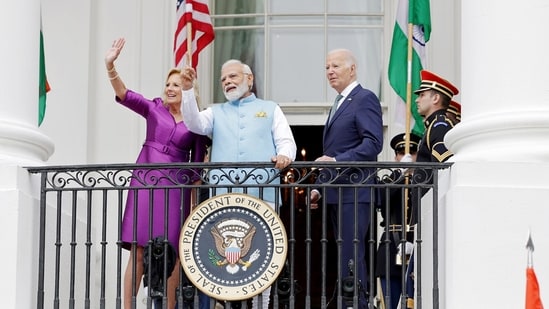
There is little doubt that in both form and substance, Prime Minister (PM) Narendra Modi’s visit to the United States (US) will go down in the history books. It didn’t mark a turn but signalled an intensification of ties in multiple domains. It didn’t mark a switch but highlighted a leap of trust required for any two countries to work together in the most sensitive sectors, from defence and space to sophisticated technology and semiconductors.
And, it was a victory
There is little doubt that in both form and substance, Prime Minister (PM) Narendra Modi’s visit to the United States (US) will go down in the history books. It didn’t mark a turn but signalled an intensification of ties in multiple domains. It didn’t mark a switch but highlighted a leap of trust required for any two countries to work together in the most sensitive sectors, from defence and space to sophisticated technology and semiconductors.
And, it was a victory for India and Indian diplomacy.
New Delhi has been keen on tech transfer and co-production. The GE jet engine deal represents that. New Delhi has been keen on developing a semiconductor manufacturing ecosystem. Announcements by Micron, Applied Materials and Lam Research represent that. New Delhi has been keen on collaboration in quantum and Artificial Intelligence. Closer integration of India in various institutional frameworks, as well as deeper research collaboration between institutes and universities, represents that. New Delhi wanted its defence and space startups to collaborate with the American ecosystem and become a part of US supply chains. The launch of Indus-X represents that. New Delhi wanted its digital public infrastructure (DPI) recognised as a global public good. American support for DPI and a commitment to help scale it up globally represents that.
New Delhi wanted the symbolism associated with a State visit and an opportunity to showcase PM Modi’s popular connect. The unprecedented attendance of 7,000 Indian Americans on the south lawns of the White House represented that. New Delhi was keen to reach out to multiple stakeholders in the American polity. The PM’s address to the US Congress for a second time — a rare honour accorded to only a select club of global leaders — represented that.
This is just an indicative, not an exhaustive, list of sterling Indian diplomatic accomplishments last week. But that is why it is somewhat perplexing to see the tone of acrimony and hostility that is dominating public discourse in India, days after the PM wrapped up his visit to Washington. Two themes seemed to have agitated the minds of some supporters of the government — one, former US President Barack Obama’s comments about the Hindu-Muslim dynamic in India, and Wall Street Journal reporter Sabrina Siddiqui’s question to Modi at a joint press conference about the treatment of minorities and place of free speech in India.
The merits of Obama’s comments or Siddiqui’s question need not detain us here, except to remember that they represent what is now a widely held view in the US political, media and academic ecosystem about the evolution and quality of Indian democracy. And, while there may be a level of exaggeration and slant involved in that conclusion, if India truly wants to correct it, there has to be remedial action at home and sincere engagement abroad.
But Obama is not the occupant of the White House, and Siddiqui’s question, which was framed respectfully and in keeping with journalistic norms, was deftly handled by the PM right at the press conference. That is why investing political capital, and deploying heavyweights — including defence minister Rajnath Singh and finance minister Nirmala Sitharaman —seems unwise, as is the appearance of encouragement of the rather uninformed and prejudiced attacks on Siddiqui.
All this does is shift focus from a diplomatic triumph. It gives ammunition to the critics of Indian democracy in Washington DC who can point to the backlash and suggest that there is little room for criticism or questioning in India, and that the regime orchestrates a backlash against it. It forces the US administration, which has done everything to woo India, on the defensive with their own press and base. It takes away from the incredible hard work that went behind the visit and the attention that needs to be given to implementing the landmark joint statement. And it speaks poorly of India’s ability to absorb criticism.
There is a clear contradiction between the liberal constituents of the Democratic Party in the US, and the Right-wing constituents of the Bharatiya Janata Party (BJP) in India — and that tension will continue to play out in various ways in the years ahead. But both governments have been mature enough to recognise the larger stakes involved, and ensured that the differences on civil liberties didn’t become the dominant theme in State-to-State ties. Some of the BJP’s leaders and supporters would do their own party a favour by continuing with the same spirit of restraint. New Delhi isn’t so weak that it needs to get rattled with comments by a former leader or a journalist. Nor is it so weak that it needs to manufacture a tale of victimhood even when it has a story of resounding success. Relish the victory in Washington rather than turning the narrative against the US to score political points at home. It is poor form and does not serve any national interest.
The views expressed are personal
One Subscription.
Get 360° coverage—from daily headlines
to 100 year archives.
Archives
HT App & Website