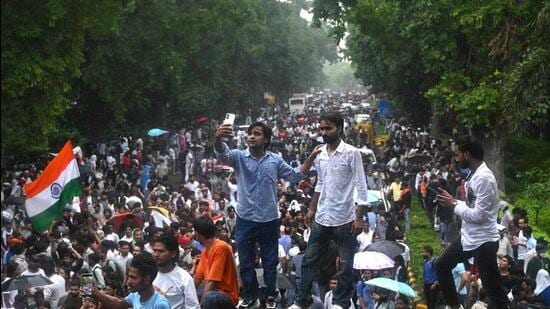
Delhi saw one of its largest ever student protests on Monday. The obvious comparisons are to the December 2012 protest, which erupted after the brutal gangrape of a paramedical student in a moving bus, or the 2011 protest, which galvanised around the Anna Hazare-led anti-corruption agitation. Barring the farmers’ protests of 2020, which were largely led by various farmers’ unions in Punjab, Haryana and Uttar Pradesh, and did not really electorally hurt the BJP, the latest protest also marks the biggest popular protest against the current government.
What is one to make out of the chain of events and the after-effects they will possibly have? Here are four things which can be said.
1. The most important differentia specifica of these protests is the following. They are the first truly large protest to happen when the BJP is in government rather than the opposition. This rules out any organised tailwinds to the protest by the umbrella organisations of the Sangh Parivar, which enjoys a significant organisational premium vis-à-vis political entities in large parts of the country and definitely the national capital. No other organisation, especially the ones on the left – as was claimed by the chief of the BJP’s information wing– can even claim to have such a mobilisation capacity in the national capital. The only conclusion which is left to be drawn is that the participation was truly organic and perhaps spontaneously catalysed by the decision to hospitalise Sonam Wangchuk using the police, and then try and prevent the march to Parliament.
2. What makes these protests truly remarkable from the government’s perspective is the latter’s failure to preempt their magnitude. The previous edition of this column had pointed out how allowing the Cockroach Janta Party (CJP) protest and subsequent hunger strike was a radical departure from this government’s modus vivendi to not allow any organised protest activity in Lutyens’s Delhi, which can significantly magnify their media coverage as well as participation. Once the government had allowed the protestors to start their hunger strike and let it continue for 20 days, it was faced with the proverbial Hobson’s choice of seeing it snowball into either a Parliament march or cracking down on them, resulting in a face-off with protestors who would have gathered in the aftermath of their forcible removal. What happened on Monday was the latter. Perhaps the government is hoping that the worst is over and things will start fizzling out from Tuesday. But there is another question to answer first.
{{/usCountry}}2. What makes these protests truly remarkable from the government’s perspective is the latter’s failure to preempt their magnitude. The previous edition of this column had pointed out how allowing the Cockroach Janta Party (CJP) protest and subsequent hunger strike was a radical departure from this government’s modus vivendi to not allow any organised protest activity in Lutyens’s Delhi, which can significantly magnify their media coverage as well as participation. Once the government had allowed the protestors to start their hunger strike and let it continue for 20 days, it was faced with the proverbial Hobson’s choice of seeing it snowball into either a Parliament march or cracking down on them, resulting in a face-off with protestors who would have gathered in the aftermath of their forcible removal. What happened on Monday was the latter. Perhaps the government is hoping that the worst is over and things will start fizzling out from Tuesday. But there is another question to answer first.
{{/usCountry}}3. Did the government not have an idea about the kind of participation the protest action would generate on Monday? There is a good reason to argue that it did not. This is because the bulk of the participation came from constituencies which are beyond the usual adversaries of the government. The worst-case scenario of an anti-government student mobilisation in this government’s sub-consciousness would have been what happened after the 2016 protests following the arrest of JNUSU president Kanhaiya Kumar. 2026 was larger than 2016 by many orders of magnitude. The government and its intelligence machinery are very good at SWOT analyses of its usual adversaries, but they were taken by surprise by the outpouring of hitherto non-partisans. This brings me to my last point.
4. What differentiates 2016 and 2026 is not just a difference in quantitative terms. There is also a qualitative factor at play. The events in JNU in 2016 were perfectly suited for the government and its ideological allies to portray them as something antithetical to national interest, especially within its own constituencies. This is not the case regarding the 2026 protests. They have been triggered by something purely logistical – NEET question paper leaks thanks to a central government agency messing things up – rather than ideological. From the “tukde-tukde gang” – which is what the right-wing dubbed the JNU cohort in 2016 – to the “cockroaches” – which is what the initiators of the latest protests called themselves, drawing on a disparaging comment from the highest judicial officer in the country during a court hearing – student protests have crossed the proverbial ideological Rubicon much to the chagrin of the BJP and its ideological allies. It is not easy to mount an ideological attack against the latter.
So, what happens next? It is useful to answer this question by listing the crux of the arguments made above. (1) implies that even an emaciated opposition in Parliament does not guarantee absence of spontaneous anger in the extra-parliamentary realm. (2) means that such anger can surpass levels much larger than what an orchestrated effort by mass organisations politically linked with opposition parties can generate. (3) implies that the government’s eyes and ears are still not capable of gauging the political mood outside its usual adversarial constituencies. (4) means that trying to ideologically vilify this protest risks alienating a constituency which is not necessarily wedded to an ideological opposition to the ruling regime but could very well have issue-based angst. This leaves the government with two choices: either concede the critical but politically embarrassing demand of sacking the education minister, or risk repressing and alienating an organically rather than programmatically angry constituency even further.
To be sure, the current government has shown in the past that it is capable of retreating to cut its losses on some issues. Examples are the withdrawal of amendments to the land acquisition ordinance in the first Modi government and farm laws under the second. But we have also seen that it can be pretty obdurate on others despite widespread protests, such as the Citizenship Amendment Act (CAA). The critical factor in the government making such decisions, one can say, has been how the BJP viewed the protests: issue-based or ideological. Fortunately for it, this protest is issue-based.
But the latest episode presents a challenge where delay in resolving an issue-based protest could lay the foundation of ideological animosity in a new generation of current and future voters. This is not to say that it will manifest itself in the election which will happen next. But Monday’s optics might have let in the Trojan horse of the Opposition’s narrative, which tries to portray the government as wrong and vengeful in what was perhaps its ideologically fortified constituency. The BJP and its ideological fellow travellers, until 2014, were masters of this art. Perhaps the BJP has now become an establishment force rather than the politically-ideologically agile one it used to be. Hubris can often get the best of the best.
(Roshan Kishore, HT’s Data and Political Economy Editor, writes a weekly column on the state of the country’s economy and its political fall out, and vice-versa)