With the government announcing an increase in fuel prices on March 22 and 23, the unofficial freeze which came with the assembly election cycle has ended. While petrol-diesel prices have been increased by ₹1.6 per litre over the last two days, cooking gas prices were increased by ₹50 per cylinder. Even with the price freeze, fuel prices have played a big role in driving up inflation in the past few months. This can be seen clearly from the contribution of fuel and light sub-category to increase in headline retail inflation as measured by the Consumer Price Index (CPI). With fuel prices beginning to rise once again, inflationary tailwinds from this end are likely to regain momentum.
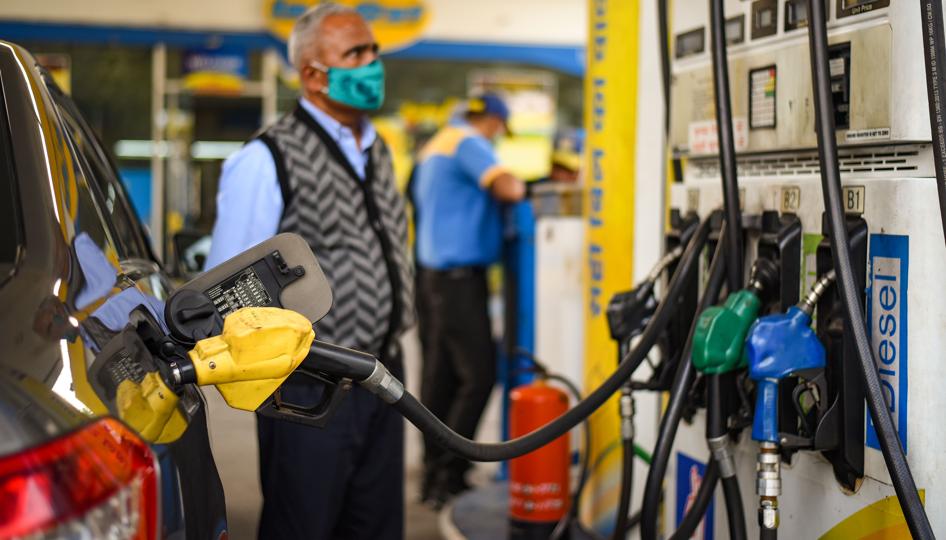
While the government’s decision saw some customary protest by the Opposition in Parliament, there has hardly been any large-scale and sustained protest over the issue. This can be said for the period preceding November 2021 as well. Fuel prices were frozen in November. To be sure, the government did reduce excise duty on petrol and diesel in November 2021. But this rollback did not bring central taxes back to pre-pandemic levels at all. Similarly, subsidies on cooking gas cylinders have been nearly abolished – it is only applicable in remote areas – under the current government for the first time.
This raises an important political economy question in India. Have people, especially the poor stopped protesting against high fuel prices, and therefore, inflation in general now? The Bharatiya Janata Party (BJP) has not suffered because of inflation in the recently held state elections.
From a purely economic perspective, this argument does not make any sense. A large number of India’s workers are employed in the unorganised sector and the incomes of most of them are not indexed to inflation. When prices rise at a faster rate, their real incomes actually fall. Monthly data on rural wages is the biggest proof of this fact. Annual growth in real rural wages has been negative in six out of the nine months ending January, the latest period for which data is available. The rich, on the other hand, have not suffered much. While the final tax collection numbers for fiscal year 2021-22 will only be available in May, news reports suggest that India’s direct tax collections (and by extension white-collar salaries and profits of companies) have seen very high growth this year.
{{/usCountry}}From a purely economic perspective, this argument does not make any sense. A large number of India’s workers are employed in the unorganised sector and the incomes of most of them are not indexed to inflation. When prices rise at a faster rate, their real incomes actually fall. Monthly data on rural wages is the biggest proof of this fact. Annual growth in real rural wages has been negative in six out of the nine months ending January, the latest period for which data is available. The rich, on the other hand, have not suffered much. While the final tax collection numbers for fiscal year 2021-22 will only be available in May, news reports suggest that India’s direct tax collections (and by extension white-collar salaries and profits of companies) have seen very high growth this year.
{{/usCountry}}This kind of inequality, where the poor are witnessing a squeeze on incomes and the rich are not, should have added to the angst over inflation. But what explains the lack of it?
The only plausible explanation seems to be that the Bharatiya Janata Party (BJP) government has adopted a more nuanced approach to managing the impact of inflation across classes and that the Opposition is still banking on a general messaging which is failing to strike a chord with the constituency which is the most vulnerable to it.
Let us take the case of fuel prices as an example. There was very little protest when the government did away with LPG subsidies initially. To be sure, the policy was rolled out very tactfully: First by nudging people to give up subsidy voluntarily for a larger good (subsidising poor people’s consumption), then excluding those with income above ₹10 lakh per year from the subsidy net and finally doing away with subsidies entirely. While this was being done, the government created a separate constituency of LPG subsidy beneficiaries through the Ujjwala scheme which basically entails a one-time subsidy to households that did not have an LPG cylinder. This kind of a class-differentiation has allowed the BJP to cushion the poor more than the rich. The government announced a free refill for Ujjwala beneficiaries last year.
The provision of free food grains under the PMGKY is another example. National Account Statistics (NAS) data shows that the food consumption component of private final consumption expenditure (PFCE) actually increased in 2020-21. This is more likely to be a result of the additional free food grain provision under the PMGKY – food received under such schemes is added at imputed prices in the PFCE as per accounting practices – rather than the poor actually spending more on food items.
While it is entirely plausible that the poor are still worse off than they were before the pandemic and inflation is playing an important role in this, it cannot be denied that the beneficiaries of these welfare programmes would see the government as having offered limited, but concrete, relief to them. Such targeted welfare provisioning, when married with targeted political campaigning, can explain why the BJP was able to manage the political anger around inflation.
As far as the Opposition is concerned, an interesting counter-factual could be asked. Will it be a better idea to raise class-specific demands such as making additional PMGKY grain entitlements permanent and adding things such as cooking oil to it across the country at the Centre’s expense or reintroducing a significant LPG subsidy for Ujjwala beneficiaries rather than protesting against inflation in general?
This brings up a related question of political praxis. Does the Opposition have the required organisational wherewithal to be able to think of such demands before the BJP implements them and then champion them among the relevant beneficiaries to make political gains? India’s Opposition ought to introspect over this question rather than lament over the fact that people have become unresponsive to their calls for action against economic misery.
Every Friday, HT’s data and political economy editor, Roshan Kishore, will combine his commitment to data and passion for qualitative analysis in a new column for HT Premium, Terms of Trade. With a focus on one big number and one big issue, he will go behind the headlines to ask a question and address political economy issues and social puzzles facing contemporary India.
The views expressed are personal