Every weekday morning, children who still need help tying shoelaces walk to school bent under expedition-sized school bags. Inside are textbooks, notebooks, lunch boxes, water bottles, art supplies, workbooks, and an almanac. Adults join this procession, carrying the bags until children board the bus or enter the school gate.
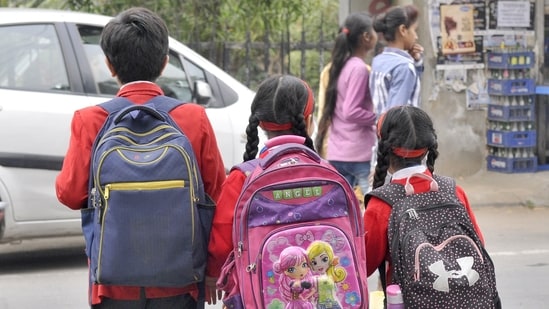
This continues despite a court ruling, ministry directions, and a government policy on school bags. The problem is familiar: Rules are announced ceremonially and circulated bureaucratically, while children cover the distance between policy and practice.
In May 2018, the Madras High Court confronted academic overloading in schools affiliated with the Central Board of Secondary Education. It directed authorities to ensure no homework for Classes 1 and 2, questioned subjects beyond the prescribed curriculum, and asked states and Union territories to ensure school bags did not exceed 10% of a child’s body weight. The judgment’s concern was larger than kilograms: Young children should not carry the adult anxiety of heavy bags meaning more education.
Later that year, the then ministry of human resource development advised states and Union territories to regulate bag weight, prohibit homework in Classes 1 and 2, avoid additional books and prescribe class-wise limits. The Policy on School Bags 2020, prepared by an NCERT-led expert group, replaced the fixed national kilogram limits with a more sensible principle: A bag should generally remain within 10% of the child’s body weight. That’s what the Indian Academy of Pediatrics recommends.
{{/usCountry}}Later that year, the then ministry of human resource development advised states and Union territories to regulate bag weight, prohibit homework in Classes 1 and 2, avoid additional books and prescribe class-wise limits. The Policy on School Bags 2020, prepared by an NCERT-led expert group, replaced the fixed national kilogram limits with a more sensible principle: A bag should generally remain within 10% of the child’s body weight. That’s what the Indian Academy of Pediatrics recommends.
{{/usCountry}}The rulings and policy have provided a practical blueprint. Timetables should identify which books are required each day. Schools should provide drinking water, reduce the need for large bottles, and regularly monitor school bag weight. In primary classes, longer blocks for fewer subjects can reduce books carried. Teachers should consider the combined burden of textbooks, notebooks, lunch boxes and other materials.
Many schools continue to prescribe multiple subject notebooks, supplementary readers, practice books, art folders and diaries. Homework for the youngest children returns under gentler labels: “revision”, “reinforcement”, “practice”, or “family activity”. Together, these habits create a system.
The physical consequences deserve more than a shrug. A disproportionate load can affect posture and gait and contribute to shoulder, neck and back discomfort, especially when children climb several floors, commute long distances or sling bags over one shoulder.
Harm accumulates quietly; prevention, therefore, requires systems.
The intellectual burden may be worse, and it has a social inequity dimension. Homework often measures parental availability rather than a child’s understanding. In affluent households, adults supervise projects, print pictures and improve presentation. In families where parents work long hours or have limited formal education, children may submit less polished work and be judged accordingly. An OECD analysis has found that socioeconomically advantaged students spend more time on homework than disadvantaged students. Homework can, therefore, reproduce the inequalities it claims to overcome
India need not import a foreign model to solve this problem. Textbooks can be divided by term. Workbooks can be integrated rather than multiplied. Schools can install labelled shelves or lockers.
Double-period timetables can reduce the subjects taught each day. Publishers should print lighter books, avoid glossy oversized formats, and disclose book weights. Digital communication can replace bulky almanacs, although screens must not become a route for endless assignments after school.
Every school should publish a book-specific weekly timetable and require teachers to follow it. A sample of bags should be weighed each term, with results shared with parents. Principals should review the total workload imposed collectively by all teachers, because no department considers its own notebook unnecessary.
New teachers should be briefed on homework and bag limits. Parents need a safe channel for complaints without fearing their child will be labelled troublesome.
Education departments and school boards must include compliance. Schools should publicly disclose their bag policy, homework policy and monitoring results. A rule without measurement becomes a suggestion; a suggestion without accountability becomes decoration.
There is also a moral question hidden inside this debate. Schools teach children about dignity, health, and scientific temper while requiring them to obey arrangements contradicting all three. A child who complains of pain may be told to become stronger; a parent who objects may be accused of preferring comfort to discipline. This reverses responsibility. Institutions, not children’s spines, must adapt. Sensible limits and boundaries teach that authority should be rational, health deserves protection and good systems remove pointless hardship.
Parents, too, must surrender to an illusion: A bag full of books is not evidence of an excellent school. Nor is an occupied child necessarily learning.
In senior school kids, competitive anxiety of parents makes idleness appear dangerous, encouraging families to buy extra guides and worksheets. But rest is not an empty time. Conversation develops language; outdoor play builds coordination and judgment; boredom nurtures imagination. A bedtime story may do more for literacy than another page of copied answers.
The heaviest object in a child’s bag is often adult expectations. Schools fear appearing insufficiently rigorous; parents fear their children falling behind; publishers profit from glossy pages; and regulators confuse issuing instructions with enforcing them. The child, being the smallest participant, receives the burden.
A lighter school bag is an argument for education that is better organised, developmentally appropriate, and respectful of childhood. India has already written the prescription. What it lacks is the willingness to administer it. Tomorrow morning, millions of children will lift their bags again. The real test of policy is whether adults finally decide to lift some of the weight.
(Chandrakant Lahariya is a practising physician who specialises in preventive and cardiometabolic medicine and a leading expert in parenting and child development. Author of an upcoming book, Pill-Free, he is on X as @DrLahariya. The views expressed are personal.)