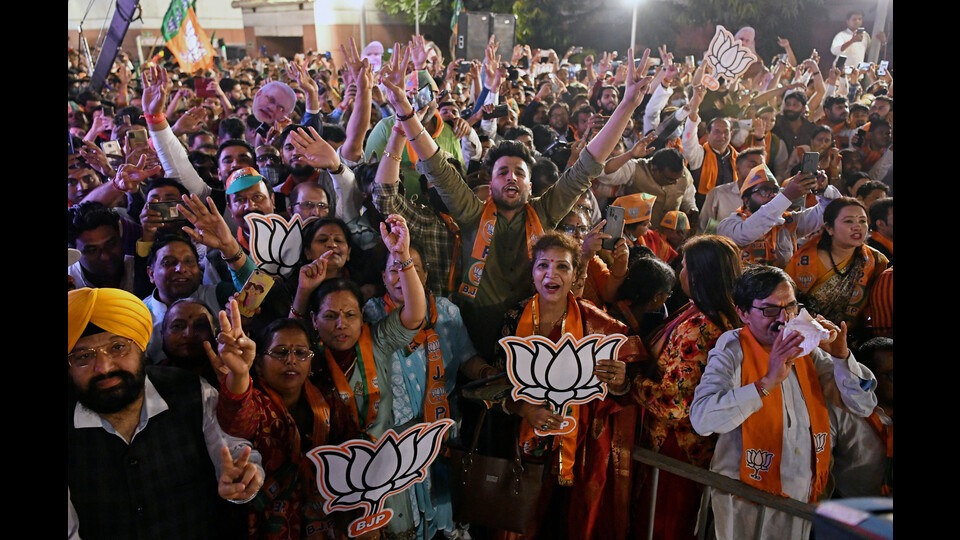
The politics of Hindutva is now focussed on the economic well-being of the extremely poor, and they will face regular opposition in the assembly, once again poised on people’s issues
The Bharatiya Janata Party (BJP) comes back to power in India’s most populous state, Uttar Pradesh (UP), in a mandate considered a referendum on the agenda and governance style of the party. The mandate seems to rise above the here and now — agrarian distress, Covid-related governance failures, price rise and unemployment, among others.
The pitch of this poll campaign was initially set by Prime Minister Narendra Modi, inaugurating the Purvanchal Expressway but by mid-February, there was an obvious course correction, with an emphasis on labhaarthi (beneficiary politics). (Rahul Singh)
As the curtain falls on the election season, I raise three questions, with vignettes gathered from my fieldwork in Purvanchal, the eastern part of UP. First, do people vote for their identity or their interests? Second, where does the meta narrative of religion and Hindutva figure in this highly localised discussion of jati, caste, and making services work for people? Third, and most important, in what ways do the voices of the people reshape the political arena?
The geography of Purvanchal is vital to locate these questions spatially. Covered in the sixth and seventh rounds of the elections, the region has political heft with 111 of the state’s 403 assembly seats. The victories of the BJP in 2017 and the Samajwadi Party (SP) in 2012 were rooted in strong performances in this region. The region is home to some of the poorest caste communities. Purvanchal is a laboratory of political ideas — vikaaswaad (development), jati and Hindutva all compete in the same cauldron — and is home to the strongholds of Yogi Adityanath (Gorakhpur), Narendra Modi (Varanasi) and Akhilesh Yadav (Azamgarh).
Many new allies of the SP, Om Prakash Rajbhar, Swami Prasad Maurya, Dara Singh Chauhan, and Krishna Patel, also belong to this region and carry with them a conglomeration of most backward social castes, including Rajbhars, Kushwahas, Nonia Chauhaans, and Kurmis, all of whom backed the BJP in 2017. Conventional wisdom dictated that these polls should have been marked by jati-based vote banks shifting to the Samajwadis. Yet, the incumbent (BJP) won, indicating that the voter moved away from the politics of jati identities.
In my field work in Gorakhpur rural and the urban peripheries of Varanasi, voters complained about the high prices of cooking gas cylinders and their inability to buy refills, but rarely blamed Modi or Yogi. In Sahjanwa (Gorakhpur), farmhands complained about the difficulties in selling their grain in the local market, long queues for procuring fertilisers and rising costs of the mobile internet — but these grumblings were against the market. These were different from their pleas to the state and leaders, mainly for support amid economic distress.
The pitch of this poll campaign was initially set by Prime Minister Narendra Modi, inaugurating the Purvanchal Expressway but by mid-February, there was an obvious course correction, with an emphasis on labhaarthi (beneficiary politics). Women voted more in greater numbers in Purvanchal — they have since 2017. Perhaps they are emerging as a bloc invested in the politics of developmentalism. Rarely did the voice of the poor electorate reach a crescendo. They complained neither of patronage politics nor control of dominant communities, as had been the case in previous governments. The BJP’s pitch of acting against the local dabang (strongman) and maintaining law and order rang true, even in the face of increased economic distress. What remained unsaid was an implicit consent to the construction of a new Ram temple and other elements of a hardcore Hindutva agenda.
It is important to note that Yadav campaigned extensively, offered himself as the face of new promises and highlighted the lack of fulfilment of the BJP’s poll promises of doubling farmer incomes, filling up of government vacancies, and implementation of the old pension scheme. By the end of the campaign, he was topping up the BJP’s welfare packet with an extended tenure and the addition of mustard oil and ghee. The improvement in its tally is a reflection of some of this effort, especially in southern Purvanchal.
But it is clear that Mandal politics is neither the SP’s exclusive preserve nor will mere paeans to social justice suffice. The political arena has been reshaped effectively by the poor raising their voice and grievances. Both the SP and the BJP now emphasise welfare and delivery. The politics of Hindutva is now focussed on the economic well-being of the extremely poor, and they will face regular opposition in the assembly, once again poised on people’s issues. This is the sunset of the Mandal-Kamandal divide that defined the landscape of UP politics since the 1990s.
Manisha Priyam is a professor at the National Institute of Educational Planning and Administration

 E-Paper