
 E-Paper



Arsenal expose Manchester City's first post-Guardiola fault line as familiar possession turns strangely fragile
Arsenal's win exposed a City squad still fluent in Guardiola's shapes but lacking his control, with fragile spacing, weak rest defence and an isolated Haaland.

 Prefer HTon Google


Manchester City’s 3–0 defeat to Arsenal in the Community Shield at the Principality Stadium in Cardiff should not be treated as a verdict on the post-Pep Guardiola era. It was Enzo Maresca’s first competitive game, City were missing important pieces, and Arsenal arrived with greater continuity. But the performance still offered an early warning: City could keep the ball without controlling the match.
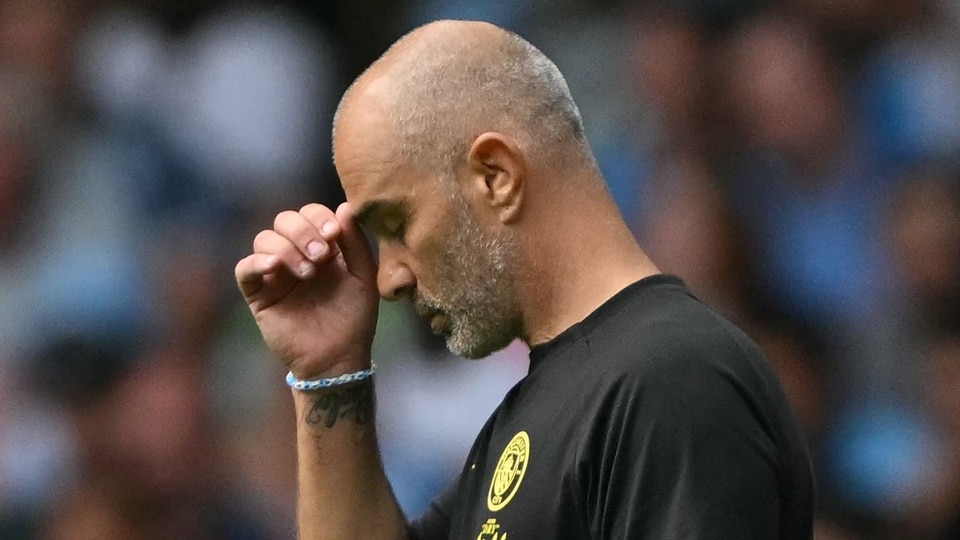
That distinction was the most striking feature of the game. City had more possession and completed more passes, yet Arsenal created the better chances and looked far more secure in the moments that actually decided the contest. Under Guardiola, possession was rarely just possession. It was a way of controlling territory, suppressing transitions and gradually forcing opponents into weaker positions. Against Arsenal, those layers came apart.
Familiar shape, weaker connections
Maresca retained many of the principles associated with Guardiola. City still tried to create width, occupy the half-spaces, build patiently and use Haaland as the central reference point. On the surface, the structure remained recognisable. The difference was in the relationships between players.
Guardiola’s City functioned through constant positional adjustment. When one player advanced, another protected the space behind him. When a winger stayed wide, an interior player occupied the channel inside. The team moved as a connected structure rather than as a collection of individuals following instructions. Against Arsenal, those connections were less precise. City frequently occupied sensible positions, but the distances between them were not always right. That made circulation slower, progression less threatening and turnovers more dangerous. The shapes were familiar. The synchronisation was not.
Arsenal attacked the gaps
Arsenal’s opening goal almost immediately set the tone. They were aggressive from the start and showed little interest in allowing City to settle into long spells of controlled possession. More importantly, Arsenal recognised that City’s first line of pressure could be bypassed. When that happened, the space behind it was larger than Guardiola would normally have tolerated. City’s midfield and defensive lines were not always compact enough to support the press, leaving Arsenal with room to attack once they escaped the initial challenge.
That was where the match became uncomfortable for City. Their defenders were often forced to retreat towards their own goal rather than stepping forward to compress the pitch. Arsenal did not need to dominate possession, they simply needed to dominate the transitions.
Rest defence was the real problem
The most worrying issue was City’s organisation behind the attack. Guardiola’s teams were exceptional at rest defence: the positioning of players who remain behind the ball to prevent counterattacks if possession is lost. It allowed City to commit numbers forward while still controlling what happened after a turnover.
Against Arsenal, that protection was inconsistent. When City lost possession, the central spaces were too easily accessible and the distances between midfield and defence could become stretched. Arsenal were therefore able to turn defensive recoveries into dangerous attacks with relatively little resistance.
This is why City’s possession sometimes felt sterile. They could circulate the ball for long periods without creating a decisive opening, yet Arsenal could become threatening within seconds of winning it back. City had the ball, but Arsenal controlled the risk.
Rodri’s absence was structural
Rodri’s absence magnified the problem because his role has always been about more than passing. He controls tempo, occupies dangerous central spaces and provides the reference point around which City organise both possession and defensive transitions. Without him, the midfield lacked the same authority.
City could still move the ball, but they struggled to manipulate Arsenal consistently. There is a major difference between passing around an opponent and moving that opponent into positions they do not want to occupy. Guardiola’s best City teams specialised in the latter. Without a player imposing that kind of order, possession became more dependent on individual decisions and less effective as a collective weapon.
Also Read:
Haaland’s isolation was a symptom
Erling Haaland’s limited involvement was another consequence of the same issue. He is most dangerous when City establish sustained possession around the opposition penalty area and force defenders into difficult choices. Against Arsenal, those conditions rarely developed. City struggled to progress cleanly through midfield, meaning Haaland was often left occupying centre-backs without receiving the service needed to exploit them.
The problem was therefore not simply that Haaland disappeared. City failed to create the environment in which he normally becomes decisive.
Arsenal had a clearer identity
The contrast with Arsenal was sharp. Arteta’s side looked like a team operating from collective memory. Their pressing triggers were clearer, their midfield remained compact and their transitions had purpose. Players seemed to understand automatically how teammates would react to each movement.
City, by comparison, looked like a team still translating familiar ideas into a new managerial language. That is the real significance of this defeat.
The scoreline may prove largely irrelevant over the course of the season, but the performance highlighted the scale of Maresca’s challenge. Guardiola did not simply give Manchester City a formation or a set of positional principles. He created a system in which possession, attacking structure and defensive security were inseparable. In Cardiff, those elements looked disconnected. City still had much of Guardiola’s vocabulary. What they lacked was the same fluency, and Arsenal punished every hesitation.


