Here is a historical fact. Except the Soviet Union (and we know how that story played out), Washington DC’s support has been a necessary, though not sufficient, pre-requisite in enabling the rise of all major powers after World War II.
The Marshall plan helped western Europe recover from the ravages of the war and the North Atlantic Treaty Organization gave the region security cover, eventually enabling the European Union to become a power in its own right. While the United
Here is a historical fact. Except the Soviet Union (and we know how that story played out), Washington DC’s support has been a necessary, though not sufficient, pre-requisite in enabling the rise of all major powers after World War II.
The Marshall plan helped western Europe recover from the ravages of the war and the North Atlantic Treaty Organization gave the region security cover, eventually enabling the European Union to become a power in its own right. While the United States (US)’s sin in bombing Hiroshima and Nagasaki can never be forgotten or forgiven, Tokyo’s political, strategic and economic integration with Washington DC, New York and San Francisco positioned Japan as Asia’s leading power for decades. The Vietnam war was Washington’s biggest mistake, a criminal one at that, during the Cold War, but it was also the US security umbrella and economic presence in what is today called the Indo-Pacific that helped the East Asian tigers emerge and spread prosperity.
And the Richard Nixon-Mao Zedong diplomatic opening in 1972, and the subsequent American economic and technological embrace of China for the last three decades, has, today, given Xi Jinping the capabilities to challenge Joe Biden for global supremacy and become the big bully in his neighbourhood and beyond.
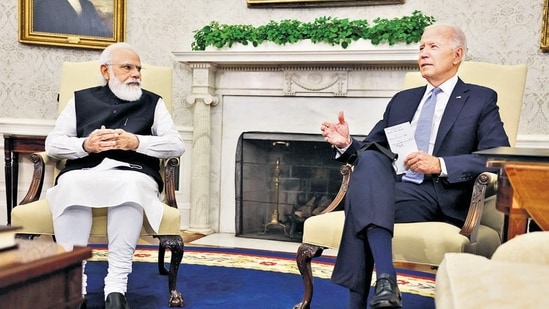
As Prime Minister Narendra Modi begins what is set to be, as HT’s reports of the possible deliverables have indicated, a historic visit to the US, Delhi’s political leadership is aware of this fact of American centrality in enabling the rise of powers. Contrary to public rhetoric, it is also conscious of India’s own security, technological, and economic deficits, including its dismal per capita income of around $2,000. And it is, therefore, conscious of the critical role that Washington DC can play in enhancing Indian capabilities. Enjoy the pomp and ceremony but keep an eye on first principles and outcomes with this framework in mind.
What’s India’s biggest security challenge? If there was any doubt before eastern Ladakh, it is now dispelled: China poses a fundamental threat to India’s sovereignty, territorial integrity, global ambitions, regional interests, and economic rise. In the immediate context, this means that Indian security forces need intelligence, equipment, logistical support, and weapon systems to both deter and counter Beijing. The US remains the world’s leading military power by a long stretch and its support, on these fronts, is already helping India at the border. This neither means India needs or wants or expects American boots on the ground, nor does it mean that the US is looking to sign up India as a treaty ally to serve all its security projects abroad. But the moment, and India’s imperatives, call for closer collaboration between the two defence systems and a willingness in Delhi to support America’s wider strategy of deterrence across the Indo-Pacific. This is what will happen during the visit, including with the acquisition of the Predator drones.
In the medium-term, security imperatives mean that India needs to build its own military-industrial base. And while Israel, France, and Russia can play a role, American defence majors with their capital and technological edge have to be a major part of the mix for this ambition to be realised. The insistence on co-production is finally paying dividends as will be visible with the GE jet engine deal.
And in the long-term, a wider definition of security encompasses equipping the country with emerging and critical technologies that have both economic and military uses and securing supply chains. This is where semiconductors, Artificial Intelligence, space cooperation, quantum and telecom infrastructure come in. Once again, India has strengths but the US edge, and its ability to build wider friendly coalitions, is hard to match. The visit will witness key announcements (for instance, Micron will announce a major semiconductor assembly, testing, and packaging plant and two other firms will announce a massive programme of workforce training for Indian engineers) as well as the launch of a defence innovation bridge for startup ecosystems to connect with governments, big capital and each other.
What’s India’s biggest economic challenge? One can safely suggest it is jobs for the 12 million-plus people who enter the workforce every year. Generating jobs requires a mix of tools. These include massive investment in infrastructure and manufacturing, equipping a young workforce with education and skills, encouraging entrepreneurship, ensuring mobility, and boosting global trade linkages.
In all these domains, the US can play a role. And during the visit, look out for announcements by private sector companies, the deepening of the knowledge partnership, relative flexibility on some aspects of immigration, establishment of deeper connections among entrepreneurs, and some movement on trade issues (which, by the way, even in the absence of a free trade pact, has grown to $191 billion dollars in goods and services last year with India enjoying a surplus). This obviously doesn’t mean that the US can solve India’s economic imbalances, neither does Delhi expect it to. That will require internal reforms and a painful structural transformation of the Indian economy with an eye on equity. But a growing bilateral partnership can help address, partly, some deficiencies and boost incomes.
India also needs political pluralism and social harmony. And while the government’s critics appear to believe that Washington DC has a role on that front, this is both naive and counterproductive. The US State does not have the locus standi, intent or instruments to do so. India’s political issues are its own and any move seen as interventionist is sure to spark a backlash. Indian political battles will be fought at home and resolved at home. And it is for Indian citizens to wage the fight for openness, freedom and democracy if they believe it is under threat.
The current government deserves credit for recognising the importance of the partnership and taking decisions to deepen it with an eye on building strategic, technological and economic capabilities in quick time. And that is why India’s Opposition, in the national interest, should support this new chapter with the US. For that, it will help if the regime can resist the temptation of using the visit to score domestic political points and project the PM as solely responsible for the transformative shift. Instead, focus on the real accomplishments that will be beneficial for Indian society, businesses, and national security. Because that is what’s on the table this week.
The views expressed are personal
One Subscription.
Get 360° coverage—from daily headlines
to 100 year archives.
Archives
HT App & Website