
 E-Paper



When love becomes a covert operation: The story of interfaith marriages
The road to love is littered with landmines, when interfaith couples choose to marry. This is where Dhanak has stepped in to help thousands of couples tie the knot.

 Prefer HTon Google


New Delhi: He is in the business of love but operates like an intelligence agent. He is forced to. Call him and he says, “We work within the framework of the law. We need to be sure that we are talking to a bona fide person. Sorry, the political climate is too sensitive. Do drop us an email first.”
Asif Iqbal, the co-founder of Dhanak (Rainbow), helps interfaith couples tie the knot amidst potential threats to life and property and his job is not easy. Only some months ago, an online press conference by interfaith couples was disrupted by both a Hindu and a Muslim and rape and death threats were issued. “We will get you. We have now identified each one of you,” a voice said, interrupting the conference.
Way back in 1998, when Iqbal spoke to his parents about his desire to marry a Hindu girl, his own family had objected. The girl’s family too had similar objections and solemnising the wedding took tremendous effort and battling social prejudices.
A lot has changed since 1998 — but, mostly, for the worse. With a range of states passing an anti-conversion law, the Prohibition of Unlawful Conversion of Religious Ordinance, Iqbal’s work is beset with near-insurmountable challenges. Haryana became the latest state to adopt the anti-conversion law on March 22. Chief Minister Manohar Lal Khattar said it was necessary to instil fear in the minds of the perpetrators. He meant Muslim men, who, Right-wing organisations believe, lure Hindu girls in the name of what they call, “love jihad”.
Several interfaith couples have been at the receiving end of this law. Non-profit organisations are now helping such couples unite but it comes at the cost of them having to give up their jobs in their home states and begin life afresh many miles away from home.
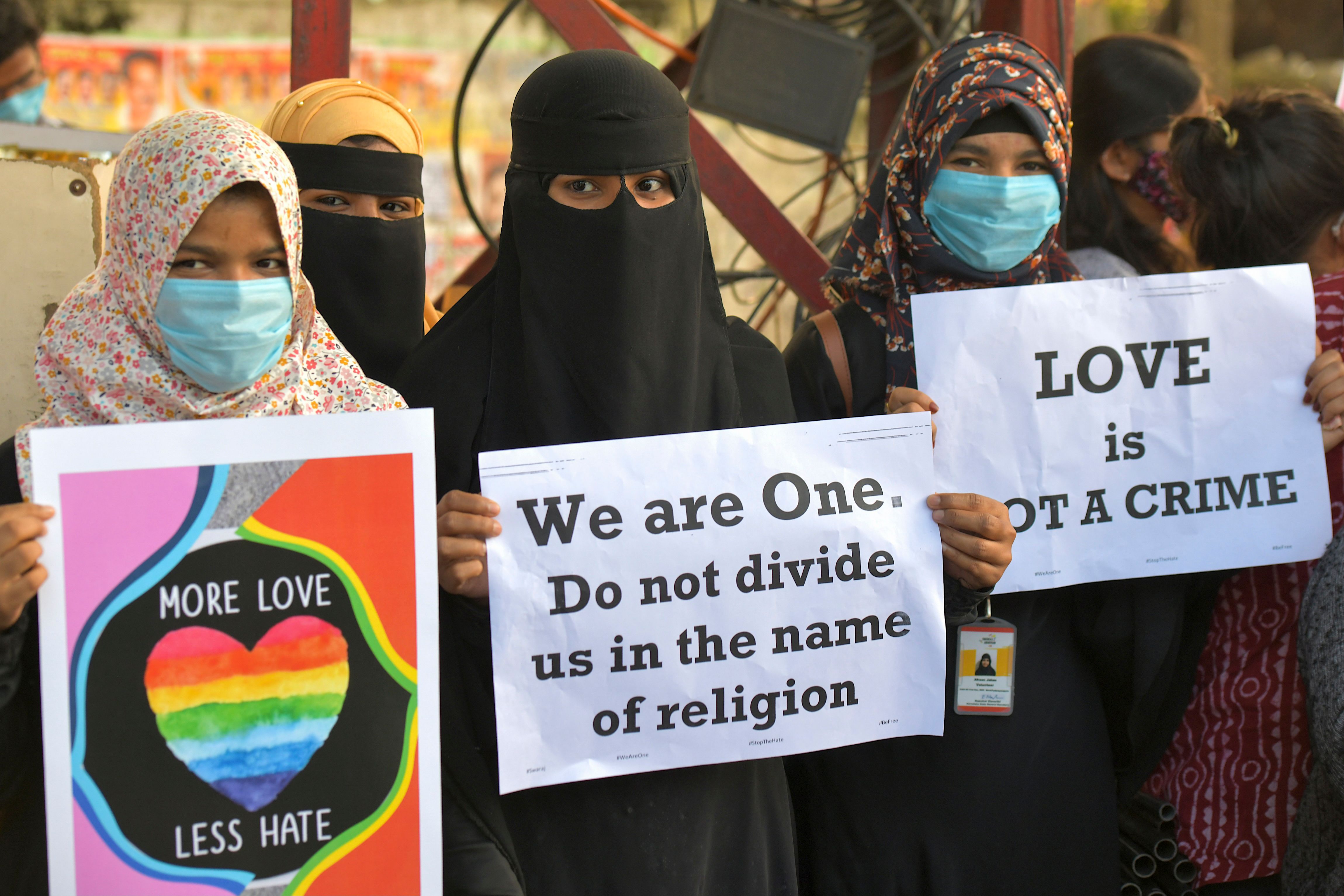
“Love cannot be chained. It is not a crime. Our first objective is not to uproot them from their homes and jobs and we are ready to produce them before the police to say they are marrying of their own accord, but rarely do they agree,” said Iqbal.
An obstacle race
The road to love is littered with landmines. Couples who choose their life partners don’t want to convert and often opt to tie the knot under the Special Marriage Act, 1954, but that is not easy, for their names and addresses are displayed on a notice board for 30 days.
On April 18, for example, just as a couple was about to enter the registrar’s office in Moradabad in Uttar Pradesh, they were waylaid by members of a Hindutva group. The Muslim man, who was the groom, was handed over to the police and has been accused of abduction. The Hindu girl was sent back to her family in Punjab.
Uttar Pradesh (UP) brought in the anti-conversion law in 2020 and available data for the first year bears testimony to the travails of interfaith couples: 108 FIRs against 340 people, of whom 189 were arrested. According to the Lucknow-based Association for Advocacy and Legal Initiatives (AALI), few couples are opting for SMA because of the fear of arrest. The police often sides with Right-wing groups and this is preventing couples from getting married in their home states.
Love has become an obstacle race and organisations such as AALI are putting couples in touch with Iqbal’s Dhanak which believes that a forced marriage is a human rights violation. While promoting the right to choose a partner, it also provides protection to couples under threat from their families and Right-wing activists.
The stories of struggle
Iqra and Mani, both 24 years old, met at a tuition class in Meerut. They have been married for three years and have a one-year-old daughter, but were forced to leave home and resettle in Punjab. He doesn’t want to say which city because Iqra’s parents are still opposed to their marriage.
Mani’s father ran a grocery store located below a mosque and the shop closed three years ago. “We thought we’ll celebrate all festivals together and pray to both Bhagwan and Allah but religion has remained an issue with her family.”
Unable to persuade her parents, Iqra left home in 2019 and made her way to Haridwar with Mani. They married in a temple and finally uprooted themselves and settled in Punjab where they have managed to pick up jobs. Iqra has no contact with her family. She called her mother on New Year’s but the only question was: when will you come back home?
Several couples have similar stories.
Omar and Neha, originally from Rajasthan, are currently staying at a safe house in Delhi. Their families sought police help and registered FIRs against them. Neha’s family accused her of absconding with cash and jewellery and went to the extent of saying she was mentally unstable. Omar’s family too complained to the police and he searched the internet for help.
That’s how he discovered Dhanak and called Iqbal for help. According to a 2018 Supreme Court judgement, states are supposed to open safe houses in every district but as of now, only Delhi and Haryana have complied.
The couple gave written statements to the police — in Delhi and Rajasthan — saying they are adults and have decided to marry of their own accord. Still, it took several months for them to register their marriage. Neha’s parents kept up the pressure, and told her, “He is a Muslim, he will sell you. Come back home. We haven’t told anyone you have left.”
The couple had to meet a senior police officer and call the chief minister’s office for help to get their marriage registered. The junior cops kept saying, why do you want to get married in Delhi. “Yahan toh chhoti chhoti batoon pe dange ho jaate hein, small incidents lead to riots in Delhi,” said Omar.
Their marriage was finally registered in November last year, but they continue to live in the safe house with police protection. Their food comes from a charitable organisation. Omar has picked up a job in Noida and they have a new set of friends: run-away couples from Bihar, Maharashtra, UP, Jharkhand and Bihar. Haryana, which complied with the safe house suggestion from the SC, has had — according to an RTI reply — approximately 10,000 couples taking shelter over the last three years.
Dhanak has helped thousands of couples and according to its data, 73% of Hindu women and 22% of Muslim women have approached them. The figures challenge the myth that Muslim men are forcibly seeking to convert and marry Hindu women.
All that these young couples are looking for is a little bit of love, and they are now willing to travel a fair distance in their quest.


