The massive fire that broke out in New Delhi’s All India Institute of Medical Sciences (AIIMS) on August 17 quickly engulfed four floors in the teaching block, damaging its crucial virology laboratory and faculty rooms.
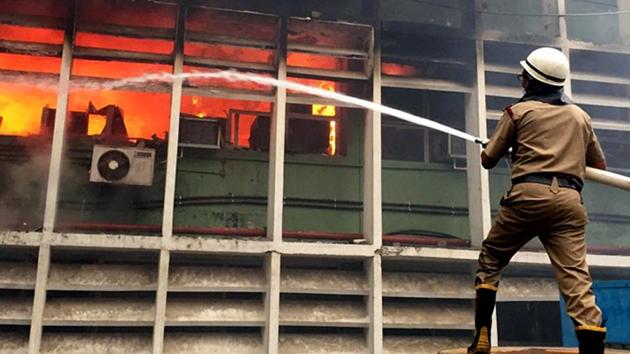
It took 34 fire-tenders to put out the fire, which fortunately spared the patient wings. As is the drill after any such incident, the Delhi Police registered a First Information Report (FIR) against unknown persons, and the fire department has alleged some hospital buildings did not have a “no-objection certificate” (NOC) from the fire department.
For a hospital that gets a daily footfall of about 50,000 people, of whom 1,500-2,000 are admitted as in-patients every day, an NOC is crucial for patient safety.
Hospital fires, like in the case of AIIMS, usually are caused by a short circuit. A Delhi government hospital building-- Lok Nayak, which is one of the oldest hospitals in the Capital, also caught fire on August 9 due to a similar reason. In June also, a fire had broken out in another old hospital-- Ram Manohar Lohia, because of a short-circuit. Old or faulty electrical fittings are prone to malfunctioning.
AIIMS must upgrade its resources and infrastructure while meeting all the requisite norms. The new OPD block, for one, is not operational yet because it hasn’t received fire and other clearances. But along with new clearances, the hospital administration must ensure that its old buildings also meet the current safety requirements.
{{/usCountry}}AIIMS must upgrade its resources and infrastructure while meeting all the requisite norms. The new OPD block, for one, is not operational yet because it hasn’t received fire and other clearances. But along with new clearances, the hospital administration must ensure that its old buildings also meet the current safety requirements.
{{/usCountry}}It is a huge task and cannot happen overnight, according to the hospital administration, but that excuse is not good enough. Doctors save lives, and it will be a travesty if some of the lives are lost to callousness in meeting fire-safety norms.