The Latin phrase a posse ad esse (moving from possibility to reality) captures something essential about how societies construct human capital. Formal education typically follows a well-marked, institutional highway. In contrast, skilling is a deliberately chosen path that leads to a definitive difference in an individual’s trajectory. Observing the International Youth Day (August 12), let us recall the theme of this year’s World Youth Skills Day (July 15) — Skills for a Shared Future — which calls for action across lines of gender, geography, and socio-economic realities, to ensure that every young person enters India’s growth story with confidence and real ownership. Yet, as we do this, we must confront some structural realities.
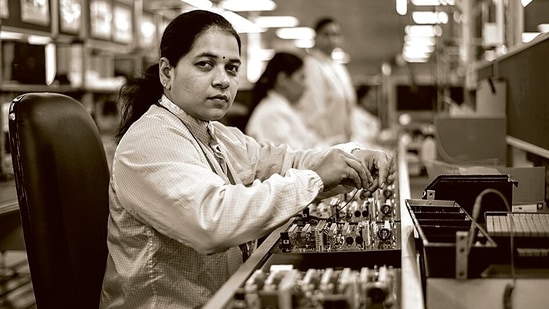
Step inside an ITI classroom, and the rigid dimensions of this challenge come sharply into focus. Of nearly 45 lakh young Indians enrolled between 2019 and 2024, only about 12% were women. When you narrow the lens to the specific technical trades that actively forge the physical world, the disparity worsens. Recent NITI Aayog analysis highlights that women account for just 4.8% of enrolment in electrician trades, 3.5% among welders, and 2.7% in motor vehicle mechanic courses. Even the broader labour macroeconomic indicators present a stark contrast. The latest Periodic Labour Force Survey data places female labour force participation at 40%. While this reflects a meaningful upward trajectory from 33.9% three years earlier, it simultaneously underscores the vast reservoir of potential that remains unutilised due to structural barriers rather than a lack of aspiration. According to research, if women’s participation rate is increased to around 54%, India can add up to $1.4 trillion to its GDP while ensuring inclusive growth.
Correcting these imbalances is not just an ethical onus but an absolute economic imperative, particularly since India hosts one of the youngest populations in an aging world. Across the aging economies of the West, talent shortages are opening in ways that would have seemed unlikely a generation ago. Agreements like the India-UK Free Trade Agreement and new global mobility partnerships are already building structured pathways for our workers into international markets. India cannot fully capture this opportunity while fielding only a fraction of its workforce at capacity. The aspiration of a new India requires a transition from a paradigm of mere livelihood support for women to one of economic empowerment and entrepreneurship.
{{/usCountry}}Correcting these imbalances is not just an ethical onus but an absolute economic imperative, particularly since India hosts one of the youngest populations in an aging world. Across the aging economies of the West, talent shortages are opening in ways that would have seemed unlikely a generation ago. Agreements like the India-UK Free Trade Agreement and new global mobility partnerships are already building structured pathways for our workers into international markets. India cannot fully capture this opportunity while fielding only a fraction of its workforce at capacity. The aspiration of a new India requires a transition from a paradigm of mere livelihood support for women to one of economic empowerment and entrepreneurship.
{{/usCountry}}For decades, skilling for women was subtly confined to fields deemed culturally congruent with domestic spaces, such as textiles, beauty, and health care. While these sectors remain economically viable, the modern industrial landscape is being rapidly redrawn by automation, artificial intelligence (AI), electric mobility, and the green energy transition.
The ministry of skill development and entrepreneurship recognises that structural asymmetry requires structural correction. Initiatives like the Nurturing Aspirations through Vocational Training for Young Adolescent Girls (NAVYA) programme, which deliberately equip adolescent girls in aspirational districts with expertise in drone assembly, cybersecurity, and green technologies, demonstrate that when the infrastructure of opportunity is in place, the response is overwhelming. Similarly, the fact that women comprise over 56% of certified candidates under Pradhan Mantri Kaushal Vikas Yojana 4.0 demonstrates that the aspiration for technical mastery is universal.
We also need gender-inclusive apprenticeship pipelines that give young women experience in emerging technologies, backed by safe transit, institutional childcare, and secure workplaces, since 44.4% of women outside the labour force cite care responsibilities as the reason. The possibility of returning to the workforce must be structurally supported. By investing in refresher skilling and returnships, we guarantee that a temporary caregiving pause never becomes a permanent exit.
Statistics are easy to cite and hard to feel, until they have a face. Poonam Kumari’s is one worth remembering. From a small village in Jharkhand to training in Malaysia, the journey was not easy but worth the effort. On July 5, at a new chip facility in Sanand, she walked the Prime Minister through the very production line she now runs. Her journey is proof that the plan can work; the task now is to make journeys like hers common, not exceptional.
It is pertinent to recognise that the objective of skilling is not merely immediate employment or entrepreneurship, but also the pursuit of lifelong learning. The modern economy demands individuals who understand how to continually build, tear apart, and rebuild their skill sets. While a young person entering the workforce today must be incredibly agile, a person at the age of 60 also needs to upskill in AI and digital banking to navigate this flux effectively. Skilling is the continuous thread that weaves through an individual’s entire life. By embracing this unending cycle of learning and bringing each individual into it, we ensure that no one is left behind, turning the promise of a shared future into our daily reality.
(Jayant Chaudhary is minister of State with independent charge for skill development and entrepreneurship. The views expressed are personal. X: @jayantrld)