The hallmark of poor governance is pitting lives against lives. The basic logic of allocation becomes this: Resources are scarce, needs are one too many. Some lives — and deaths — therefore assume greater significance than others. Similarly with crime. It is no wonder, then, that crimes against women are not seen as a national security issue. If they were, the national capital would have been going into damage-control mode after a spate of incidents highlighting, yet again, the State’s abject failure in protecting half of its citizens. It is de rigueur to see women’s security as an isolated issue, and crime against them as something that doesn’t deserve multi-agency high alerts.
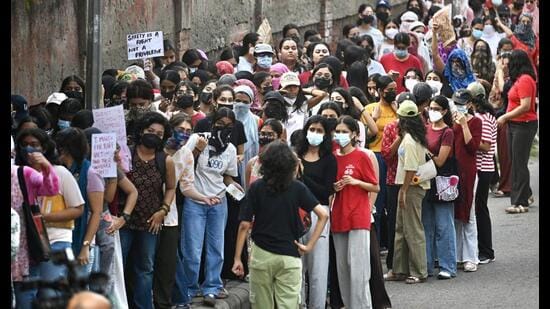
Just this month, Delhi hosted two big-ticket international events: the Brics summit and SEMICON India 2026. It was not lost on anyone that the state and Union governments put all their heft behind the arrangements. Roads, freshly patched up to cover potholes, were dotted with police personnel who only routinely become conspicuous in the service of VIPs and their movements. It should be a matter of pride for everyone that both these events, bringing together heads of government and industry from various countries, concluded smoothly with no security hiccups. In the same month, news headlines suggest that the rape of at least four women in Delhi made it to the public sphere. In the latest Astha Kunj Park case, the cops reportedly admitted to not patrolling the 142-acre park due to lack of proper lighting.
Imagine a similar statement made by a soldier deployed along the international border. Or, imagine either the domestic intelligence agency or R&AW officers explaining, after a terror attack in the capital, that they hadn’t infiltrated a terror module because it was too dangerous. Now imagine such statements coming with a predictable regularity, while lives and livelihoods continue being threatened. If this sounds unacceptable for the sixth-largest economy and the fifth-largest spender on defence in the world, let’s probe deeper into why we have adopted an institutionally indifferent stance on women’s safety. This is a policy gap that ought not to exist in the first place, as it flouts India’s constitutional principle of equality.
{{/usCountry}}Imagine a similar statement made by a soldier deployed along the international border. Or, imagine either the domestic intelligence agency or R&AW officers explaining, after a terror attack in the capital, that they hadn’t infiltrated a terror module because it was too dangerous. Now imagine such statements coming with a predictable regularity, while lives and livelihoods continue being threatened. If this sounds unacceptable for the sixth-largest economy and the fifth-largest spender on defence in the world, let’s probe deeper into why we have adopted an institutionally indifferent stance on women’s safety. This is a policy gap that ought not to exist in the first place, as it flouts India’s constitutional principle of equality.
{{/usCountry}}This newspaper has been highlighting how crimes against women, of varying degrees of severity, from gender-based verbal insults to gangrapes and murders, exemplify an absence of reliable safeguards for nearly 700 million citizens of India. In absolute numbers, therefore, the situation is nothing short of a nightmare. National security has inalienable links to the economic growth of a country. If half the population is forever calculating risks to person and property, how can we imagine that any national vision will manifest on the ground? Women’s labour force participation in India has been telling this story statistically, only to be filed as a “gender” issue — a predictable consequence of envisioning policies in silos.
A large part of the equality discourse emanates from morality. In more than 75 years, this hasn’t worked as desired. The economic underpinnings of the pervasive feeling of not being safe are now being recognised as a gaping hole in policy formulation. Even if imperfect, it has moved the needle towards an assessment of the loss in national productivity owing to women’s absence on the work floor. A bigger case needs to be made for acknowledging the sense of foreboding, of impending doom, the moment a woman finds herself at the receiving end of gender-based violence. No citizen in a functioning democracy ought to feel that — less so when national security dominates policy, political, and public domains with unmistakable intensity, often bordering on fetish.
National security is still the theatre of men. From budgetary to operational details, almost everything is masculinised in theory and practice. Irony is even deeper when women at the high table, ministerial or executive, satisfy themselves with the status quo and do precious little to conceptualise a security code that applies equally to all citizens, irrespective of whether lives are lost in a bomb blast carried out at the behest of an enemy State or get routinely snuffed out in parks and moving buses that no security personnel bothered to check for irregularities.
A sense of fatigue and ennui can be observed engulfing those who care to treat and be treated as equals. News headlines are met with indifference, and violence against women gets treated as a fait accompli. Except it is not. It is only a matter of fixing the attitudinal biases that create hierarchies of acceptable breaches in the national security armour that India seeks to build for all its citizens. Sure, securitising an issue has pitfalls, too. Heavier policing without addressing root causes such as impunity, poor conviction rates, or entrenched social attitudes muddles the idea of security, but that’s a later problem. Let’s reframe national security first.
The views expressed are personal