The Munich shooting range evokes uneventful memories for Rahi Sarnobat. Her 13-year-long shooting career has endured gun malfunction to misfiring to poor scores in the German city. For Rahi, anything and everything can go wrong when it comes to the Munich range.
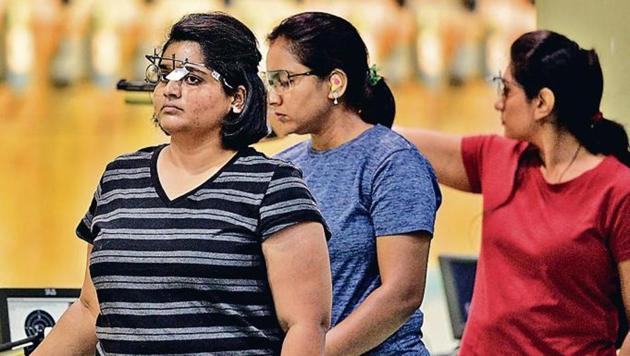
To make matters worse, Rahi was struggling to translate her high practice scores into competitions when the ISSF Munich World Cup came calling in May. In the two previous World Cups, in Delhi and Beijing, she had finished 15th (580) and 26th (579), respectively, in qualification. The quota in 25m sports pistol for the 2020 Tokyo Olympics looked a distant dream. That’s when Rahi and her coach Munkhbayar Dorjsuren decided to give it their all in the year’s third World Cup and nail the Olympics quota in Munich itself. It was also a way to heal her mental scars.
“We especially chose the Munich range to get the quota place as it is the home range of my coach. My training was going very well but it was just not happening in competitions,” says a relaxed Rahi.
“I had very bad memories of the range, so we wanted to tackle that too.”
{{/usCountry}}“I had very bad memories of the range, so we wanted to tackle that too.”
{{/usCountry}}The memories had been piling up for years. Rahi had shot some of her lowest scores in Munich (2011 and 2013), and 2017 was the most brutal. She was making a brave return from an elbow injury that had all but stalled her career. Her first competition was in Munich where her gun malfunctioned.
“I had never qualified for the finals in 13 competitions in Munich, leave alone win a medal. I found the range very, very cold. I once remember it was minus 2 degrees and we shoot outdoors (25m). Coming from a hot country, it’s very difficult. It was windy, cloudy and raining and it was very harsh,” reminisces Rahi, who was here to participate in season’s fifth national trials in air pistol at the Karni Singh Range.
Doubts cropped up in Rahi’s mind every time she visited the Hochbrück range. “It was important to get rid of those fears.”
This time, Rahi made sure she would only encourage good thoughts. She shot down gold with a Tokyo Olympics quota in 25m pistol, six years after she won her first gold, in Changwon, South Korea. In the final, Rahi relived the haunted past through young Manu Bhaker, who was leading at one point but a pistol malfunction drowned her hopes. Rahi consoled Manu after the match. “What happened with Manu happened with me (malfunction) five years back. I know how it feels.”
After Manu bowed out, Rahi ensured India returned with at least one quota place from 25m pistol. “I have been shooting for 13 years and I have experienced all this so many times. Now I can manage different situations and conditions.”
A camp at Frankfurt Oder ahead of the Munich World Cup helped her acclimatise. Also, Rahi and her coach talked in detail about what was going wrong with her shooting. “In Delhi and China I had a chance. I had very good training sessions but I could not perform. We discussed many things, like psychological, mental and performance pressure. Technically, I was ready but, maybe, mentally I was not there (in Delhi and China World Cups),” she says.
The bad memories of the London Olympics, when she was only 21, were playing in her mind somewhere. “I had gone to London at a very young age, too young to understand the level of competition at the Olympics. When I realised the magnitude of the task, I had lost my berth in the national squad. Subsequently, I got injured and was out of the action. At the start of the year, I was again trying hard to book an Olympic berth. This time, I was doing everything I could possibly do but still the performance was not coming. The bad patch created self-doubts; can I do it again?”
She got her answers at the Asian Games in Jakarta last year where she became the first Indian woman shooter to win gold at the continental meet. The win brought her back in the reckoning, this time as an experienced shooter.
“This Olympics will be eight years round the clock since 2012. It’s very hard especially with injuries to believe that you can do it again. Many times you think of giving up. After the injury, I was shocked how can I shoot with this hand. I was there in the team but not performing to my expectations.”
She got that belief back after hiring Dorjsuren, the Mongolian-German, as coach in 2017. The double world champion and double Olympic medallist instilled in her self-belief.
Rahi now wants to make Munich her base and train for the 2020 Olympics. Shooters who have already qualified organise competitions and camps in Europe.
“I will try to compete in maximum number of competitions there. I am focusing on European competitions because most of the top shooters who have qualified will be competing there.
“Germany is the hub of shooting and Dorjsuren is part of the European Olympians group. I can stay at my coach’s place and just drive down for competitions with her.”