
 E-Paper



Blue plaques lose their lustre at some historic homes in Pune
Drawing inspiration from London’s famous blue plaques, Jayantrao Tilak, veteran parliamentarian and grandson of Lokmanya Tilak introduced the concept in Pune in the 1980s

 Prefer HTon Google


Blue sapphire rounds, or plaques, that were put up as heritage signs at the places of residents of famous personalities in the city, have lost their shine.
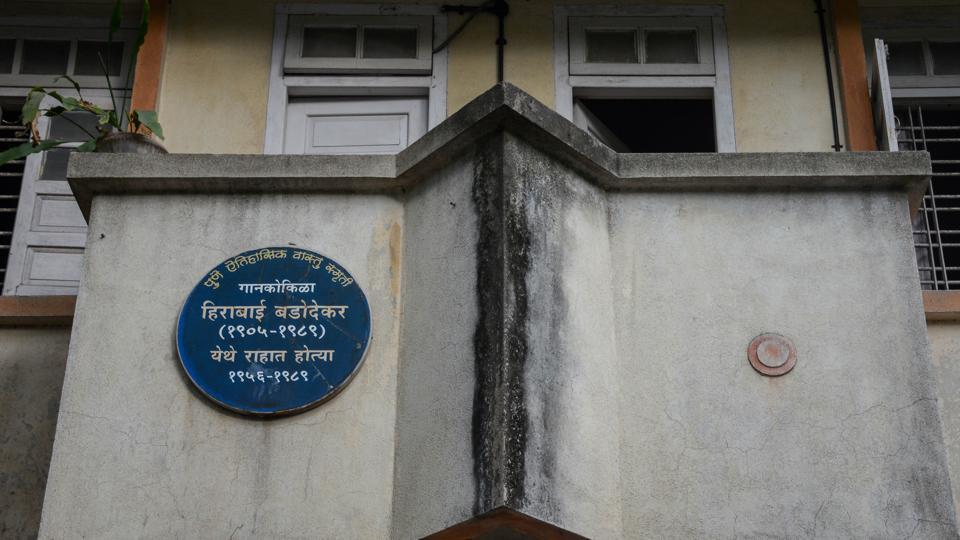
Drawing inspiration from London’s famous blue plaques, Jayantrao Tilak, veteran parliamentarian and grandson of Lokmanya Tilak introduced the concept in Pune in the 1980s.
Under his guidance, a committee of heritage experts was set up and 135 plaques were put up, across the city. While some of these plaques have been well maintained, some were found in a state of neglect, as in the case of residence of economist and vice-chairman of the planning commission, Dhananjay Gadgil, on Law college road. Only the last faint letterings suggested the name ‘Gadgil’ while the rest of it has completely faded.
“My father, Jayantrao Tilak, went on a trip to London where he saw these famous blue plaques that link the people of the past with the buildings of the present. He thought that since many stalwarts were born in this city, why not introduce it here. Thus, he set up a committee of people from the Tilak Smarak Samiti, which included historians, and created the Pune Heritage – Blue Plaque Scheme. After careful research, blue plaques were put outside the homes of well-known people at their dwellings or where they stayed or were born,” said Deepak Tilak, chairman of the Tilak Smarak Samiti.
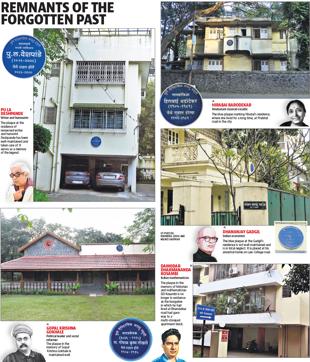
A total of 135 plaques were put up at the homes of eminent persons from Pune such as women’s rights activist Ramabai Ranade, classical vocalist Vasantrao Deshpande, the multi-faceted humourist Pu La Deshpande, historian DD Kosambi and freedom fighter Gopal Krishna Gokhale.
Deepak Tilak said that when the initiative began, it was not easy to trace the dwellings of famous freedom fighters, and stalwarts from the field of literature, theatre and culture. “The team of researchers would spend time going to the old wadas and get information of the people living there. The criteria were very clear, that the person should have been born in that place or should have been residing in the place for more than 10 years,” said Tilak.
While some of these plaques are well maintained, others are in total neglect, like that of Gadgil on Law College road.
Madhav Gadgil, ecologist , son of Dhananjay Gadgil, who owns the house, said, “We have been leasing the house for many years now and never really thought about the plaque. Now, that it has been brought to my notice, I will approach the Samiti and ask if they can help clean and maintain it.”
The plaque in the memory of the eminent filmmaker Vishnupant Damle, whose 1937 film ‘Sant Tukaram’ was the first Indian film to be screened at an international film festival, has been well maintained with descendants taking good care of it with immense pride.
“When we repainted the house, we also cleaned and gave a fresh paint to the letterings. This is a legacy left by our grandfather and it is honour for us,” said Ajit Anant Damle, a chartered accountant by profession.
No new requests for blue plaques, says committee
In the past four years, the demand for putting up of blue plaques has reduced substantially.
“We put up a plaque on Vinchurkar Wada on February 28, 2018, as this was the place where Swami Vivekananda and Lokmanya Tilak met. This year, we are still in the process of putting up a plaque in the memory of writer VG Kanitkar, but only after we get a ‘no objection certificate’ from the society,” said Anil Sapkal, secretary of the samiti.
He expressed hope that more people should come forward to have the plaques put up. “Punekars are worried that if their house has a plaque, it might get registered as a heritage place and then they won’t be able to redevelop it. Hence, several societies and homes are hesitant to come forward,” he said.
London’s mark
London’s famous blue plaques are now managed by the English Heritage. The London blue plaques scheme was launched in 1866 and is believed to be the oldest of its kind in the world. Across the British capital, over 900 plaques, on buildings humble and grand, honour the notable men and women who have lived or worked in them.
State of blue plaques
A visit to some of the blue plaque installations in the city revealed that the memorial plate at the place where the reformist Ramabai Ranade lived at Seva Sadan, Sadashiv peth, was missing. The school authorities did not have any reply when asked about it.
The plaque in the memory of classical vocalist Vasantrao Deshpande, littérateur Pu La Deshpande and Gopal Krishna Gokhale were being maintained well.
The plaque in the memory of historian and mathematician DD Kosambi is no longer in existence as the bungalow in which he had lived on Bhandarkar road had given way to a multi-storeyed apartment block.


