
 E-Paper



Many migratory birds miss Bhigwan winter date
There are 77 species of migratory birds that visit Bhigwan during the winter, but the flamingos are the major attraction


The water body at Bhigwan near Pune is a winter destination for migratory flamingos, but this year, the turnout has been sparse.
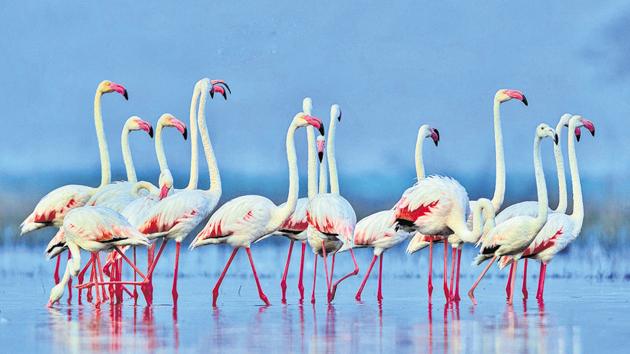
Girish Jathar, assistant director, Bombay Natural History Society (BNHS), says that there are 77 species of migratory birds that visit Bhigwan during the winter, but the flamingos are the major attraction.
“There are 43 species of water land birds and 34 species of migratory land birds, which is a total of 77 species of migratory birds. Flamingos are the most popular ones. A fairly good number of these birds can be seen,” said Jathar.
Talking about the flamingos, Jathar said that these birds breed in the Rann of Kutch.
“From there they migrate locally to all parts of the country. Bhigwan is one of them. Flamingos can be seen in other parts of the country like the Chilka lake in Odisha,” said Jathar.
Speaking about the decline in flamingo population this season, Dharmaraj Patil, a city-based ornithologist, said “It seems the birds are late. Bhigwan is a popular spot for bird watchers as the maximum number of birds are flamingos. Due to ecotourism, a lot of young youth from the small town are working as local guides. They have informed us that this year, the numbers of flamingos are low.”
He added that aside from the wetlands, there are the grasslands where a lot of raptors can be seen.
“The number of raptors, like eagles and harriers are also few in number. Wolves are also seen in the area, but the number this time is less,” said Patil.
Talking about the reason, he said that the erratic climate is one of the major reasons.
“Due to erratic weather, this year as well as the last year, we have seen that the mud habitat has been affected. As it is a wetland, the land fills up quickly. Last year, the rain was heavy. This year, relatively, the rains were normal, but there is a possibility that the groundwater table was high. This could be one of the reasons,” said Patil.


