A pink bus parked inside Sambhaji park, Jungli Maharaj road, is addressing the hygiene needs of women for the past six months. Ti Swachatagruha, the retired Pune Mahanagar Parivahan Mahamandal Ltd (PMPML) buses turned lavatory, is one of the popular public lavatories for women.
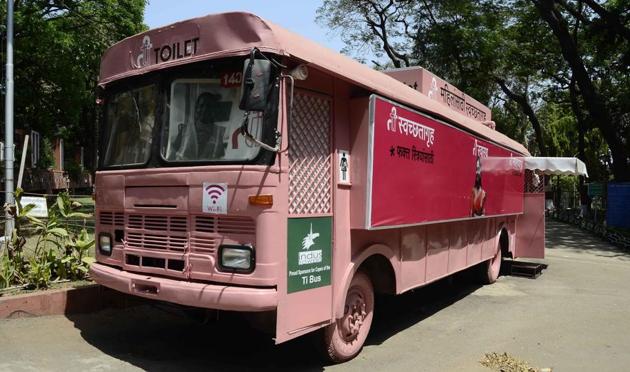
“Ti is also for toilet integration and has a high-quality rest room, saves water, energy efficient and safe for women with a unique panic button placed inside the structure for emergency,” said Rajeev Kher of Sara Plast India Limited, the mastermind behind the pink mobile bus toilets.
Made from scrapped PMPML buses, the Ti toilet has large mirrors above two wash basins, a TV set which runs infotainment on women’s health, choice of four toilets, three Indian squat styles, and one western commode style. The toilet is also equipped with sanitary dispenser as well as a baby diaper changing space within the bus and offers a small assortment of beverages at a minimal cost. The service, however, is not available for free, but charges Rs 5, which according to Kher, is reasonable, looking at the amount invested in creating such safe and clean environment for women.
The idea came about in 2016 when Kher met the then municipal commissioner Kunal Kumar, who was also heading the Smart City initiative, mentioned a shortage of toilets. “As we have worked in sanitation sector, we pitched the idea of creating mobile toilets for women when a non-governmental organisation (NGO) Milun Saaryajani had urged Pune Municipal Corporation (PMC) to build toilets for women. I had seen similar kinds of restrooms for the homeless in San Francisco, while I was working abroad. I had the pilot ready within eight weeks, once I got a scrapped bus from the authorities. The very first such mobile toilet equipped with shower was stationed at Shimla Office chowk in 2016,” said Kher.
{{/usCountry}}The idea came about in 2016 when Kher met the then municipal commissioner Kunal Kumar, who was also heading the Smart City initiative, mentioned a shortage of toilets. “As we have worked in sanitation sector, we pitched the idea of creating mobile toilets for women when a non-governmental organisation (NGO) Milun Saaryajani had urged Pune Municipal Corporation (PMC) to build toilets for women. I had seen similar kinds of restrooms for the homeless in San Francisco, while I was working abroad. I had the pilot ready within eight weeks, once I got a scrapped bus from the authorities. The very first such mobile toilet equipped with shower was stationed at Shimla Office chowk in 2016,” said Kher.
{{/usCountry}}According to Kher, these toilets are quick and easy to install and are using recyclable material like 100 per cent polyethylene ‘pans’ in the toilets. “We have used eco-friendly colours, and also have installed solar panels on the top which provides electricity to run these bus toilets. Another feature is the use of technology to detect foul smell. We have humidity and moisture chip installed which has been developed by MIT labs, US and helps to eliminate foul smells to make these toilets have freshness from within. The buses also have free Wi-Fi and are general packet radio services (GPRS) enabled,” he said.
The first pilot project was made in a factory at Sanaswadi with funding from corporate social responsibility (CSR) at the cost of Rs 6 to Rs 10 lakh. The scrapped buses are now upcycled, semi-permanent and owned by the PMC. “We used the bus as an enterprise model and also give the women a sense of belonging,” said Kher.
He stated another reason why the concept of Ti toilet works is that it has a full-time attendant who owns the space, hence making the service aspect viable and saleable. “These buses are helping bring up the standard of sanitation and giving dignity to women and help bring a change in lifestyle, though awareness is needed on treating the toilet as their own and keeping it clean which is an ongoing process.”