The mysterious and perhaps mythical beast called Yeti made news recently after the Indian Army posted what it claimed to be are footprints of the said creature. The legend around the Yeti, or abominable snowman, goes back to the 1920s and until very recently several papers and documentaries have been made on the creature which according to the folklore roams around in the Himalayan region and has never been fully sighted. Though there are visuals of ape-like man depicting the Yeti, a term used by a British explorer in 1951, Eric Shipton who while looking for a different route up Mt Everest found a footprint and eventually was the first ever to document sighting of similar sized footprints in the Lhakpa La of Tibet.
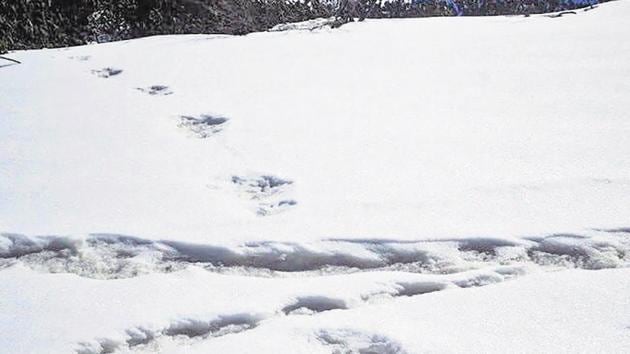
It is good, if we have arrived at a discovery like this, but without complete evidences, it will be unfair to claim anything. The Yeti is generally believed to be taller than the average human and has resemblances to an ape. Scientists have long thought that the abominable snowman isn’t real and the evidence thus far suggests that it could be a bear.
Crucial here is that all one has to go on are footprints. There isn’t any hair or DNA samples which could be used to verify. However, this hasn’t stopped the Army from taking these footprints seriously. While many over the decades have claimed to have spotted the creature, there isn’t anything that can be described as decent evidence of it even existing. The news about discovering Yeti is a good fictional story to tell to the coming generations. - Abhinav Meghawale
Misinformation from the Indian Army
{{/usCountry}}Misinformation from the Indian Army
{{/usCountry}}The Indian Army’s announcement of mysterious footprints of mythical beast Yeti with photographic evidence of footprints on Twitter doesn’t just appear as a farce to sceptics. With respect to our understanding of animals, it reveals how the discovery of such a cryptic species is communicated. It is also an example of how such misinformation has wider implications for biodiversity conservation. Nepali Army also refuted the Indian military’s claim that its soldiers had discovered Yeti footprints in the Himalayas, saying they were more likely just a bear. This is pure miscommunication and is leading the citizens to believe something that is untrue. - Sohaib Patel
Concentrate on other important issues
We are still unsure whether the images that were tweeted by the Indian Army were of the Yeti or of a wild bear. Nepal officials have clearly dismissed the Indian Army’s claim that one of its mountaineering expedition teams had discovered footprints of the mythical creature called Yeti in the Makalu-Barun conservation area near the Nepal-Tibet border. They have claimed that it is the footprints of a wild bear that frequently appear in that area. Therefore, I am unsure whether to claim these findings as discovery or term it as fictional theory. Nevertheless, there are many more important and relevant things happening in the country and the world which deserves more importance than the discovery of Yeti. Farmer suicides, water crises, population explosion, poverty, global warming are some of the issues that are important and need to be discussed. Hence, politicians who are congratulating the Indian Army on social media need to concentrate on important issues pertaining to the country. - Rutuja Patil
Fiction story fit for a Bollywood movie
The discovery of an ancient snowman or Yeti will make an amazing fictional story, fit for a Bollywood movie. The story of the discovery has all the elements to make sure that the film is a hit. The Yeti is believed to be an ape-like creature, much taller and bigger than an average human. It is covered in thick fur and is believed to live in the Himalayas, Siberia, Central and East Asia. There have been many stories about abominable snowman mostly based on unconfirmed accounts. This is a perfect script for a movie. Besides this, there is hardly any evidence claiming that Yeti is real. We only have images of footprints of the creature which also as per the claims of the Nepali officials are only of bear. These evidences only make it a partial discovery based on assumptions. - Ajinkya Deshpande
Hallucinations at high altitudes
Mostly these are cases of Himalayan Brown bear, Tibetan Blue bear footprint or hallucinations at high altitudes. There has been no conclusive evidence yet. Earlier, there was a monastery in Nepal at the base camp of Mount Everest which claimed to have a skull of a Yeti, but after the tests were conducted, it turned out to be a skull of an antelope. Many theories like these have time and again surfaced in our country, however, with lack of concrete evidences. People also believe that Yeti exists and roams at Panchachuli peak. Another myth is that ‘Ashwathama’ - immortal son of Dronacharya from Mahabharata - is still alive and roaming in the mountains and noises heard are his cries in despair. But where are the evidences? We should treat this as a good fiction story, as stories don’t need to be factually based and are often creation of imagination. - Aditya Nayak
Social media jokes on Yeti galore
All this is a build-up narrative with a combination of human curiosity, myth and other non-factual elements. It is a good fiction story to tell your grandchildren. However, there is no concrete evidence to back the Indian army’s claims of sighting a Yeti. The Indian Army should have exercised more responsibly before declaring the sighting of any footprints as Yeti’s. What more, the tweet from the additional director general - public information of Indian Army, claiming to have sited the footprints of the mythical beast ‘Yeti’ went viral on social media. Many social media users in the country woke up to these extraordinary claims, with many of them taking the discovery with a pinch of salt. What followed were a series of memes. The Indian Army could have avoided the social media circus, had they acted responsibly. - Pushkar Joshi
Indian Army’s Yeti claim was bad data
The Indian Army is expected to be sure of facts and figures before claiming the sighting of a mythical creature called Yeti. Providing a photographic evidence of a 32x15 inches footprint does not mean that the creature exists. It is the 21st century, and people will believe a theory only if it has evidence that has scientific backing. However, Indian Army’s claim is not scientifically proved. It is a human nature to think about something supernatural and Yeti is just a theory. By tweeting about the incident, the Indian Army has proved that they are not credible. - Maya Bhatkar