Parenting at the Sukhna lake in the early night can get a bit nervy when small bats dodge and race in the balmy air, weave circles around visitors and sometimes fleetingly touch human bodies. Tiny bats are so mysteriously mad, seemingly chasing nothing but thin, darkening air. Parents turn apprehensive that “hungry” bats might nip their kids’ ears or suck tender blood from exposed necks like mini-draculas. While ignorance may add to the bliss of the lake’s ambience, it ill-serves the fact that these small creatures are harmless and performing a key eco-system function as predators of mosquitoes, moths, beetles, flies, termites etc.
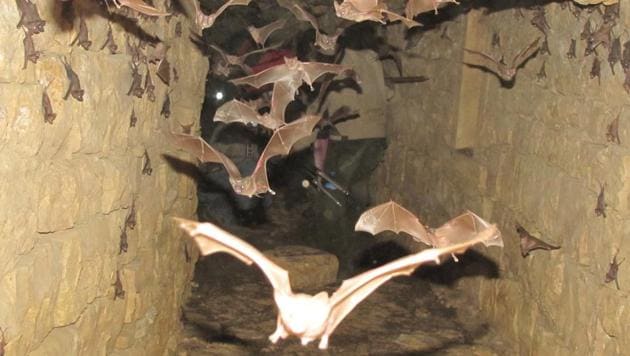
Imagine a situation wherein mosquitoes at the Sukhna Lake invaded and bit walkers like clouds of locusts setting upon lush fields. But thanks, in part, to insectivorous “Evening Bats”, explosions of mosquito population are defused. Thus, little bats are not blood suckers as myth would have us swear but slayers of real blood suckers!
Assistant professor Sumit Dookia of the Guru Gobind Singh Indraprastha University, New Delhi, has undertaken extensive field research of bats in urban North-West and Western India. “Small bats lead unknown lives and are not conspicuous like large fruit bats roosting in the open. Insectivorous bats prefer damp, dark places to roost like dilapidated houses, forts, unoccupied or closed houses, hanging tree roots (ficus aerial roots), dry palm leaves, cervices outside houses, eaves of buildings, outside brick walls, near gates or windowpanes and not to forget under New Delhi’s flyovers and in urban drainage tunnels,” Dookia told this writer. Common insectivorous bats found in urban areas include Greater and Lesser Mouse-Tailed Bats, Indian Pygmy Bat and Asiatic Greater and Lesser Yellow House bats.
“Western research established that small bats eat thousands of mosquitoes. The sterling example is the Little Brown Bat (Myotis Lucifugus) of North America of which a single specimen gobbles 300 to 3,000 insects a night! The Pipistrelle can eat 3,000 tiny bugs a night, equivalent of one-third of its body weight. Species of bats, from the same families that the Little Brown Bat and Pipistrelle hail from, are found in Indian urban spaces too. Western studies are indicative of the enormous services rendered by self-effacing Indian bats in controlling urban insects,” informed Dookia.
{{/usCountry}}“Western research established that small bats eat thousands of mosquitoes. The sterling example is the Little Brown Bat (Myotis Lucifugus) of North America of which a single specimen gobbles 300 to 3,000 insects a night! The Pipistrelle can eat 3,000 tiny bugs a night, equivalent of one-third of its body weight. Species of bats, from the same families that the Little Brown Bat and Pipistrelle hail from, are found in Indian urban spaces too. Western studies are indicative of the enormous services rendered by self-effacing Indian bats in controlling urban insects,” informed Dookia.
{{/usCountry}}To purge people’s minds of bat demonisation, Dookia reasons with them and cites hard facts. “The myth is that bats nip human ears but I show people that despite intimate interactions with bats, my ears are intact! Our research teams go deep into caves and tunnels housing thousands of bats without protective gear but not once have we been attacked. I ask people to search their memories and cite one case of a human attacked by a bat. Of course, if a human catches a bat the fearful creature will bite as a natural defence mechanism. People are all ears when I draw reference of rising malaria and dengue cases and warn them: if people do not safeguard bat habitats these diseases would assume epidemic proportions,” said Dookia.
vjswild1@gmail.com